Poetry

Article Number
85
relevantdate

    Three sisters entertained Union soldiers in their St. Augustine home during the Civil War, carefully gathering information. While two sisters continued to distract the soldiers, the third, Lola Sanchez rode a horse through backwoods and marshes to relay Union plans to Confederate forces.

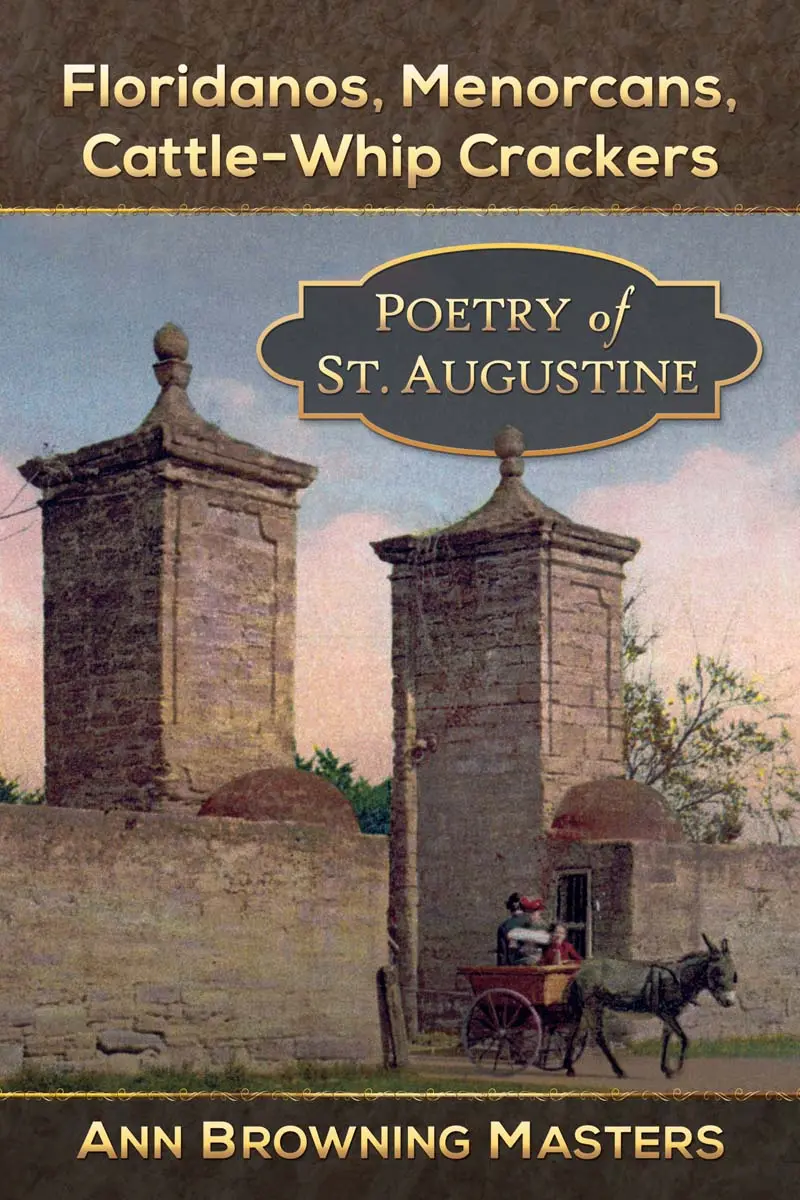
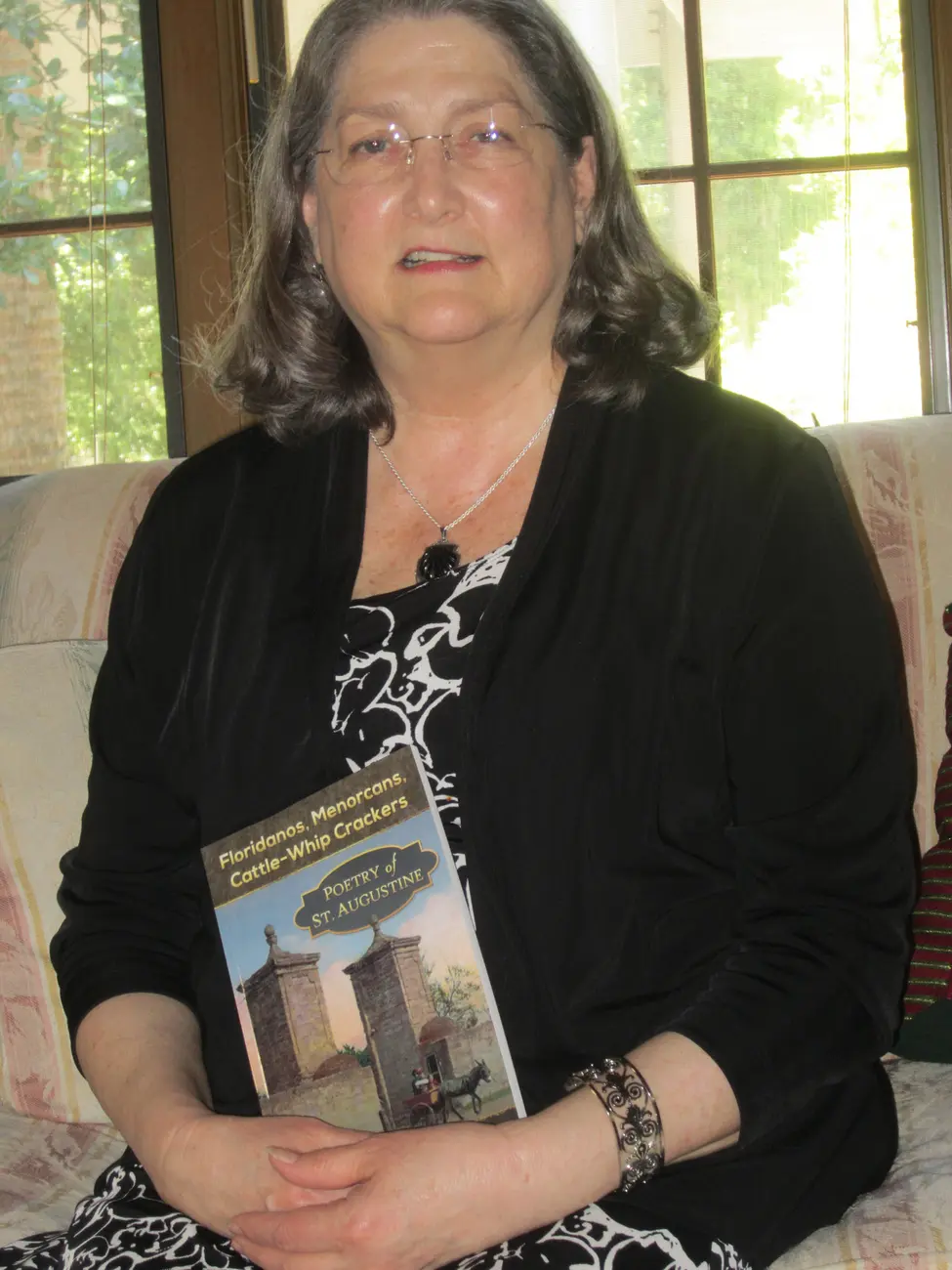
    Poet Ann Browning Masters is related to the Sanchez sisters and writes a poem from Lola’s perspective in the new book “Floridanos, Menorcans, Cattle-Whip Crackers: Poetry of St. Augustine.”

    Masters will be discussing her work Friday evening at 7:00 at the Library of Florida History, 435 Brevard Avenue, Cocoa. The presentation is free and open to the public.

    The Spanish established St. Augustine on September 8, 1565, making it the oldest continuously occupied European settlement in what would become the United States. Descendants of those Spanish settlers are called “Floridanos.”

    A twelfth generation Floridian, Masters can trace her lineage back to the early days of America’s first permanent European settlement, making her a Floridano.

    “In St. Augustine on my mother’s side, her family records that are first there in the records with the Catholic Church are in 1602, when Elena Gonzales married Diego Alvarez,” says Masters.

    “For almost a hundred years, her daughters, granddaughters continued to marry men who came to St. Augustine. They stayed there. Then in 1704, Juana Perez, one of those great-granddaughters, married Jose Sanchez. So my family line maternally, goes with the Sanchez family. My mother’s maiden name is Sanchez.”

    The First Spanish Period in Florida ended in 1763, when the British took control of the region for twenty years. During the British Period, Scotsman Andrew Turnbull brought indentured servants to Florida to settle New Smyrna. The term “Menorcan” is used to describe these people and their descendants, although not all of them were from the island of Menorca.

    “They are of Italian, Greek, and Menorcan descent,” says Masters. “Menorca is one of the Balearic Islands southeast from Barcelona (Spain) and at the time, Menorca was under control of Britain, so it made sense that a British land owner would recruit indentured servants from this Spanish, basically, island of Menorca.”

    The Turnbull Plantation failed, and the indentured servants from New Smyrna fled north to St. Augustine where they were provided sanctuary.

    “The paternal side for me is the Menorcan side,” Masters says. “In my mother’s Floridano side, they married some Menorcans. So for me, it’s a blending of those two cultures.”

    It is a popular myth in St. Augustine that hot datil peppers arrived in the area when Menorcan settlers brought them there. Extensive research and three trips to Menorca have convinced Masters that the legend is not true.

    What is a fact is that Menorcans in St. Augustine have been cooking with datil peppers for many generations, as Masters explains in her poem “The Menorcan St. Augustine Litmus Test.” In the poem, she says that if you enjoy eating the burning hot peppers and ask for more, you can be called “a good Menorcan.”

    The third group named in the title of Masters’ poetry collection, and the third part of her ancestry, is “Cattle-Whip Crackers.” The word “cracker” probably originates with the William Shakespeare play “The Life and Death of King John” where talkative Scotch-Irish people are called “crackers.” Those people eventually came to Florida as pioneers.

    “There are so many origins for the word. We can go back to the Scotch-Irish, the craic, the talk at the pub and a good time. In America, the corn crackers, that’s another derivation. In this case though, what I’m talking about are people who owned cows, had ranches. In the South we would say they ‘ran cows.’ Growing up, that was my understanding of the term, although at the same time it did have that pejorative term of a racist that it has now. But that’s another usage for that term.”

    In her book “Floridanos, Menorcans, Cattle-Whip Crackers: Poetry of St. Augustine,” Masters explores her personal heritage, but also addresses historical topics and perspectives.

    “For me, the local language, the vernacular is poetic. When I hear this speech, I hear the voices speaking narrative poetry. That’s why many of the poems are almost like monologues with characters telling their story. That’s poetry for me.”
    PDF file(s)
    Article Number
    76
    relevantdate

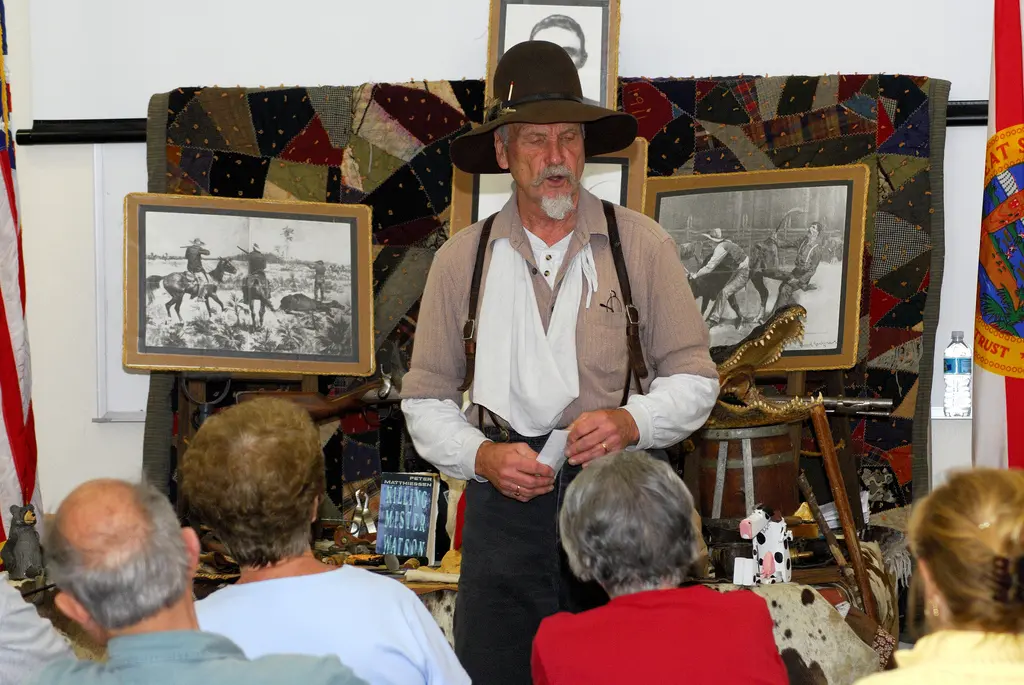
      Hank Mattson is known as the “Cracker Cowboy Poet” who “tells it like it was.”

      A native of Lake Placid in Highlands County, Mattson recites his poetry and discusses Florida’s pioneer culture at libraries, schools, and festivals throughout the state.

      “When This Old Hat Was New” is a poem Mattson wrote about Jacob Summerlin’s life as a Florida cowman in the 1800s. Appalachian folk musicians Dana and Susan Robinson set the poem to music, and it earned the 2015 Will McLean Best New Florida Song Contest, selected first out of 42 entries.

      Mattson’s poetry tells the stories of colorful characters from Florida’s pioneer past such as Jacob Summerlin, Bone Mizell, and Hamilton Disston, but much of it is also based on his own experience as a “Cracker cowman.”

      “I don’t ride much anymore, but there was a day when I did,” says Mattson. “Some places they round up cattle nowadays with ATVs and the like, but on the place where I work, and there are a whole lot of others, where you can’t get those things. We still use dogs and horses as they did years ago, and you’re never gonna get away from that.”

      When Mattson performs his poetry, he surrounds himself with interesting Florida artifacts and Cracker Cowboy equipment including a Civil War era McClellan saddle, branding iron tools, emasculating tools, de-horning tools, and pliers for stringing wire on fences.

      Until Florida passed a “fence law” in June, 1949, Florida cattle were allowed to roam free. As the population of the state grew in the early twentieth century, automobiles and trains were having more frequent encounters with cattle congregating on roads and tracks.

      “I was 11 years old when Florida passed the fence law,” says Mattson. “Before that, if they hit your cattle, they paid you for it. Now if a cow gets out, it’s our fault. We have to pay for the damage to the car. So things have changed.”

      In his public presentations, Mattson recites his poem about the origin of the word “Cracker.” He explains that the term goes back to the William Shakespeare play “The Life and Death of King John.” In Act II, Scene I of that play, the Duke of Austria says, “What cracker is this same that deafs our ears with this abundance of superfluous breath?”

      “He was speaking about Scotch-Irish folks, and that’s where it started from,” says Mattson. “When they came over here, the name ‘Cracker’ came with them.”

      Although the Duke in Shakespeare’s play found the talk of the “crackers” tiresome, the original meaning of the term is less judgmental. “It’s a derivative of the Gallic word ‘craic,’ which means interesting, educational conversation,” says Mattson.

      Cracked corn was a staple in the diet of the Southern people who became referred to as “crackers.” The term has also become associated with the cracking of the whip as Florida cowmen herded their cattle.

      “We’re proud of that here in the state of Florida, although sometimes people use it in a derogatory manner,” says Mattson. “That’s just part of goin’ down the trail, I guess.”

      While Cracker culture is slowly becoming relegated to history books, museum exhibits, theatrical presentations, and poetry readings, Mattson points out that some Florida families who have been working in the cattle industry for generations continue to do so.

      In one of Mattson’s most poignant poems, “Progress,” he describes how his family homestead was foreclosed on, torn down, and replaced by a giant discount store. Standing in the grocery department, he closes his eyes and imagines he can still smell the sugar cane boiling as his family makes syrup. He revels in his memories until a shopper rudely brings him back to the present.

      As urban sprawl continues to envelop Florida and take over the land that was once reserved for Cracker Cowboys and their cattle, Mattson hopes that his poetry, and now songs based on it, will preserve the memory of our state’s pioneers for future generations.

      “I just want somebody to know what went on here before they pave over the entire state,” says Mattson. “If it wasn’t for the people here in Florida raising cattle, this whole state would be paved over right now.”

      PDF file(s)

      1980 – Edmund Skellings was named the Poet Laureate of Florida, a lifetime appointment, by Governor Bob Graham on this date. Originally from Ludlow Massachusetts, Skellings studied English at UM Amherst, than pursued graduate studies at the University of Iowa. Even early in his career, Skellings was a proponent of young people learning to write well and study poetry. He began teaching at Florida Atlantic University in 1967 and began experimenting with early audio amplification, combining this new technology with his poems.