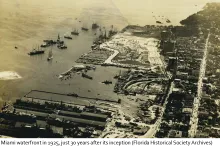
1896 – The first train of Henry Flagler’s Florida East Coast Railroad arrived in Miami on this date! A year earlier Henry Flagler and Julia Tuttle, Miami’s founder, had reached a deal which would eventually grant Flagler half of Mrs. Tuttle’s land north of the Miami River. The land was for the development of a new city including hotels, streets, docks and other public facilities, laying the foundation for the city of Miami to incorporate in July of 1896. By 1897 approximately 2,000 people inhabited the new town, half of whom were employed in some capacity by Flagler.
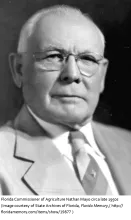
1960 – Arguably Florida’s most influential, and certainly its longest running Commissioner of Agriculture Nathan Mayo died on this date while in office. Mayo, having served in that capacity for 37 years became one of Florida’s most vocal proponents of Florida agricultural products. Born in North Carolina in 1876, Mayo moved to Marion County with his family when he was 10. He established a farm in Summerfield where he lived throughout his life. Mayo was elected to the state legislature in 1921 and was appointed Commissioner of Agriculture in 1923.
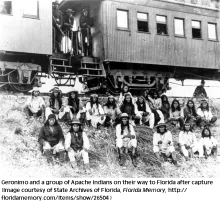
1886 – The first 77 Chiricahwa Apache Indian prisoners from the southwestern U.S. arrived at Fort Marion in St. Augustine on this date. Comprised mainly of women and children, over 500 Indians would be held captive in the fort by October of that year. The small groups under the leadership of Geronimo were pursued by intense U.S. military forces in the southwestern U.S. until almost all surrendered. Although many were sent to Fort Marion in St.
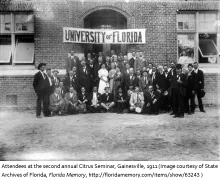
1911 – The second annual Citrus Seminar was held in Gainesville on this date. The seminar began as a venue for the state’s citrus growers to meet and discuss techniques, trends, laws and everything else related to one of Florida’s historically important industries. Although citrus production in Florida has dropped in the recent past due to development, disease and freeze since its introduction centuries ago, citrus remains an important part of the Florida history.
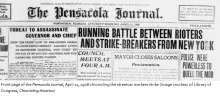
1908 – Citizens of Pensacola were still dealing with a large riot that was taking place in their city between electric streetcar employee union workers and strike breakers from New York on this date. The strike began on April 6th shortly after workers at the Pensacola Electric Company unionized and negotiations over wages and other issues between the two sides were at an impasse.
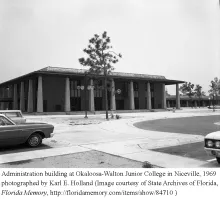
1969 – The Niceville campus of the Okaloosa-Walton Junior College was dedicated on this date. The college began holding classes temporarily in Valparaiso on April 3, 1964 before moving to its permanent location in Niceville in late 1968. The school voted to change its name to Okaloosa-Walton Community College in 1988, and in 2008 the college started offering four-year degrees, changing the name again to the Northwest Florida State College. Currently the college serves almost 15,000 undergraduates at seven campuses including the original campus in Niceville.
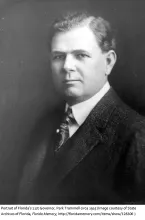
1876 – Park Monroe Trammell, the 21st governor of Florida (1913-1917), was born in Macon County, Alabama, on this date. Trammell attended school in Polk County as a youth. As a young man, he worked in a newspaper office in Polk County. During the Spanish-American War, he served in the Quartermaster’s Corps in Tampa. Trammell studied law at Vanderbilt University and Cumberland University, from which he graduated in 1899. After returning to his in Polk County home, he practiced law, owned and operated citrus groves, and operated a newspaper.
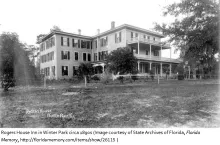
1882 – The Rogers House Inn, located on the southeast corner of Morse and Interlachen in Winter Park, opened its doors on this date, effectively marking the beginning of the small resort community. Wealthy northern developers Oliver E. Chapman and Loring Chase chose the site for the Inn because of its proximity to a group of idyllic lakes and the newly constructed South Florida Railroad depot.
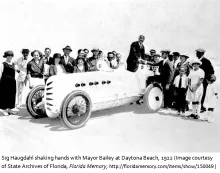
1922 – Sigurd Olson “Sig” Haugdahl broke the land speed record at Daytona Beach on this date. Sig reached a speed of 180 miles per hour in a car he built named the “Wisconsin Special.” The car had an 836 cubic inch, 6 cylinder airplane engine capable of producing 250 horsepower. Although Sig’s world record breaking run was widely publicized and was recorded, the American Automobile Association did not recognize the new record because they did not have any officials from their organization present at the time of the run, and Sig was not a member at the time.
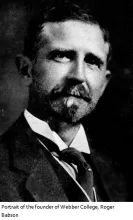
1927 – Webber College was established in Babson Park near Lakeland on this date. Now called Webber International University, the school is a private institution focused on business education. The school’s founder Roger Babson was an entrepreneur, investor and prominent business theorist who founded a number of business colleges around the country in the early 20th century. Webber was one of the first business schools founded in the U.S. exclusively for women. It is now coeducational.