1947 – The Florida State College for Women (FSCW) in Tallahassee was reorganized and renamed Florida State University (FSU) on this date. In response to the massive influx of WWII-veterans returning to the state who were taking advantage of government-funded educational programs, the Florida State Legislature decided to revert the school back into a coeducational facility. Begun in 1851 as one of two seminary schools in the state, the school reorganized into an all-women’s institution in 1905 and remained so until after WWII.
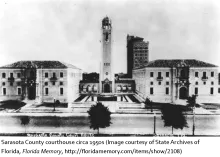
1921 – Sarasota County, Florida’s 60th county was created by the Florida legislature on this date. Exact origins of the name are unknown, although many believe it has been used in some form since early European colonial times. One of the first permanent settlers was William H. Witaker who settled on Yellow Bluffs in 1851, but later moved north to Manatee County in 1865 after his homestead was burned. Currently, the largest city is North Port and the county seat is the City of Sarasota.  


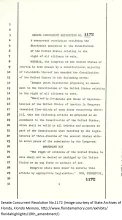
1969 – The Florida Legislature symbolically ratified the 19th amendment to the U.S. Constitution, granting women the right to vote on this date. Although Florida was not one of the states that moved to ratify the 19th amendment back in 1919/1920, the state did pass a law granting all residents suffrage in 1921. Senate Concurrent Resolution No.1172 was passed easily by the State House and Senate and was signed by Governor Claude Kirk on May 22nd.  

1835 - John T. Lesley was born in Madison County on this date. In 1848, Lesley moved with his family to Tampa. Lesley fought in the State Militia during the Third Seminole War until 1858. Captain Lesley commanded Company K of the 4th Florida Infantry, the "Sunny South Guards," and made Major in 1862. Lesley resigned his commission in 1863 to recruit a cavalry company. At the end of the war, Lesley returned to Tampa. Lesley served as Sheriff for two years. In 1869 Lesley ran for Mayor of Tampa.

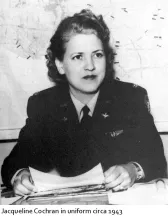
1906 – The first woman to break the speed of sound in an airplane Jacqueline Cochran was born in Muscogee near Pensacola on this date. Cochran began flying airplanes in the early 1930s after moving to New York and was soon competing in a number of speed races. During WWII she became the director of the WASP (Women Airforce Service Pilots) program which trained hundreds of female pilots. After the war, Cochran began flying jet aircraft and continued to break records and push the boundaries of aviation. She holds more speed and distance records than any other pilot male or female.

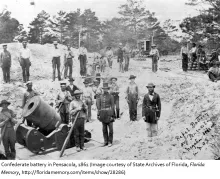
1862 – The City of Pensacola surrendered to Union forces on this date. In January of 1861 Confederate troops from Alabama and Florida took over the Navy Yard and Fort Barrancas, while Union Forces held on to Fort Pickens. Both sides received troop reinforcements over the next few months and in September the first major engagement occurred during the Battle of Santa Rosa Island.

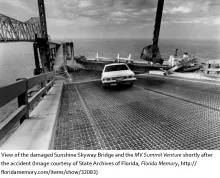
1980 – A 578.9 ft. long freighter named the MV Summit Venture struck a support pier of the Sunshine Skyway Bridge which spans Tampa Bay on this date. The freighter was navigating through a heavy thunderstorm around 7:30 a.m. when the accident occurred, causing over 1400 ft. of bridge to plummet into the bay. Six cars, a truck and a Greyhound bus fell 140 ft. into the water killing 35 people. A new bridge was erected in its place which opened in 1987.

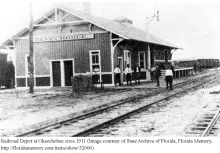
1917 – Okeechobee County, Florida’s 54th was created on this date. Carved from portions of Osceola, St. Lucie and Palm Beach counties, it comprised nearly 500,000 acres. By early 1917 leading citizens of Okeechobee approached St. Lucie County Representative J.M. Swain who introduced the bill to the legislature in early April. The original partition plan included part of De Soto County but representatives from that county protested against the loss of territory.

1877 – The Bank of Jacksonville opened its doors on this date. Started by William Boyd Barnett in a small office with his son as the only employee, the bank soon grew to become one of the largest in Jacksonville, and later the entire state. William Barnett moved to Jacksonville from Kansas because his wife enjoyed improved health in the warm Florida climate. Renamed Barnett Bank, and inherited by his son Bion in 1903, it operated branches throughout the state until 1998 when NationsBank purchased Barnett Banks of Florida Inc., then the largest bank merger in U.S. history.

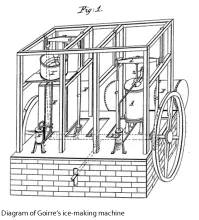
1851 - Dr. John Gorrie, a physician in Apalachicola, patented his ice-making machine today on this date. Gorrie, (1802-1855,) looking for a way to cool patients suffering from malaria fever, was granted Patent No. 8080 for an machine to make ice artificially. His invention led the way for commercial ice making machines and eventually for the development of air conditioning.  He is one of two Floridians honored with a statue in the Capitol Rotunda in Washington, D.C.


Imagine a Florida with NO air conditioning!!!!