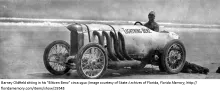
1910 - Barney Oldfield established a new land speed record of 131.7 miles-per-hour at Daytona Beach on this date.  Oldfield was driving the “Blitzen Benz,” manufactured in Mannheim Germany in 1909 by the Benz & Cie which boasted an inline four cylinder engine producing 200hp. The Daytona/Ormond Beach area was ideal for these early land speed attempts and is often referred to as the “Birthplace of Speed.” 
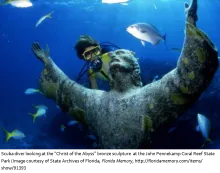
1960- The Key Largo Coral Reef was established on this date, thus establishing the underwater area as officially part of the state park system, and the first underwater park in the United States. The park encompasses approximately 70 nautical square miles of underwater reefs and mangrove areas. A few years after the underwater park was established, land was donated and developed to include a camping area and visitor’s center on land adjacent to the reefs.     

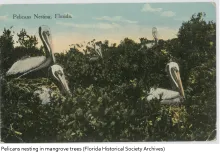
1903 – The Pelican Island National Wildlife Refuge on the Indian River Lagoon in East Central Florida became the first national refuge on this date. By the late 1800’s Florida’s wildlife populations, specifically bird populations were dwindling due to overhunting for plumes. Pelican Island, a small 3-acre mangrove island, hosted thousands of brown pelicans, spoonbills, and other waterfowl utilized the island as a rookery for their young.

1812 – Forces from the Patriot Army set up camp in East Florida on Rose’s Bluff near the St. Mary’s river. This ragtag Patriot army, comprised mostly of Georgians, set out to invade, occupy and overtake the Spanish forces at St. Augustine, thus claiming the territory for the United States. The Spanish had very weak control of its borders and the Patriots believed they could muster popular support amongst the East Florida population and start a revolution, but that reality never came to fruition.

1845 – Florida is admitted into the United States as the 27th state on this date! After centuries of Spanish rule, 20 years of British control, and almost 25 years as a U.S. territory, Florida was finally voted in as a state. President John Tyler signed the admission bill. Floridians had voted in a referendum in favor of statehood in 1838 and a state constitution was approved in 1839, but it was not until the U.S. Congress approved the act in 1845 admitting both Florida and Iowa that it became official.

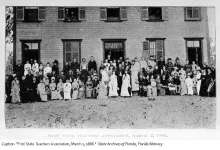
1886 - Teachers from around the state met at the Florida Chatauqua in DeFuniak Springs and formed the Florida Education Association (FEA). At the time, most Florida teachers had a sixth-grade education and no formal training in teaching. Teachers' monthly wages ranged from $20 in Gadsden County to a high of $77.50 in Polk County. This teachers' union remains the state's predominant voice for educators and is affiliated with the National Education Association and the American Federation of Teachers.

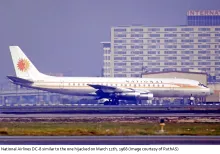
1968 – Three Cuban exiles hijacked a National Airlines DC-8 Flight 28 from Tampa to Miami on this date. Five minutes into the flight the men pulled out pistols and shouted, “Havana, Havana,” forcing the pilots to divert their route from Miami to Cuba. Between the years 1968 and 1972 dozens of flights from Florida to Cuba and vice versa were hijacked for reasons variously attributed to terrorism, political asylum, extortion, Americans fugitives fleeing law enforcement, and simply transportation between the two counties at a time of heightened political tensions.

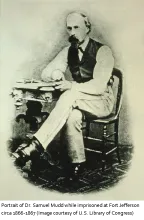
1869 – Dr. Samuel Mudd left Fort Jefferson aboard the US schooner Matchless bound for Key West on this date. Mudd had been convicted of aiding and conspiring with John Wilkes Booth in the 1865 assassination of President Abraham Lincoln.  Mudd was sentenced to life imprisonment and was sent to Fort Jefferson in the Dry Tortugas, about 70 miles west of Key West. It was at this desolate post that Mudd would reside until being pardoned by President Johnson on February 8th, 1869. Mudd was officially released from confinement on March 8th.

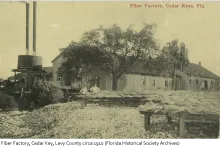
1845 – Levy County was created on this date. Located on Florida’s Gulf coast, Levy County was named after prominent planter, businessman and politician David Levy Yulee, who served as one of Florida’s first two U.S. Senators. The county seat is Bronson. The city of Cedar Key on the coast became an important port in Florida during the 19th century, exporting large amounts of lumber, naval stores and cotton from the interior. The westernmost terminus of the Florida Railroad in Cedar Key connected Levy County with Fernandina on the east coast. 

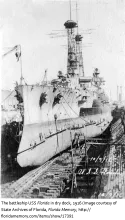
1909 – The keel of the USS Florida(BB-30) was laid during a ceremony at the Brooklyn Navy Yard on this date. The Florida was a Florida class dreadnought battleship which was commissioned in May of 1910. It had a displacement of 21,825 tons, was 521 ft. long and traveled at a maximum speed of 21 knots per hour. She was one of the first ships during the American occupation of Veracruz Mexico, and also served with the 6th Battle Squadron of the Grand Fleet, which patrolled the North Sea during WWI.