In 1763, Spain ceded the Florida territory to Britain in exchange for the Havana, a result of allegiances during the French and Indian War. Known as the British Period (1763-1783) it marked the beginning of England’s colonization attempts on the peninsula. The dividing line between East and West Florida became the Apalachicola River, with the British colony of Georgia to the north, and the Mississippi River to the west. The territory was sparsely populated with most of the European colonists living in and around St. Augustine in East Florida, and Pensacola in West Florida, the capitals of each colony respectively. The groups now moving into Florida when the British took over colonial control were an amalgamation of many smaller Native American clans and familiar groups who were loosely linked by language and custom in the southeastern U.S. The British began in earnest meeting with the local leaders within these Indigenous communities and established ties that led to trade agreements. Key to the economic success of the British Floridas was a successful, trusting, and fruitful relationship with the various Indigenous groups living in and bordering the Floridas. The primary commodities coming out of the wooded backcountry were deer and otter pelts, more so the former. Items being imported and traded for the aforementioned peltry were Europeans metal goods such as firearms, gunpowder, jewelry, clothing and alcohol. Although the economy of the colonies was important, the other, and arguably the more pressing reason that the British catered to the needs and wants of the Indian population was strategic military alliances. During the French and Indian war, the British relied upon the provision of Indigenous American warriors to fight alongside the white colonists and the British army to defend her colonial possessions.
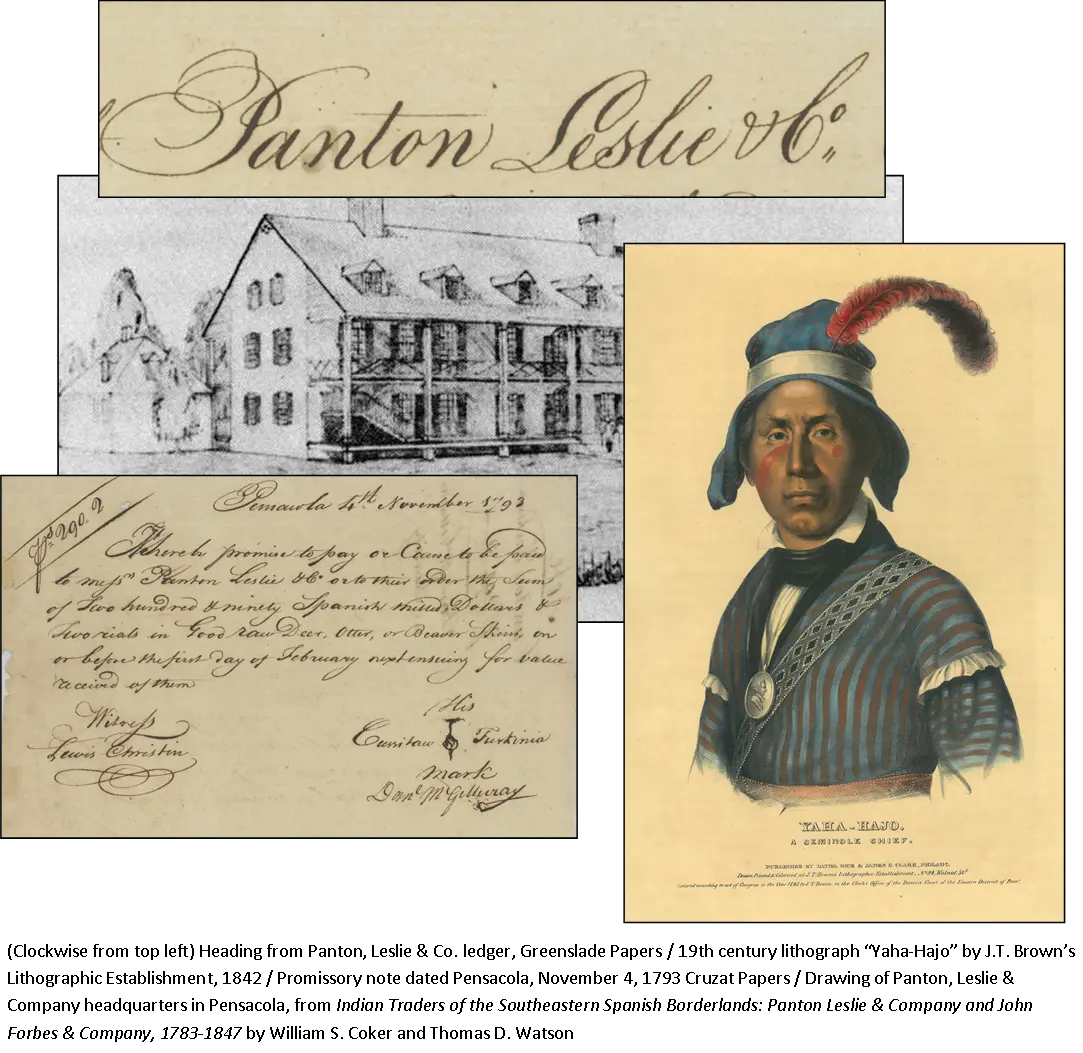
The North American continent presented a wealth of resources beyond just precious metals such as the ones mined from Central and South America. More importantly, the continent possessed natural resources and ample land for agriculture which by the 18th century would prove to be a driving force in the rapid immigration of Europeans into the Americas. Control of raw materials produced in the Americas became the motivating force between European traders and Indigenous inhabitants during the late 18th and early 19th centuries. This competitive environment proved perfect for the emergence of large-scale trading operations which could handle the volume of necessary arms and goods coming into North America, but also the volume of deerskins and other peltry being exported out. It was through political coercion, complex trading networks, and opportunistic dealings that the partners and traders involved were able to procure so much wealth in the span of only a few decades. The enormous financial successes of the company and its successor, John Forbes and Company (JF&CO), are not the key issues explored in this project. Rather, it was the effect on Creek and Seminole Indian culture and trade that paved the way for hostilities between Anglo settlers and Indians in Florida during the Creek Civil War and the Seminole Wars period. The exertion of soft power upon the Indigenous populations led to the breakup of the clan systems and eventually led to the aforementioned armed conflicts. It is through the exploration of original documents, combined with the presentation of these materials in the form of podcasts that the long-term impacts of the late colonial period Indian trade can be better understood.
In this exhibit you can search through original documents relating to the fur trade and listen to audio podcatsts which provide context for these narratives
You can also connect and share your thoughts about this exhibit through the Florida Historical Societies Facebook page. We invite discussions on this topic and will expand and improve upon the exhibit based on user feedback.
The Trade on the ground • Talks with Native Americans • Land Cessions • Time and Place
Teacher's Guide
| Attachment | Size |
|---|---|
| Teacher's Guide - Fur Trade in Florida | 177.92 KB |