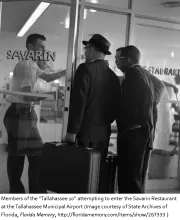
1961 – Ten members of the Interfaith Freedom Ride were arrested in the Tallahassee Municipal Airport after attempting to eat at a segregated airport restaurant. The group rode from Washington D.C. to Tallahassee in a move of protest against the segregated interstate busing system in the south, ending their trip in Tallahassee. The group planned to then fly back to Washington D.C. from the Tallahassee Municipal Airport and decided to sit-in at the Savarin Restaurant inside the airport when ten of the protestors were arrested.
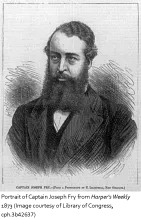
1826 – Captain Joseph Fry, infamous captain of the Virginius was born in Tampa on this date. Captain Fry was a member of the second graduating class of the U.S. Naval Academy and served with distinction around the world until the outbreak of the American Civil War. Fry joined the Confederate Navy and saw action on the Mississippi River. After the war Fry was looking for work and agreed to captain a side-wheel steamer named the S.S. Virginius.

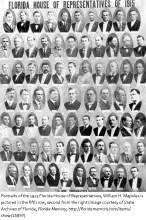
1915 – Okaloosa County, Florida’s 52nd county was created on this date. The name Okaloosa is derived from a Choctaw word meaning “black water.” A steamboat operating on the Blackwater River named the Okaloosa brought passengers from Milton to Pensacola.  One of the county’s early settlers and State Representative William Mapoles first introduced the bill to create Okaloosa County citing the recent population growth due to the burgeoning lumber, turpentine and fishing industries in the area and the need for more representation.

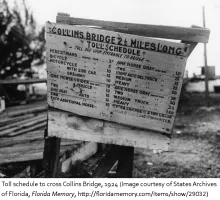
1913 – The Collins Bridge, the first bridge connecting Miami Beach with Miami opened on this date. It was built by early south Florida land developer John S. Collins and partially financed by Carl G. Fisher. At the time of completion it was the longest wooden bridge in the world at 2.5 miles. The original bridge was replaced by a series of arch drawbridges in 1925 and renamed the Venetian Causeway. The Collins Bridge opened up Miami Beach to rapid growth and development which hasn’t slowed ever since!

1925 – The Ocean Pier and Casino at Daytona Beach opened its doors on this date. One of the most recognizable features on one Florida’s most popular beaches, the Ocean Pier, built in 1925, replaced an earlier structure known as Keating Pier which was constructed in the late 19th century. After a devastating fire in 1920, Jeter McMillan built the new casino. Over the years the pier has hosted thousands of charity balls, dances, civic events, weddings, and beach goers from around the world.

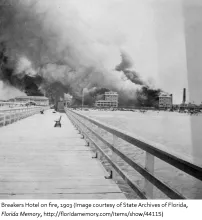
1903 – The Breakers Hotel burned down on this date. In 1896, Henry Flagler built his a second hotel, The Palm Beach Inn on the beachfront of the Royal Poinciana. Soon guests requested rooms "over by the breakers." When Flagler redoubled the hotel's size, he renamed it The Breakers. The fire occurred during an expansion project, the fourth in less than a decade. Less than a year later on February 1, 1904, it reopened to universal acclaim. Rooms started at four dollars a night, including three meals a day.

1845 – Andrew Jackson, 7th president of the United States, two-term U.S. Senator, and Representative from Tennessee, and first Military governor of the territory of Florida died at his home in Tennessee on this date. Jackson first came to Florida as a military general in 1818 during the First Seminole War when he crossed into then Spanish held West Florida chasing Seminole and Creek Indians and destroying their towns. Jackson then captured Pensacola without direct orders to do so, or any formal declaration of war.

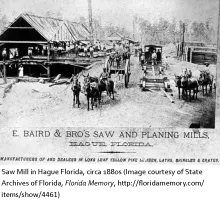
1873 – African-American sawmill workers idled mills in North Florida on this date. The Jacksonville Labor League had been organized to force employers to make concessions, and decided to take action to address “relations now existing between capital and labor in this vicinity” which were “unequally and unjustly balanced.” The workers were seeking a 10-hour day and a minimum payment of $1.50 per day. The Labor League’s demands were considerably moderate at the time, considering most Northern workers were fighting for an eight hour day standard.

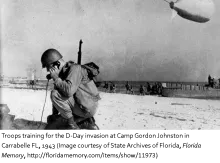
1944 – Thousands of Floridians and men who had trained in Florida took part in the largest amphibious military operation in human history on the Normandy coast of France on this date. Over 150,000 allied troops participated in what was nicknamed Operation Overlord. Many Americans trained for the amphibious landing at Florida bases including Camp Gordon Johnston, and Camp Blanding, as well as a number of Naval Air Stations, Army Air Fields and Naval bases. By 1942 there were more than 170 military facilities in Florida.

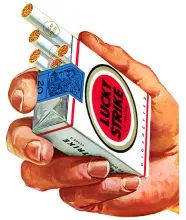
1963 – The Florida Supreme Court responded in a 5-2 decision in the Green V. American Tobacco Company suit that cigarette companies are not liable for the deaths of cigarette consumers, but they did argue for the first time that cigarettes could be linked to lung cancer. The lawsuit was originally brought against the American Tobacco Company, makers of Lucky Strike Cigarettes, by Miami resident Edwin Green in 1957. Green was diagnosed with lung cancer in the early 1950s which he argued was caused by decades of smoking Lucky Strict cigarettes.