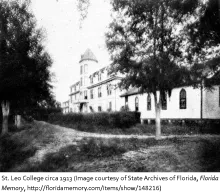
1889 – St Leo University was chartered in Pasco County on this date. St. Leo was the first Catholic college in Florida named after Pope Leo the Great. The college was temporarily phased out to become a prep-school but was reopened in 1959. The school steadily grew in the following decades and in 1999 St .Leo established one of the first online degree programs in the country, building on a long tradition of providing distance degree programs for U.S. military personnel. Today St. Leo is still one of the largest providers of higher education to military-related personnel in the U.S. 

1906 – Long running Florida politician Robert Lee Fulton Sikes, known as the “He-Coon”, was born in Isabella Georgia on this date. Sikes attended the University of Florida as a graduate student receiving an MS in 1929. He later moved to Crestview and established a publishing business there. He was elected to the Florida House of Representatives in 1936 and served until 1940 when he won a seat in the U.S. House of Representatives for Florida’s 1st district. Sikes would serve in that position until 1978, briefly resigning during WWII to serve in the military.

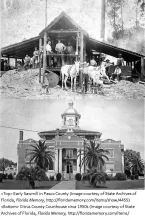
1887- Citrus County (Florida’s 44th) and Pasco County (Florida’s 45th) were established by the Florida legislature on this date. Both located on Florida’s central gulf coast, Citrus and Pasco Counties relied heavily on agricultural industries such as citrus production in the late 19th century, the former of which adopted the product for its name, while the latter chose U.S. Senator and former Confederate soldier from Florida, Samuel Pasco as its namesake. The county seat of Citrus County is Inverness and Pasco County’s seat is Dade City.

1905 – The Carnegie Library in Jacksonville was officially opened to the public on this date. In May of 1901 a devastating fire destroyed most buildings in Jacksonville including the city’s library. In 1902 industrialist and philanthropist Andrew Carnegie agreed to donate $50,000 towards the construction of a new library provided the city designate a site and provide $5,000 annually for library support. When the library was opened, it was the largest and only tax-payer supported library in Florida. The original building still exists, but is now privately owned.

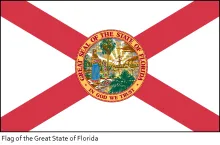
1899 - An amendment to the state constitution was approved by the Florida Legislature on this date that provided for the adoption of the current state flag. The exact dimensions were further defined in the 1968 rewriting of the state Constitution. Over the last 500 years Florida has flown no les than two dozen different flag designs including those representing colonial Spanish, French, Confederate and revolutionary forces.


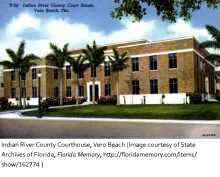
1925 – Indian River County, Florida’s 65th county was created on this date from the northern portion of St. Lucie County. The county is named for the Indian River Lagoon system which runs through the eastern part of the county. Indian River County is home to Pelican Island National Wildlife Refuge, the first created in the United States in 1903. The current population is approximately 140,000 residents and the County Seat is Vero Beach.

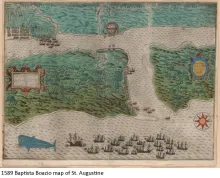
1586 – Sir Francis Drake and over 1,000 men left St. Augustine after burning the settlement to the ground on this date. The raid was part of a much larger Anglo-Spanish War between England and Spain which spilled over into the new world. Although the city was destroyed and much of their supplies had been plundered by Drake’s forces, the people of St. Augustine were able to slowly rebuild with the help of the Spanish government, and eventually began construction on a permanent stone fort after subsequent attacks from others, now known as the Castillo de San Marcos.

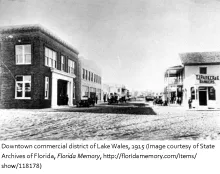
1917 – The City of Lake Wales was incorporated on this date. Located in Polk county, Lake Wales was first settled and developed in 1911 by the Lake Wales Land Company. The company purchased 5,000 acres of hilly land surrounding the body of water Lake Wailes, named after land agent Sydney Wailes. By the time the town was incorporated it already boasted a telephone line connected with Haines City, a school with almost 100 pupils, a newspaper, electricity plant, and paved streets along the main roads.

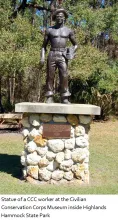
1933 – The first Civilian Conservation Corps (CCC) camp in Florida was established in Eastport near Jacksonville on this date. The CCC was a federal worker-relief program designed to get young men working on construction and conservation projects through the U.S. as part of the New Deal. Over the course of the program (1933-1942) over 3 million young men worked for the CCC. In Florida, the work done by the CCC established a number of state parks including the Suwannee River State Park, Myakka River State Park, and Highlands Hammock State Park.

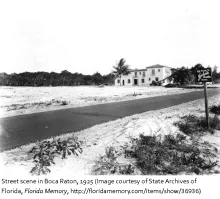
1925 – The town of Boca Raton in Palm Beach County was incorporated on this date. The name originates from Spanish and originally appeared on 18th century maps further south. One of the earliest settler after the Second Seminole War was T.M. Rikards who built a house near the present-day Palmetto Park bridge. During the 1920s, Baca Raton experienced a massive land boom and the population grew sharply. During WWII much of Boca Raton was converted into the Boca Raton Army Air Force Base. Florida Atlantic University now sits on the site of the former Army Air base.