Environment

Article Number
95
relevantdate

    Ever since 16th century Spanish explorers realized that Florida was a large peninsula, people have dreamed of finding or creating a “shortcut” linking the Atlantic Ocean to the Gulf of Mexico.

    By the early 19th century, a series of politicians and businessmen envisioned cutting a canal from one side of Florida to the other, creating a direct path for commercial boat traffic across the top of the peninsula.

    The Cross Florida Barge Canal would save three days of travel for ships if they didn’t have to go all the way around the peninsula, and could instead cut right through the middle of the state.

    In 1935, the Army Corps of Engineers made plans for the Gulf Atlantic Ship Canal, a 30-foot deep waterway that would allow large vessels to cross the state through Ocala.

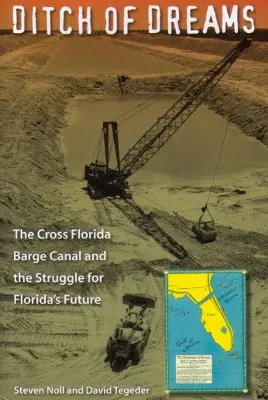
    “As a result of a threat to the aquifer, issues of salt water intrusion, there will be a turn towards creating a barge canal, only 12-feet deep,” says David Tegeder, co-author of the book “Ditch of Dreams: The Cross Florida Barge Canal and the Struggle for Florida’s Future.”

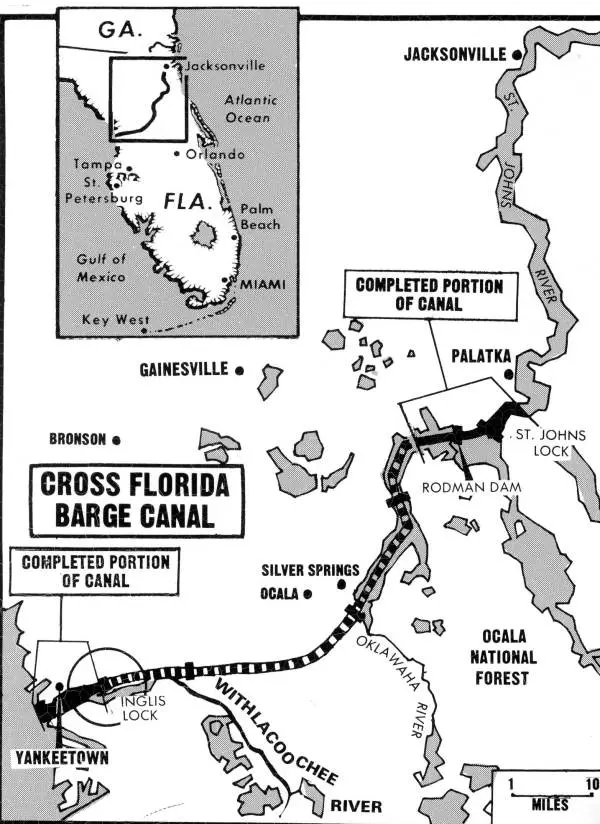
    Proponents of the Cross Florida Barge Canal planned a series of locks and dams that would allow a commercial waterway to be created from Jacksonville to Yankeetown, a community north of Tampa and west of Ocala.

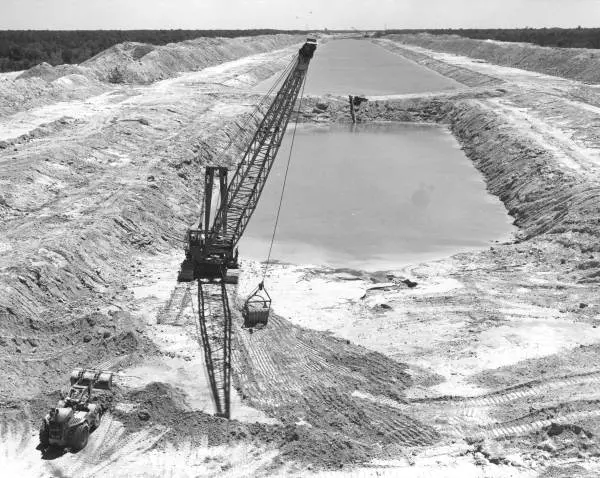
    With the Great Depression of the 1930s, construction began on the Cross Florida Barge Canal as a way to stimulate the economy and provide jobs. As part of his New Deal program, President Franklin D. Roosevelt approved a five million dollar allocation of federal funds for the project.

    “In September of 1935, 6,000 men are going to descend upon Ocala, Florida, and begin this construction,” says Tegeder. “Ocala is now a boomtown. There’s rapid growth. In one week the city issues ten liquor licenses as a measure of that optimism, and prosperity begins.”

    Efforts to ensure that canal workers were being treated fairly were met with violence. In 1936, a labor organizer named George Timmerman came to Ocala to see that workers had reasonable compensation and safe working conditions.

    “He is captured, roughed up, and found in the woods crucified, tied to a tree with his lips sewn shut, as a warning that labor activism will not be tolerated on the canal,” says Steven Noll, co-author of “Ditch of Dreams.” “After that, Mr. Timmerman disappears from the historical record.”

    The African American community of Santos, about six miles south of Ocala, was decimated by the canal project.

    “It is an African American community built around both Saturday night jook joints and Sunday afternoon churches,” says Noll. “It is wiped off the map in the 1930s by the canal. The canal is never built there, but the land is taken from these people either through eminent domain or purchased for pennies on the dollar, and the town is basically destroyed.”

    Environmental concerns stalled completion of the canal for several decades. Federal funding allowed construction to resume in 1964, with President Lyndon Johnson presiding over the ground breaking ceremony. By this time, national defense had joined job creation as a rationale for building the Cross Florida Barge Canal.

    “The national defense angle is that the canal will provide a sheltered waterway for protection, especially for oil tankers as they traverse the waters from the oil fields of Texas and Oklahoma to the refineries of New York,” says Noll. “They will not be able to be victims to the predatory operations of enemy submarines, whoever they might be.”

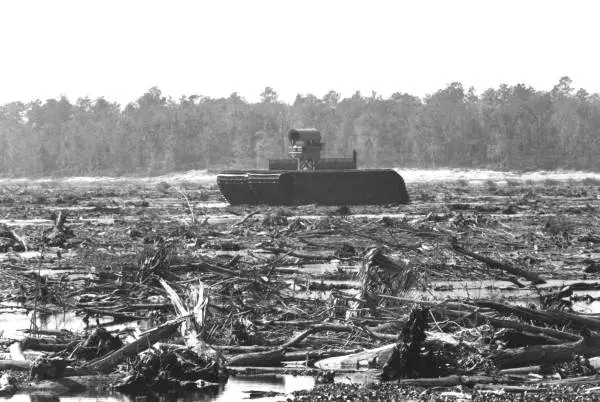
    Marjorie Harris Carr led a group of environmentalists who successfully argued that the Ocklawaha River must be preserved and construction of the canal stopped. Their arguments were fueled by the use of a gigantic, destructive machine called “the Crusher,” that decimated Florida’s natural landscape.

    “This thing could mow down six 80-foot cypress trees in one swath,” says Tegeder. “It basically cleared about an acre an hour.”

    By the time President Richard Nixon halted construction of the canal in 1971, seventy-five million dollars had been spent on the project, and it was approximately 28 percent completed.

    Today, the Marjorie Harris Carr Cross Florida Greenway provides hiking and biking trails on the remnants of the Cross Florida Barge Canal.
    PDF file(s)
    Article Number
    33
    relevantdate

      When most people think of Florida’s natural environment, an explosion of color comes to mind. We imagine multiple shades of green in a Florida swamp, bright red Poinciana trees, and the turquoise waters of the Gulf Coast. We picture the oranges, purples, pinks, and blues of the Florida sky.

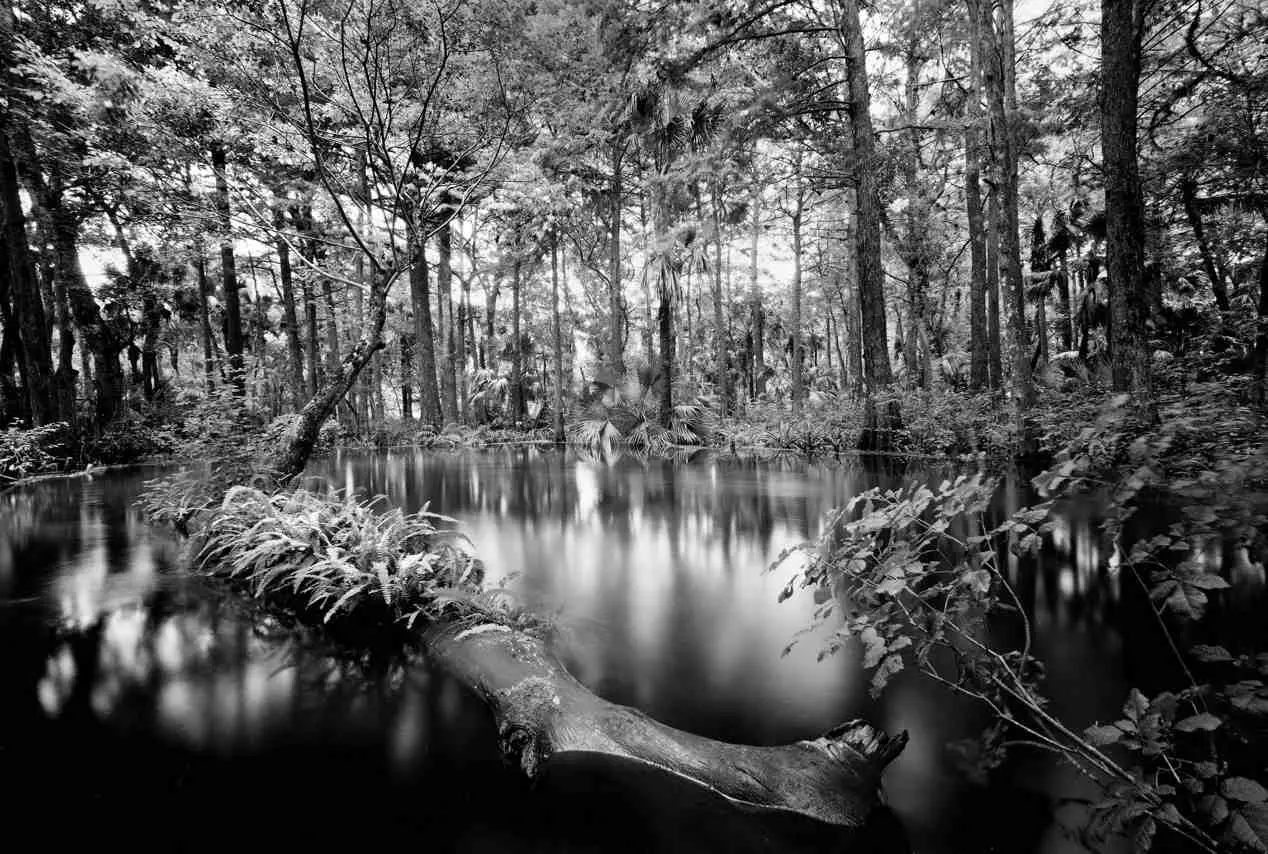
      The black and white photographs of Clyde Butcher allow us to look at the natural Florida in a different way.

      “The main reason to do black and white is because the colors are so vibrant you can’t see the image,” Butcher says. “Black and white shows the oneness of nature. Without the whole system, nature doesn’t work, and I think the black and white brings a reflection of that in the work so you can actually see the landscape. You don’t just see the color.”

      Butcher’s work has been compared to that of photographer Ansel Adams, best known for his black and white images of the American West. Like Adams, Butcher mostly uses a large format camera. Some of his images are as large as 6 feet by 9 feet.

      “When you’re in nature you’re scanning, and you’re looking around, and you’re putting this whole scene of nature together in your mind,” Butcher says. “That’s the same feeling I want you to get looking at a photograph, is being there.”

      Capturing his amazingly detailed images of Florida’s natural landscape sometimes requires that Butcher wait hours or even days for the right conditions. He’s known to stand chest high in water or lay on the ground for long periods of time to get the photograph he wants.

      Much of Butcher’s work has a three-dimensional quality. Clouds, for example, often seem to be floating right out of the photograph toward the viewer. “I’ve been working with a wide-angle lens since 1960, so I’ve learned to be able to create these spaces,” Butcher says.

      Many of Butcher’s photographs contain empty spaces that seem to invite the viewer in, to participate in the natural scene depicted. While some of his images are of coastal and island settings, most are focused on the Everglades. “For some reason you call it a swamp, I guess there’s some designation, but it’s actually more of a river,” Butcher says. “It’s a unique place. People don’t know what they have here. It’s gorgeous.”

      Butcher’s photographs do not include people. His images seem to capture a time in Florida before humans arrived to build highways and homes.

      “One of the main reasons I don’t put people in the pictures is because if someone is there, they’re taking your space,” Butcher says, adding that people’s clothing and hairstyles could “date” his photographs and he wants the images to exist outside of a particular historical period.

      Butcher goes beyond preserving Florida’s natural environment in his photographs. He is an active environmentalist who brings attention to the need for conservation with his work. Butcher has created exhibits specifically to benefit the Florida Department of Environmental Protection, the state’s “Save Our Rivers” program, the South Florida Water Management District, and a variety of environmental groups.

      In 1998, Butcher was inducted into the Florida Artists Hall of Fame.

      Butcher’s Big Cypress Gallery is located in the heart of the Everglades, between Naples and Miami on the Tamiami Trail. His gallery and studio is in the middle of a National Park that protects the wild Florida.

      From the Big Cypress Gallery, trained guides lead visitors on “Swamp Walks” through the water and trails of the Everglades, exposing them to cypress trees, alligators, exotic birds, and rare wildlife. Butcher and the guides encourage people on the walk to remain silent for five minutes, to become absorbed in the unique natural surroundings.

      “People are shocked that Florida is still here. They think about Disneyworld and Orlando and Miami, and they think it’s gone,” Butcher says. “Florida’s still here, it’s just a little harder to get to.”

      Butcher’s beautiful photographs make the natural environment of Florida accessible to everyone.

      The Foosaner Art Museum, 1463 Highland Avenue, Melbourne, has photographs of Clyde Butcher in their permanent collection. The museum gift store has a new 2015 calendar of Butcher’s images.

      Dr. Ben Brotemarkle is executive director of the Florida Historical Society and host of the radio program “Florida Frontiers,” broadcast locally on 90.7 WMFE Thursday evenings at 6:30 and Sunday afternoons at 4:00, and on 89.5 WFIT Sunday mornings at 7:00. The show can be heard online at myfloridahistory.org.

      PDF file(s)