Florida Frontiers

A Tag for nodes that are relevant to Florida Frontiers.   For example if an artilce is about Florida Frontiers and you would like a 'View' to sorty by Tag criteria for it... us it.

Article Number
59
relevantdate

    This week the nation is remembering a series of three marches in support of voting rights that took place fifty years ago. Peaceful protesters in Florida’s neighboring state of Alabama were attacked by police.

    The demonstrations encouraged President Lyndon Johnson to sign the Voting Rights Act.

    Less than a year earlier, demonstrations in Florida helped lead Johnson to signing the Civil Rights Act on July 2, 1964.

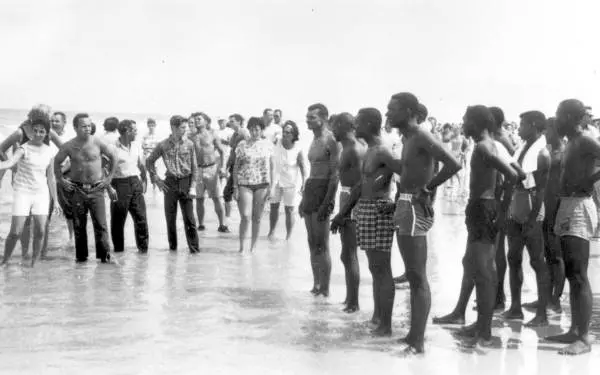
    In St. Augustine, attempts by protesters to peacefully demonstrate for civil rights were also met with threats and violence.

    “I’m history. I was there,” says Barbara Vickers, who was 41 in the summer of 1964.

    The night of greatest violence came on June 25, 1964, when peaceful demonstrators, both black and white, were attacked with bricks and stones.

    “We used to march down from the different churches, and we had night marches. The night that they beat Andy Young on the corner there, I was there that night,” says Vickers. “We couldn’t come in the plaza because they had rocks ready for us, so we had to march around the plaza. The bricks came flying here and there. A lot of people got hurt that night, but I didn’t get hit.”

    Vickers lived across the street from African American dentist and air force veteran Dr. Robert B. Hayling, who was the organizer of the local civil rights movement in St. Augustine. Young men had to patrol her street every night to defend Dr. Hayling from attacks by the Ku Klux Klan.

    As demonstrations became more frequent and violence against the protesters increased, Martin Luther King Jr. came to St Augustine to help organize the effort. It was King who encouraged Vickers to join the movement and participate in peaceful protests.

    “Dr. King came. He looked at me and said ‘Young lady, will you go?’ There was something about his eyes that was electrifying to me and before I knew it I said yes.”

    King and his followers were known for their strategy of encouraging social change through non-violence, even in the face of police harassment and intimidation. St. Augustine was the only Florida city where King was arrested.

    “After the meetings, we had to drive back to our homes, and I was stopped many times going home,” Vickers says.

    “They searched my car and they found the crank for the tire, and the police said I had a weapon. They said ‘I could arrest you for this.’ They were doing all this to intimidate us and discourage us from going to the meetings. Nothing kept me from going to the meetings.”

    As demonstrations reached their peak in St. Augustine, the Civil Rights Act of 1964 was being filibustered in congress. The images of segregation and violence coming out of the city helped to end the stalemate and get the legislation passed.

    Decades later, Vickers felt that the everyday people of St. Augustine who helped to move civil rights forward for all Americans needed to be recognized. She formed the St. Augustine Foot Soldiers Remembrance Project, which raised funds for a monument.

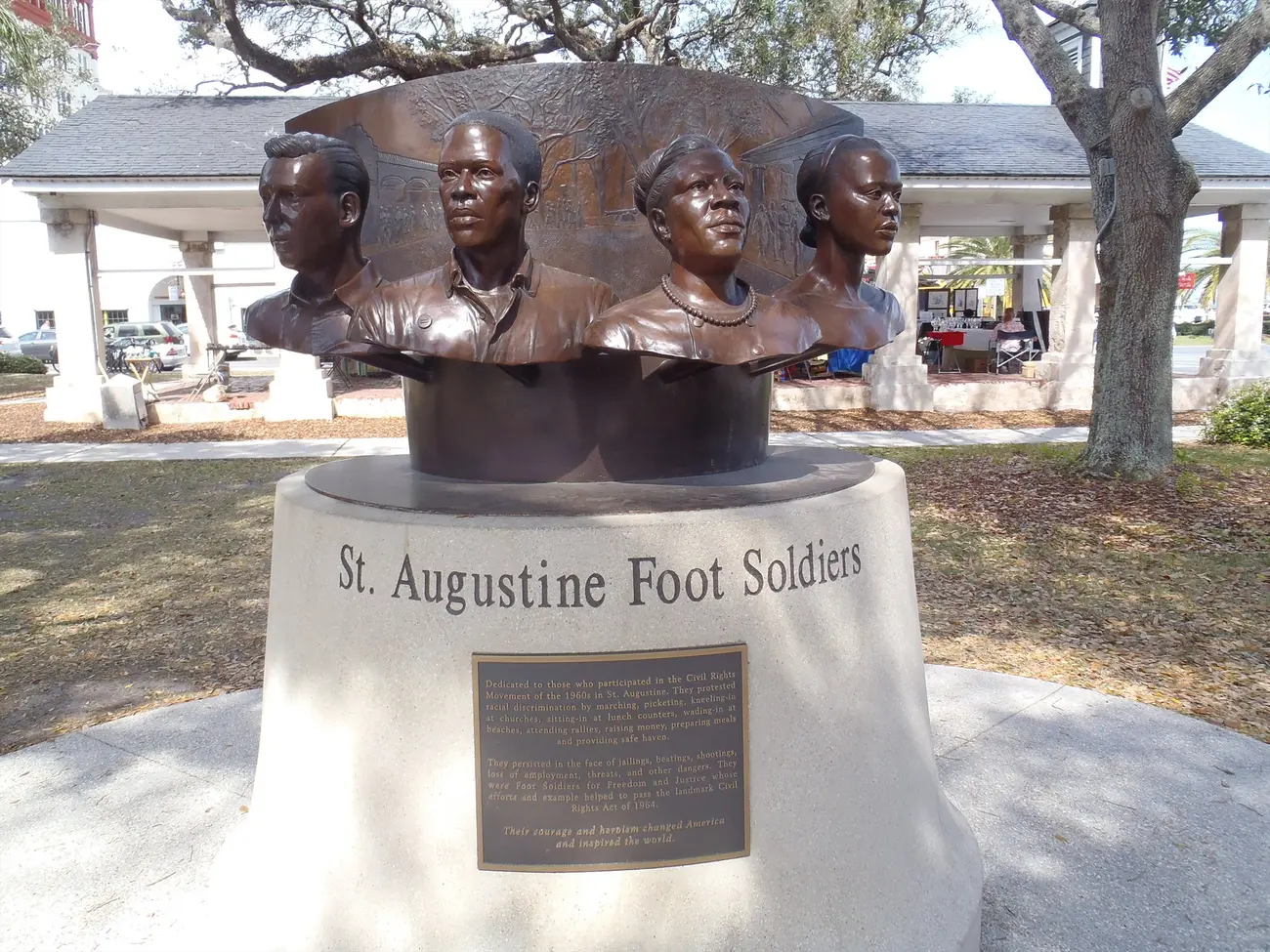
    In May 2011, the St. Augustine Foot Soldiers Monument was unveiled in the downtown plaza where demonstrators had been attacked.

    The bronze sculpture is facing away from the slave market where black people were bought and sold as property, and toward the building where the first attempts occurred to integrate drug store food counters in the city.

    “It’s not a depressing subject, it’s an enlightening subject,” says sculptor Brian R. Owens. “The Civil Rights Movement confirmed that we have what it takes to survive the childhood of our species, that we have the tools at our disposal that we need to solve our problems.”

    The monument designed by Owens includes four bronze busts in front of a relief sculpture. Each of the people depicted represents many others who fought for equality in St. Augustine. They include a white male college student, a black male in his 30s, a black woman in her 60s, and a black teenage girl.

    Black people helped build St. Augustine in 1565, but were left out of the city’s 400th anniversary celebration in 1965. Times have changed for this year’s 450th anniversary.

    “We were left out the last time, but not this time,” says Vickers.

    Dr. Ben Brotemarkle is executive director of the Florida Historical Society and host of the radio program “Florida Frontiers,” broadcast locally on 90.7 WMFE Thursday evenings at 6:30 and Sunday afternoons at 4:00, and on 89.5 WFIT Sunday mornings at 7:00. The show can be heard online at myfloridahistory.org.
    PDF file(s)
    Article Number
    58
    relevantdate

      People have lived in Florida for more than 10,000 years.

      March is Florida Archaeology Month, and the 2015 theme is “Innovators of the Archaic.” The Archaic Period began about 9,500 years ago and continued until about 3,000 years ago.

      Florida is rich with Archaic Period archaeological sites. Stone tools, pottery with distinctive regional styles, and prehistoric architectural foundations called shell middens have been discovered throughout the state. More than 100 dugout canoes, some dating to 5,000 years ago, have been excavated at Newnans Lake in Alachua County.

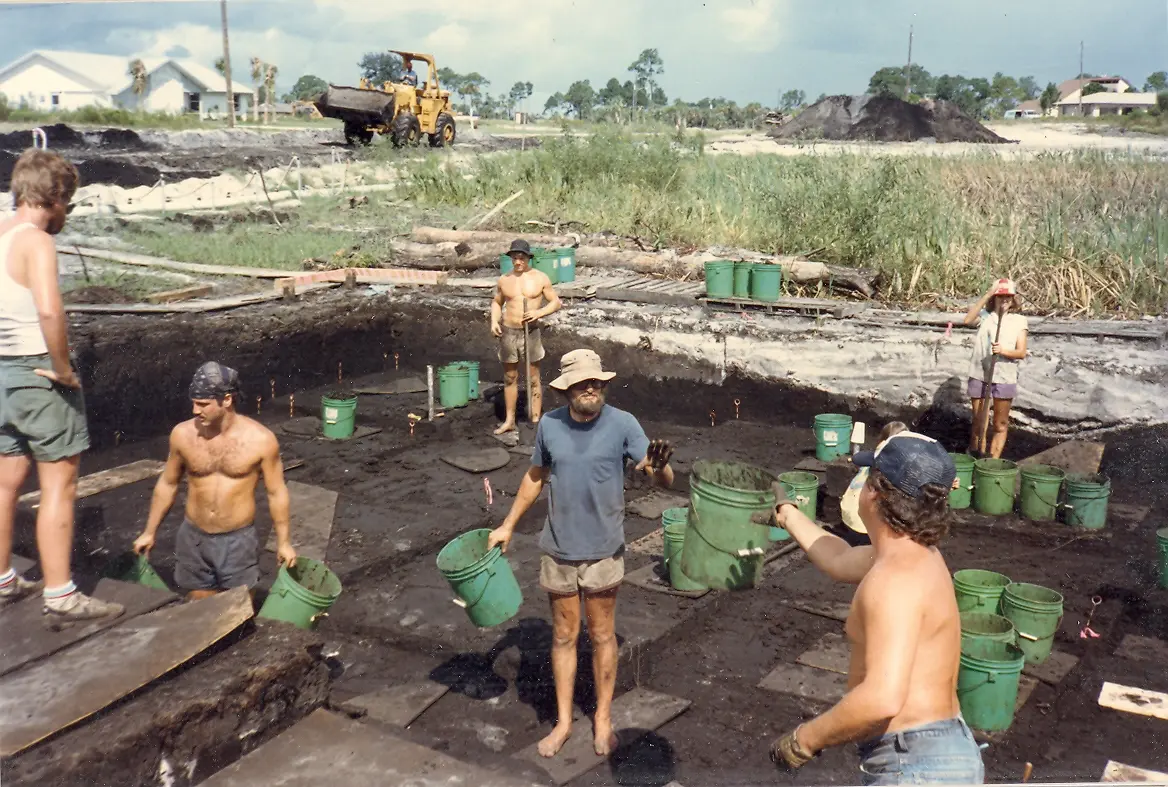
      One of the most important Archaic Period archaeological excavations in the world happened in Brevard County. In 1982, as construction began on the Windover Farms neighborhood in Titusville, ancient human remains were uncovered. Archaeologists from Florida State University were called in to investigate.

      “We arrived at the Windover construction site after five hours in the car from Tallahassee,” says Bruce Piatek, director of the Florida Historical Society Archaeological Institute and the Brevard Museum of History and Natural Science.

      “Physical anthropologist Dr. Dailey, Archaeologist Dr. Doran and I, Dr. Doran’s graduate student, stepped out of the car by the construction trailer. The site superintendent set three five gallon buckets on his pickup truck tail gate and pulled out the first of six skulls. Dr. Daily examined the skull and while doing so we all heard something flopping around inside the cranium. Dr. Dailey flipped the skull over to look in the foramen magnum, then pulled out his pocket knife and removed a chunk of grayish stuff from inside the cranium. He rubbed it between his fingers, smelled it, and I think tasted it, then said ‘couldn’t be,’ and handed the skull to Dr. Doran.”

      It was later determined that the “grayish stuff” was remarkably preserved brain matter that was more than 7,000 years old.

      Nearly 200 complete sets of human remains were discovered at the Windover site, and 91 of the skulls contained intact brains. The bodies were ritualistically buried in the same position, wrapped in some of the oldest woven cloth ever found. The anaerobic environment of the pond cemetery allowed the ancient human remains and artifacts to be amazingly well-preserved.

      Bruce Piatek, one of the first archaeologists to see the Windover remains, now runs the Brevard Museum in Cocoa where the story of the Windover People is told.

      “We are the one place in the state where you can come and learn about this almost miraculous archaeological site,” says Piatek.

      The Brevard Museum is holding activities for Florida Archaeology Month including public lectures from Sara Miller of the Florida Public Archaeology Network on Friday, March 6, and Annette Snapp from the Ah-Tah-Thi-Ki Seminole Museum on Friday, March 20.

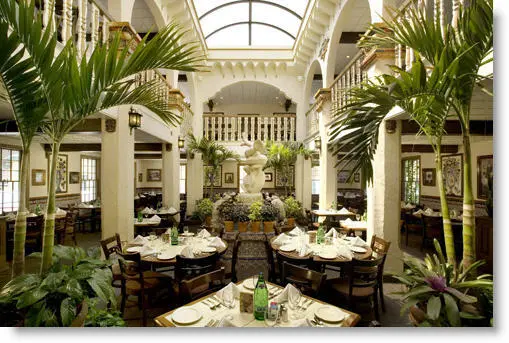
      A bus will depart from the museum on Wednesday, March 25, for a trip to St. Augustine to see the new Government House exhibit, the Castillo de San Marcos, and an active archaeological excavation. Lunch will be at the Columbia Restaurant.

      A free “Archaeology Day” will be held on Sunday, March 8, from 1-4 pm on the museum grounds. Hands-on activities for people of all ages will be presented by FHSAI and FPAN.

      “It’s an opportunity to work with the technology that these native peoples of Florida would have used,” says Kevin Gidusko, public archaeology coordinator for FPAN.

      “We’ll have atlatls, a throwing stick that was utilized by the people of Florida to hunt. It was used much longer than bows and arrows, which are relatively recent. We’re going to have an opportunity for people to learn about prehistoric pottery through actively making some of their own the way native peoples did. They’ll also look at native plant technology through the types of seeds and types of plants that they would have grown.”

      The Florida Historical Society Archaeological Institute, located at the Brevard Museum, is also celebrating its first anniversary this month. Over the past year FHSAI has published the book Searching Sand and Surf: The Origins of Archaeology in Florida, hosted an ongoing series of free public lectures, and actively participated in archeological research around the state.

      “There’s a lot of interesting history,” says Piatek.  “We’re helping to find more of it and document more of it, so we can build that story.”

      Dr. Ben Brotemarkle is executive director of the Florida Historical Society and host of the radio program “Florida Frontiers,” broadcast locally on 90.7 WMFE Thursday evenings at 6:30 and Sunday afternoons at 4:00, and on 89.5 WFIT Sunday mornings at 7:00. The show can be heard online at myfloridahistory.org.

      PDF file(s)
      Article Number
      57
      relevantdate

        The loud booming of cannon fire ripped through the north Florida pine forest fifteen miles east of Lake City as startled cavalry horses whinnied. Repeated rifle fire rang through the trees as more than 10,000 soldiers confronted each other on February 20, 1864, near Ocean Pond.

        The Battle of Olustee was the largest conflict of the American Civil War fought on Florida soil.

        Each side began with about 5,000 troops. When the three hour battle was over, 1,861 Union soldiers and 946 Confederate soldiers were dead.

        “It is significant because it comes at a time when the United States is attempting to swing Southern states back into the Union,” says Sean Adams, associate professor of history at the University of Florida.

        “There was an attempt, for example, to reconstruct Louisiana in 1863. The notion is that you’re also, then, going to swing Florida into the Union.”

        Three new U.S. Colored Troop Regiments bravely fought as Union soldiers at the Battle of Olustee, some even before they had an opportunity to complete their training.

        “This is after the Emancipation Proclamation had made it possible for African American soldiers to serve,” says Adams. “So the combination of those factors, the presence of black soldiers, but also the idea of reconstructing Florida creates the impetus for this campaign to secure Florida.”

        The Union lost this battle, but won the war 14 months later.

        Florida was the third state to secede from the Union, in January 1861, behind only South Carolina and Mississippi.

        “Florida was very significant to the Confederate war effort in that it supplied beef, it supplied salt,” says Adams. “It was an area where supplies could come in. The United States sets up a blockade of Confederate coasts, but of course Florida has a massive coast, so there’s no way that those Union ships are going to be able to keep all activity away from Florida.”

        The Olustee Battlefield Historic Site is Florida’s first State Park, established in 1909. Since 1977, an annual reenactment of the Battle of Olustee has been staged at the park.

        “Typically we plan for about 2,000 reenactors,” says Gary Dickinson, president of the Olustee Battlefield Citizen Support Organization. The CSO is the not-for-profit group that presents the reenactment. “We have 21 cannons, those are full-size artillery pieces. We’ll have between 50 and 75 mounted cavalry units.”

        Authentic Union and Confederate camps are part of the reenactment weekend. Food vendors are on hand, along with informational displays, and people selling Civil War era costumes and other memorabilia. Period music is presented along with a variety of public programs addressing various Civil War topics.

        Joel Fears is a long-time participant in the Battle of Olustee annual reenactment weekend. Fears says he had graduated from college and was nearly “an old man” when he first discovered that African Americans were not just slaves, but actually fought and died in the Civil War. He wants to share this information with the public.

        “I’m representing James Henry Gooding. He was one of the people who fought here. He wrote dispatches to the New Bedford Mercury newspaper, and he also was writing the story of this battle,” says Fears. Gooding was wounded and captured at the Battle of Olustee, and died from his injuries.

        Brevard County resident Mitch Morgan would not miss the Battle of Olustee reenactment weekend. Participating in the annual event has special meaning for him.

        “My great-great-grandfather died on the battlefield here,” says Morgan. “I’ve been out here for about 18 years now, and for the first 10 years or so, I didn’t know that, until I got interested in my genealogy and family history. I always got one of those feelings here, that there was something more to this than just being in Florida’s biggest battle. I’m a native Floridian, but something else was going on.”

        Through his genealogical research, Morgan discovered that his great-great-grandfather’s unit was the first on the field at the Battle of Olustee, and that his relative was killed.

        “I don’t know where he’s buried. Possibly right where we’re standing, because they’re buried all over the area here. So it’s real personal for me, now even more so, because I have an ancestor here.”

        Dr. Ben Brotemarkle is executive director of the Florida Historical Society and host of the radio program “Florida Frontiers,” broadcast locally on 90.7 WMFE Thursday evenings at 6:30 and Sunday afternoons at 4:00, and on 89.5 WFIT Sunday mornings at 7:00. The show can be heard online at myfloridahistory.org.
        PDF file(s)
        Article Number
        56
        relevantdate

          Before the Hippie Movement of the 1960s promoted expanded consciousness, sexual freedom, and a widespread questioning of authority in American popular culture, the Beat Generation of the 1950s led a counterculture movement of their own.

          The term “Beat Generation” brings to mind the City Lights Bookstore and Vesuvio Café in San Francisco, or poetry readings at smoky jazz clubs in New York, but it was in Florida that the leading writer of the movement, the man who coined that phrase, did some of his most important work.

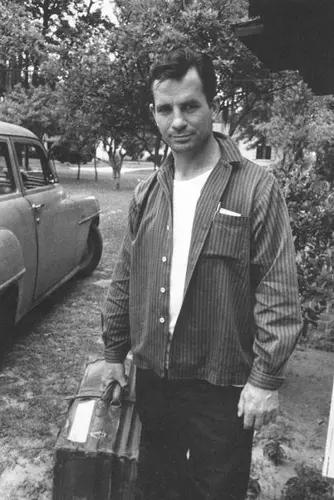
          Jack Kerouac is considered to be one of the most significant and influential writers of his generation. He was a primary figure of the Beat movement along with poet Allen Ginsberg and novelist William S. Burroughs.

          Kerouac was living in Orlando when he found out that his seminal novel “On the Road” was going to be published. The semi-autobiographical work follows narrator Sal Paradise as he travels across the country and into Mexico with Dean Moriarty and other friends as they indulge in drinking, drugs, and sex while being inspired by jazz music and the possibilities of adventure while traveling into the unknown.

          “Florida played a crucial role in Jack Kerouac’s career, especially because it represents his transformation from this 35-year-old nomadic nobody, this shy writer from Lowell, Massachusetts, to literally, the bard of the Beat Generation,” says Bob Kealing, broadcast journalist and author of the book “Kerouac in Florida: Where the Road Ends.”

          “He made his last edits to ‘On the Road’ here in College Park, in northwest Orlando. He also wrote his follow-up ‘The Dharma Bums’ here in the Historic Kerouac House, and his last prolific period was here in Orlando in 1957 and into 1958. He wrote dozens of letters and poems and he was finally seeing success, and it really energized him,” says Kealing.

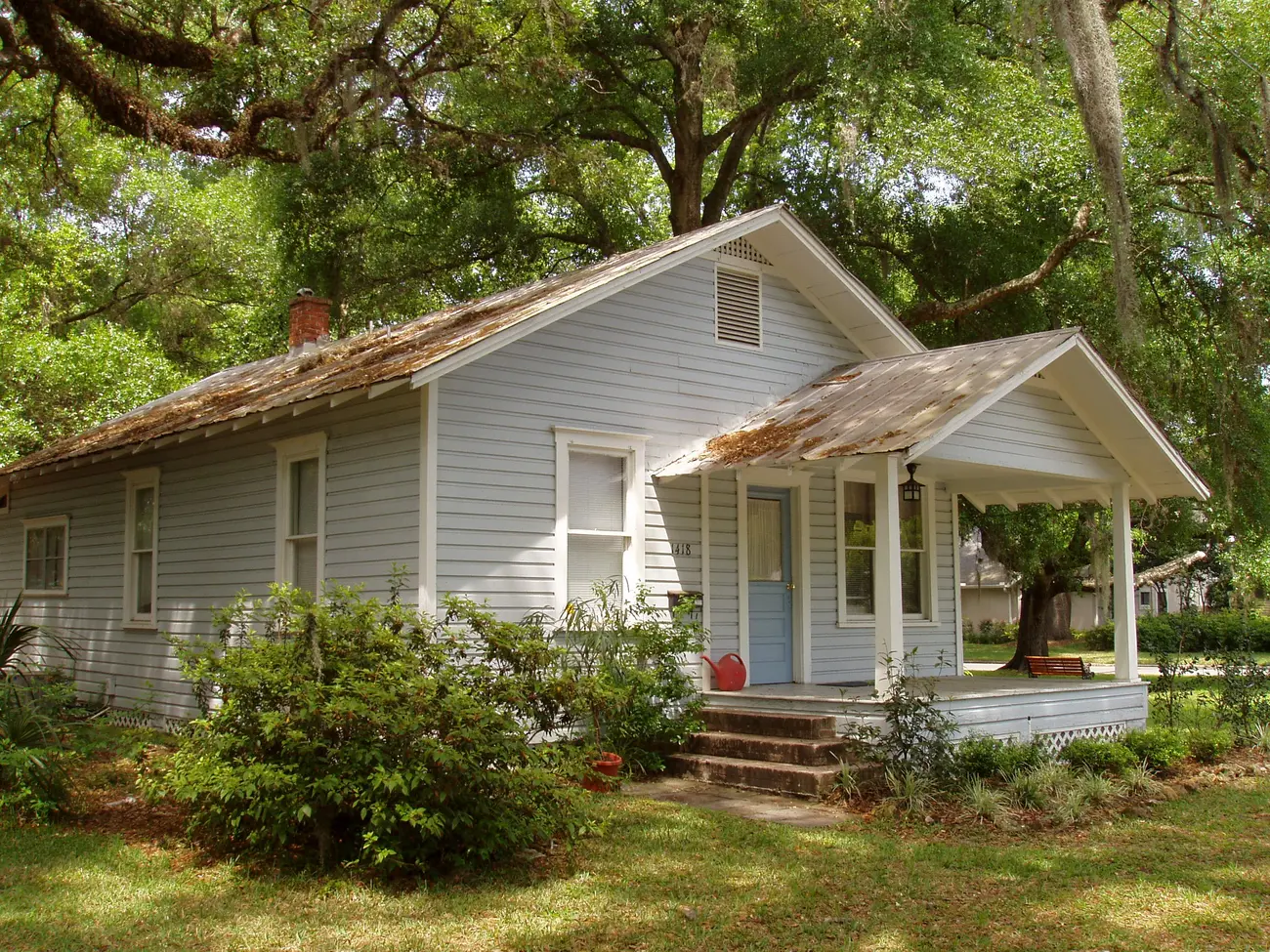
          Today, the Orlando home where Kerouac was most prolific is designated as an historic landmark, and functions as a temporary residence for aspiring writers.

          In the late 1990s, Kealing discovered that Kerouac had lived in the 1926 cottage at 1418 Clouser Avenue in Orlando. After leading the effort to save and refurbish the house, Kealing helped to establish the not-for-profit Kerouac Project in the fall of 2000, to provide three month residencies for promising writers. The writers-in-residence live rent free and are provided a stipend for food, so they can focus on their work.

          The Beat Generation writers are recognized as leaders of an American counterculture movement and influential precursors to the Hippies, but their work has not been universally embraced. Truman Capote famously criticized Kerouac’s free form style of writing, saying, “That’s not writing, it’s typing.”

          Bob Kealing points out that following World War II, the United States entered a period of prosperity characterized by a proliferation of prefabricated suburban communities. Soldiers returning from the war started families in these new neighborhoods, establishing a conventional, modern, “normal,” American existence.

          The Beat Generation was looking for something different.

          “There was a certain class of literary types, including Kerouac, including Ginsberg, who were looking for another path, if you will, a creative path. The Beats really freed up Post-World War II America to pursue non-traditional lifestyles, for better or worse, to celebrate the search for one’s own road,” says Kealing.

          Kerouac’s own search for fulfillment led down a rocky road. With the exception of his mother and last wife Stella, Kerouac’s alcoholism strained most of his personal relationships to the point of breaking. He had hoped to build a communal home in Orlando to include his sister Caroline and her family, but that never happened. Caroline died in 1964 and is buried in Orlando’s Greenwood Cemetery.

          Jack Kerouac died in 1969 at the age of 47, in St. Petersburg, Florida, but his work lives on.

          “Kerouac’s work, especially ‘On the Road,’ really is a love letter to the West, and to finding one’s own road out there,” says Kealing. “I think that’s why it resonates so much in the United States, but also around the world, because of this Romantic notion of travel and wanderlust, and seeing what’s out there. I think that’s why the Beats continue to strike a chord even around the world today.”

          Dr. Ben Brotemarkle is executive director of the Florida Historical Society and host of the radio program “Florida Frontiers,” broadcast locally on 90.7 WMFE Thursday evenings at 6:30 and Sunday afternoons at 4:00, and on 89.5 WFIT Sunday mornings at 7:00. The show can be heard online at myfloridahistory.org.
          PDF file(s)
          Article Number
          55
          relevantdate

            “Come in, and welcome to my home,” says an animatronic version of John G. Riley, talking to students at the Riley House Museum. The life-sized robotic figure speaks from behind Riley’s desk, hands gesturing, mouth moving, and eyes blinking as he tells visitors about Florida history.

            “I was just catching up on my passion, reading. You know there was a time when a man like me was not allowed to read. You see, I was born into slavery on September 24th, 1857, right here in Tallahassee.”

            John G. Riley was an educator and entrepreneur in Tallahassee’s African American community.

            “He lived to 1954, so he was 97 years of age,” says Althemese Barnes, founder and executive director of the Riley House Museum. “He lived to experience much change in those 97 years. After slavery, he chose to go into education. Of course, during slavery he was denied the opportunity to read and write, but he learned from some of his relatives who were literate.”

            Riley became principal of Lincoln Academy, the first African American school in Leon County that offered a secondary program. He served as principal for 33 years, from 1893 to 1926. During that time he also acquired a significant amount of real estate in downtown Tallahassee.

            At the beginning of the 20th century, Smokey Hollow was a thriving African American community with black owned businesses, schools, and churches. Smokey Hollow was destroyed through the use of eminent domain in the 1960s.

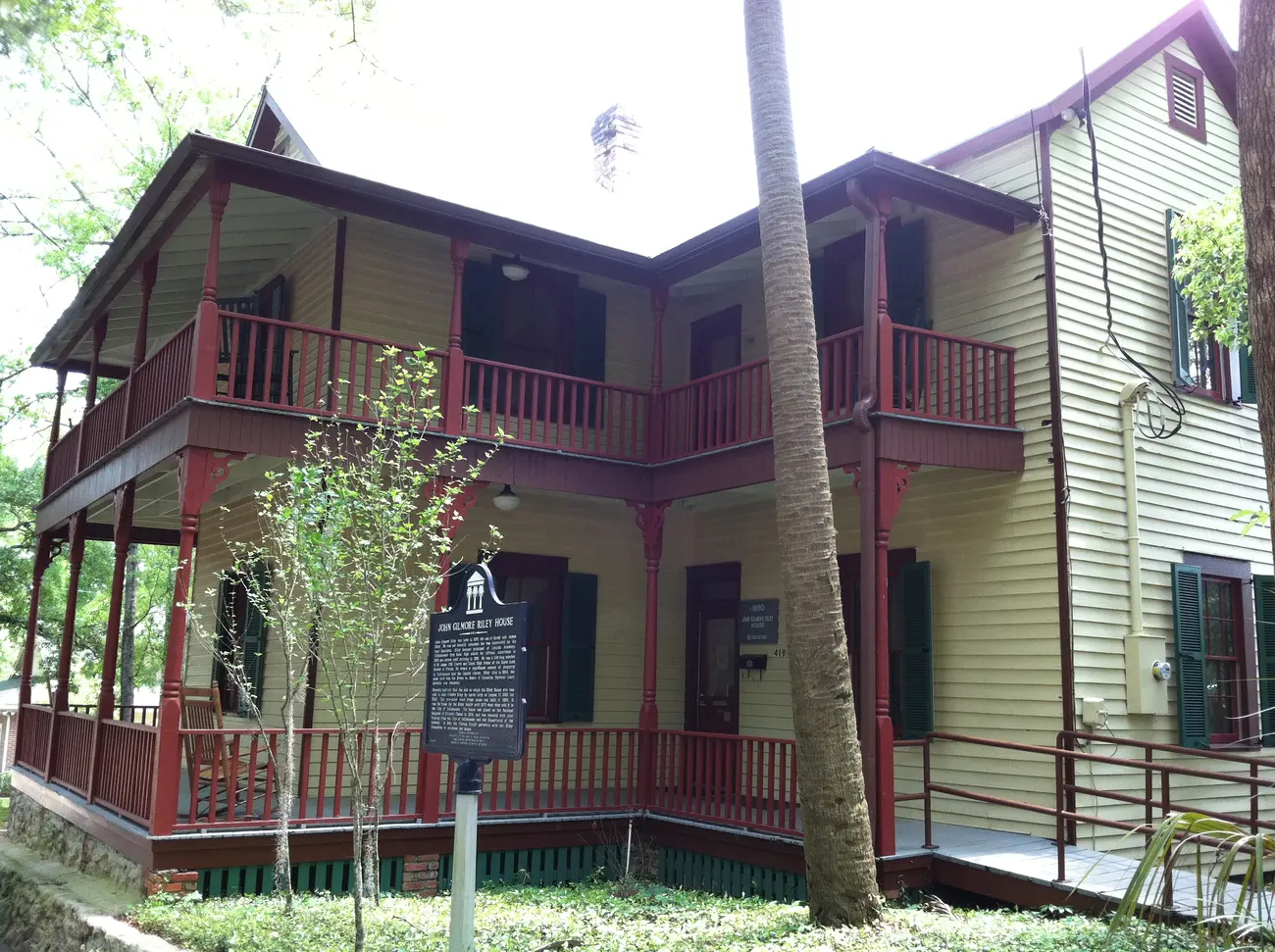
            Riley’s home, now a house museum, is the only existing structure that remains from Smokey Hollow.

            “During its existence, that was the time of legal segregation, so there were very independent black communities that evolved out of a necessity to survive,” says Barnes.

            “When blacks came out of slavery, there was a great passion for religion and education. So usually in most of these black independent communities, you would find a school and churches, and usually a cemetery attached to the church. So you had these enclaves where blacks lived and relied a lot upon each other to deal with the social issues of hostility and injustices and inequality that existed.”

            Like all of the other structures in the Smokey Hollow community, the Riley House was threatened with demolition, but because of its particular historical significance, it managed to escape the wrecking ball.

            Restoration of the home began in the 1970s, and it was placed on the National Register of Historic Places in 1978. The building opened as a house museum in the mid-1990s.

            “The house was almost lost,” says Barnes. “The city bought it for back taxes and the plan was to demolish it and erect an electric substation on this site. Some local citizens who knew all that Mr. Riley had contributed decided that shouldn’t be.”

            Funds were raised to purchase and refurbish the house, with the first restoration completed in 1981. The home was preserved but underutilized for 15 years.

            “The people who saved the house didn’t live long enough to do the second thing that they wanted to have happen, which was for it to be a museum to preserve African American history and promote history,” says Barnes. “When I retired, I decided to make this my philanthropic effort, and we started the museum in January of 1996.”

            Built in 1890, The John G. Riley House Museum is a two-story wood frame building on brick piers, with a gable roof and a brick chimney. In addition to period furniture from the late 19th and early 20th centuries, the museum has rotating gallery space and an adjacent building for public presentations.

            The goal of the museum is to educate all people about African American history and culture, and John G. Riley’s contributions.

            “One of my most important involvements, next to my job as principal and my church work at St. James CME,” says the Riley robot, “is working with Booker T. Washington and the Negro Business League throughout Florida to advocate racial uplift through economics and education, and promote racial harmony.”

            The John G. Riley House Museum is located at 419 East Jefferson Street in Tallahassee. Hours are Monday through Thursday, 10am to 4pm, Friday and Saturday, 10am to 2pm, and by appointment.

            Dr. Ben Brotemarkle is executive director of the Florida Historical Society and host of the radio program “Florida Frontiers,” broadcast locally on 90.7 WMFE Thursday evenings at 6:30 and Sunday afternoons at 4:00, and on 89.5 WFIT Sunday mornings at 7:00. The show can be heard online at myfloridahistory.org.
             

            PDF file(s)
            Article Number
            54
            relevantdate

              Brevard County history enthusiasts and fried fish lovers have a lot to look forward to this Saturday.

              The Fifth Annual Eau Gallie Founders Day and Fish Fry will be held February 7, from noon to 4:30 pm on Highland Avenue, featuring a History Tent, a variety of vendors, and live music. Evening activities begin at 6:00 with music provided by a series of DJs. The event is co-hosted by the Eau Gallie Arts District and Eau Gallie Rotary Club.

              The Fourth Annual Merritt Island Pioneer Day will be held on February 7, from 10:00 am to 4:00 pm, at Sams House at Pine Island and St. Luke’s Episcopal Church, both located on North Tropical Trail. The event features Living History Demonstrations, arts and craft vendors, live folk music, and a Fish Fry Dinner with seatings at 4:30 and 5:30.

              Following the Third Seminole Indian War in 1859, the U.S. Army sent John Houston to what would become Eau Gallie, to determine if any Seminoles remained there.

              “Houston fell in love with the area, received a soldier’s land grant, and settled his family here,” says Gene Davis, chair of the Eau Gallie Founders Day History Tent.

              What is now the back portion of the Rossetter House Museum in Eau Gallie is believed to originally have been quarters for the Houston family slaves. The Houston family cemetery is located just south of the Rossetter House on Highland Avenue.

              William Henry Gleason gave the town its name in 1860. The name Eau Gallie is believed to mean “rocky water.”

              “The area grew and Eau Gallie was incorporated in 1863, and was an independent city until 1969, when it merged with Melbourne,” says Davis.

              Caroline P. Rossetter moved to Eau Gallie in 1902 with her family. In 1921, at the age of 23, Rossetter took over her father’s Standard Oil Agency, becoming a successful businesswoman just months after women received the right to vote in the United States.

              The most famous resident of Eau Gallie was African American writer, folklorist, and anthropologist Zora Neale Hurston. She wrote Mules and Men, her most important collection of folklore there in 1929, and came back to live in the same cottage for much of the 1950s.

              Another early settler of Eau Gallie was John H. Sams, who established a homestead with his family in 1875.

              The 36 year-old Sams built a cabin for his wife and five children. For three years, he tried to establish a successful orange grove, but failed. He had no better luck with other crops he attempted to grow. In 1878, Sams decided to move his family to Merritt Island.

              Sams didn’t just pack up his family’s belongings to make the move north. He packed up the entire house itself.

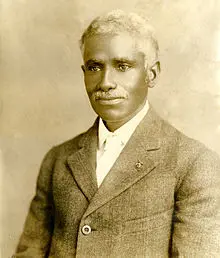
              In November 1878, Sams dismantled his three-room cabin piece by piece, placed the sections of his home on a raft, and floated it up the Indian River to Merritt Island.

              John H. Sams was a much more successful farmer on his new Merritt Island property, growing citrus, sugar cane, and pineapple crops.

              Today, the 1875 Sams Family Cabin serves as an education center in the 950-acre Pine Island Conservation Area, owned jointly by the Environmentally Endangered Lands (EEL) program and the St. Johns River Water Management District.

              “When you’re talking about the history of the property out at Sams House you’re talking about a big chunk of time,” says Kevin Gidusko, co-chair of Merritt Island Pioneer Day. “As far as human occupation goes, perhaps a few thousand years. You also have evidence of Ice Age megafauna.”

              Prehistoric artifacts are displayed in the Sams Family Cabin.

              The Sams family helped to establish St. Luke’s Episcopal Church, a congregation that remains active today.

              In 1880, John H. Sams was named the first Superintendent of Schools in Brevard County.

              By 1888, Sams built a new, two-story home directly adjacent to the original family cabin.

              “When you visit the property today you will see a bit of what life would have been like for the Sams family when they lived on the site,” says Gidusko.

              Both Eau Gallie and Merritt Island are providing opportunities to celebrate local history, and eat a meal of fried fish, this Saturday.

              Dr. Ben Brotemarkle is executive director of the Florida Historical Society and host of the radio program “Florida Frontiers,” broadcast locally on 90.7 WMFE Thursday evenings at 6:30 and Sunday afternoons at 4:00, and on 89.5 WFIT Sunday mornings at 7:00. The show can be heard online at myfloridahistory.org.
              PDF file(s)
              Article Number
              53
              relevantdate

                Henry Plant was extending his railway system into the small pioneer settlement of Tampa, Florida, in the 1880s. In addition to making Tampa more accessible by rail, Plant expanded the port and built luxury hotels in the area.

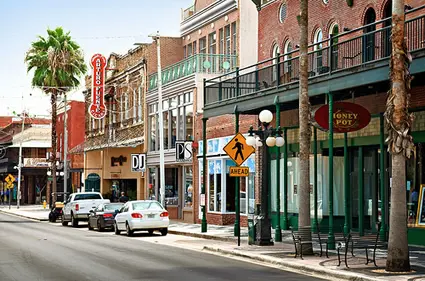
                This new infrastructure enticed Cuban businessman Vicente Martinez Ybor to move his cigar manufacturing operation from Key West to the Tampa area, establishing Ybor City.

                Ybor’s friend, Gavino Guitierrez, had suggested that the Tampa area would be a great place to build an expansive new cigar operation. After visiting Tampa, Ybor agreed.  “So he came up and he bought 40 acres, and started to lay out the plans for his cigar town,” says Elizabeth McCoy, curator of programs and education for the Ybor City Museum.

                As Ybor built his city based around cigar manufacturing, Henry Plant continued developing the Tampa area as well. Plant’s Tampa Bay Hotel, designed in a distinctive Moorish Revival style, is now the University of Tampa.

                Ybor established his town in 1885, and it was annexed by Tampa in 1887.

                “In a period of about one year, he created a grid for the city,” says Chantal Hevia, president of the Ybor City Museum Society. “He built housing for the cigar workers and then he brought them from Cuba and Spain, and ultimately from a couple of little towns in Sicily.”

                Although primarily populated by Cuban and Spanish cigar workers, Ybor City was a multi-ethnic community.

                “There were groups that came from Sicily, but there were also small groups from Germany and a Romanian Jew contingency that also found Ybor City and contributed to it,” says McCoy. “Not only in the cigar industry, but in the businesses that helped support the city.”

                When Stetson Kennedy traveled throughout Florida in the late 1930s and early 1940s collecting oral histories, he recorded interviews in Ybor City. In his book Palmetto Country, Kennedy writes about the unique community institutions of Ybor City, including mutual aid societies and social clubs.

                “They provided a social outlet and sense of community for the people,” says McCoy. “They also provided some other vital services; banking, medical services, and this was all done in a cooperative setting. When you paid your dues to be a member of the club, by virtue of doing that, you gained access to the hospitals and the pharmacies and the banking facilities.”

                In the early decades of the twentieth century, the hospitals associated with the two major Spanish mutual aid societies, El Centro Asturiano and El Centro Espanol, were deemed the most modern and well-equipped in the region.

                “It was cradle to grave service,” says Hevia. “The minute someone was born into a family they fell under the plan of the head of the household. This was for twenty-five cents a week. They would get not only health care, but the Spaniards alone had four cemeteries, Italians had their own cemeteries. You were taken care of. If you lost your job, they would come to your rescue. It was a great way to socialize with your own and be cared for in a new land that was probably inhospitable at first.”

                From the late 1800s through the first three decades of the twentieth century, the diverse residents of Ybor City thrived. A period of economic decline began in the 1930s. The city’s hand-rolled cigars had difficulty competing with less expensive machine-rolled cigars and the increasing popularity of cigarettes.

                After World War II, returning soldiers moved their families away from the urban center into newer housing developments. During the 1960s, many historic structures in Ybor City were demolished, some to make way for Interstate 4.

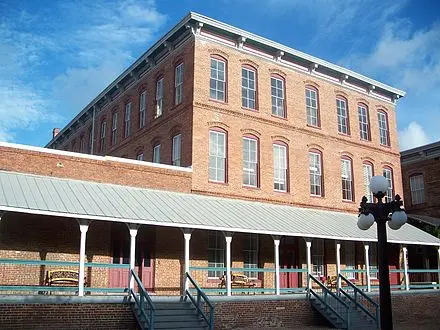
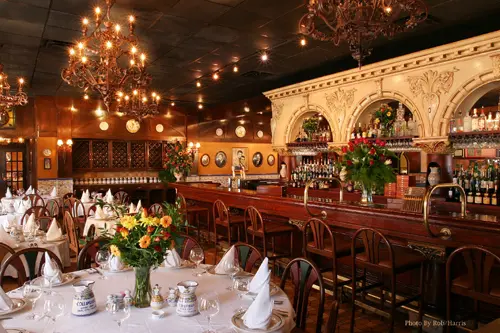
                One institution that held on through it all is the Columbia Restaurant, which opened in 1905. The Columbia is still an anchor for the community.

                “It brings a lot of tourism to Ybor City,” says Hevia. “We have a lot of other historic places where you can get traditional and typical foods, but it is the iconic one.”

                As historic preservation efforts emerged in the 1970s and ‘80s, Ybor City was revitalized. Many of the core elements that make the community unique have remained in place for more than a century, and can be experienced and enjoyed today.

                Dr. Ben Brotemarkle is executive director of the Florida Historical Society and host of the radio program “Florida Frontiers,” broadcast locally on 90.7 WMFE Thursday evenings at 6:30 and Sunday afternoons at 4:00, and on 89.5 WFIT Sunday mornings at 7:00. The show can be heard online at myfloridahistory.org.
                PDF file(s)
                Article Number
                52
                relevantdate

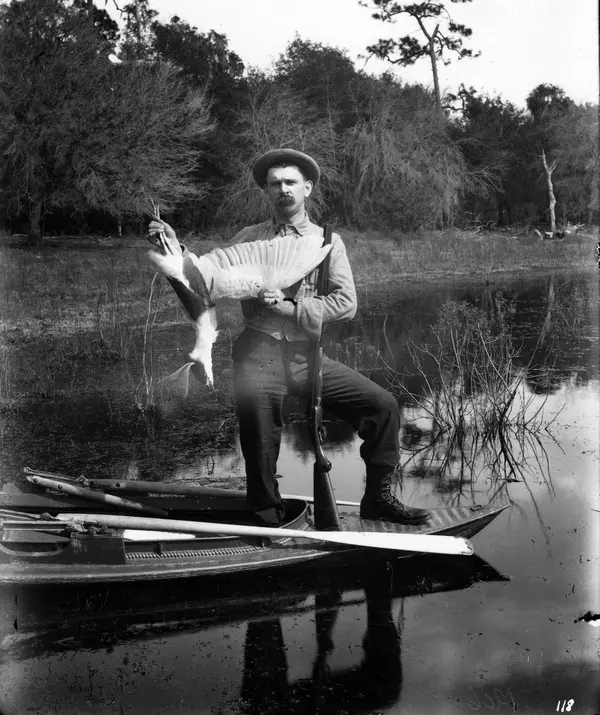
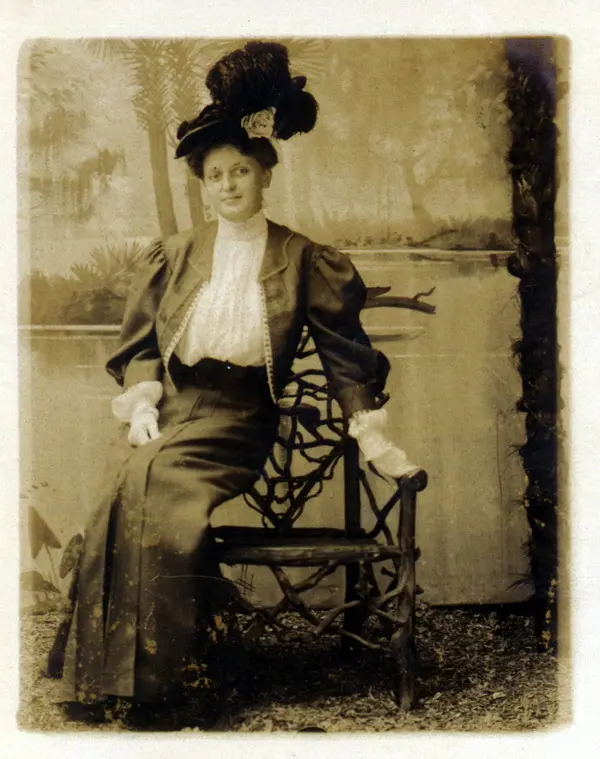
                  In the late 1800s, it was very fashionable for women to wear bird plumes, and even entire bird carcasses, on their hats. This fashion trend led to the beginning of the conservation and environmental movement in Florida.

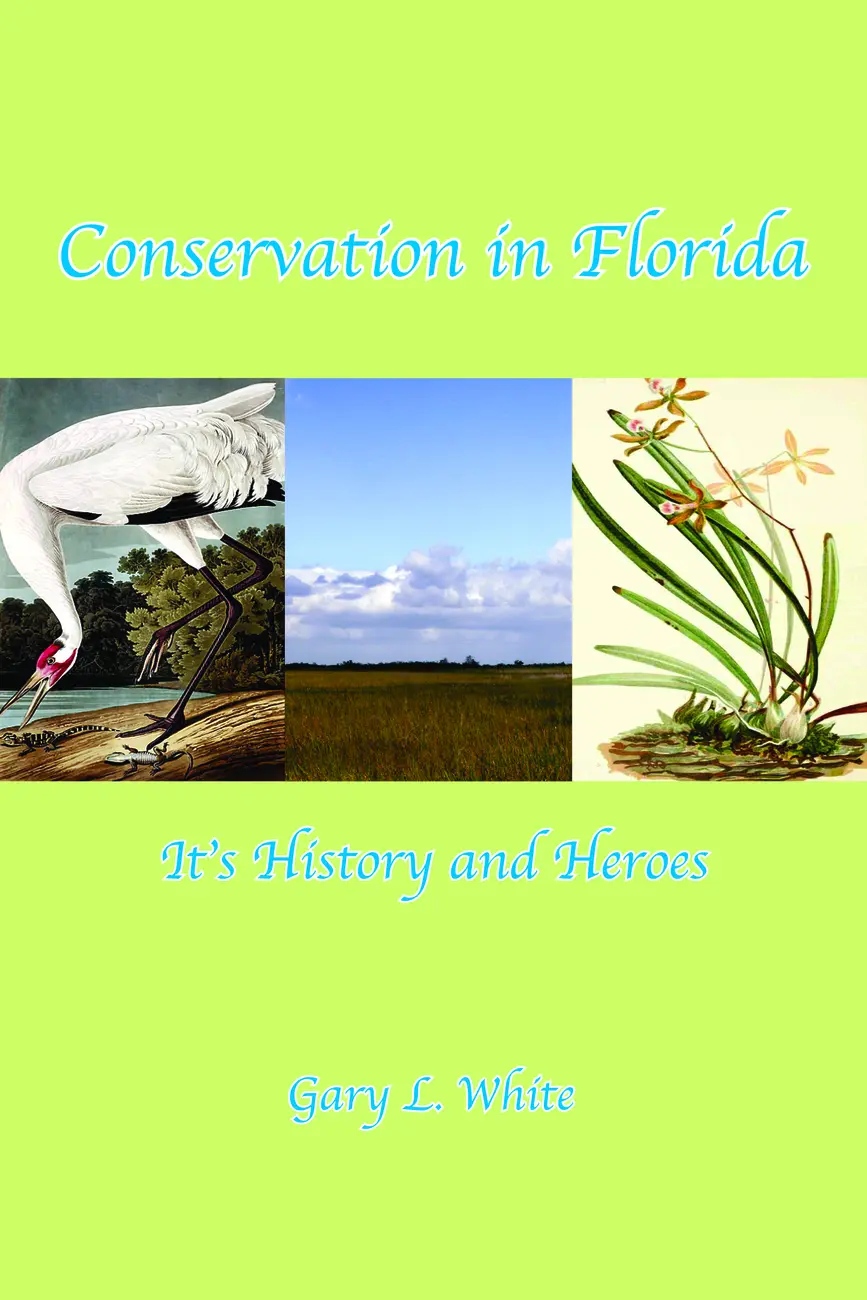
                  “The conservation movement in Florida began with a specific aim. It was a group of people who were alarmed about the fact that wading birds were being slaughtered in the Everglades for their feathers, which were sold to hat manufacturers in the North,” says Gary White, author of the book Conservation in Florida: Its History and Heroes.

                  “Since then, it’s broadened to include many other areas (such as) concern about invasive species, protection of the land itself; not only the birds and other wildlife but the land itself that they depend on for habitat. There’s much more understanding now of how certain species have to have a certain kind of habitat. So it’s broadened greatly over the past century or so.”

                  This week, thousands of conservationists, environmentalists, naturalists, bird watchers, and eco-tourists will converge on the Titusville campus of Eastern Florida State College for the 18th Annual Space Coast Birding and Wildlife Festival, presented by the Brevard Nature Alliance, January 21-26.

                  Saturday afternoon from 2:00 pm to 4:00 pm, Gary White will be signing copies of his book in the Exhibit Center at the festival.

                  “The organized conservation movement in Florida began March 3rd, 1900. That was the day that fifteen people met at a house in Maitland and decided they were going to create the Florida Audubon Society,” White says. “Their purpose was to bring attention to the slaughter of birds, because there were no laws at the time to protect wading birds in the Everglades, so one of their highest priorities was to push the legislature to enact laws that would protect birds.”

                  The Florida Audubon Society was successful. The Florida legislature passed a law protecting non-game birds in 1901. The popularity of plumed hats around the world, and the rampant slaughter of birds to meet that demand, had nearly led to the extinction of egrets and other birds in Florida. President Theodore Roosevelt established Pelican Island, Florida, as the first National Wildlife Refuge in 1903, to protect birds from plume hunters.

                  It was the Maitland home of Louis F. and Clara J. Dommerich where the Florida Audubon Society was founded. One member of the group was particularly persuasive when it came to convincing women to stop wearing plumed hats.

                  “Mary Munroe was the wife of a renowned nature writer, Kirk Munroe,” White says. “She met strangers on the street who were wearing hats adorned with bird feathers, which was extremely common at the time, and (would) lecture them on the cruelty that went into those feathers being on their hats. According to the early biographers, some of the women were so moved by what she said that they took off their hats and pulled off the feathers and changed their ways right there.”

                  From the work of naturalist William Bartram and ornithologist John James Audubon in the late 18th and early 19th centuries, to the most contemporary discussions of climate change and water use, Conservation in Florida: Its History and Heroes chronicles in detail the pivotal moments in our state’s environmental movement as it developed.

                  “After the original priority of enacting laws to protect birds, the next major stage was turning attention toward the preservation of the Everglades,” says White. “In south Florida there had been schemes for decades to drain the Everglades. Networks of canals were dug to try to dry it up so it could be used in a more valuable way. That process started in the 1920s and lasted about twenty years until in 1947, Everglades National Park was dedicated.”

                  Another milestone in the conservation movement was the successful effort to halt construction of the Cross Florida Barge Canal in 1971, after about a third had been built. Since the 1800s, attempts had been made to bisect the Florida peninsula with a canal across the state, which would have devastated both the St. Johns River and the Ocklawaha River.

                  The conservation and environmental movement continues today, and it all started with opposition to a misguided fashion statement.

                  Dr. Ben Brotemarkle is executive director of the Florida Historical Society and host of the radio program “Florida Frontiers,” broadcast locally on 90.7 WMFE Thursday evenings at 6:30 and Sunday afternoons at 4:00, and on 89.5 WFIT Sunday mornings at 7:00. The show can be heard online at myfloridahistory.org.
                  PDF file(s)
                  Article Number
                  51
                  relevantdate

                    The Key Marco Cat, a part feline, part human wood carving, is one of the most intriguing Native American artifacts discovered in Florida.

                    In 1896, archaeologist Frank Hamilton Cushing led an excavation on Marco Island that uncovered the six-inch-tall Key Marco Cat along with thousands of other Calusa Indian artifacts. The excavation was one of the first formal, organized archaeological expeditions in the state.

                    In addition to the Key Marco Cat, Cushing’s team excavated vibrantly colored ceremonial masks and other carved objects, identifying the Calusa as one of the most artistic tribes to inhabit Florida prior to European contact.

                    “Because they lived in this very rich environment with the estuary system, the fish was plentiful, the shellfish was plentiful, so they didn’t spend any time worrying about food,” says Craig Woodward, director of the Marco Island Historical Museum.

                    “They were not an agricultural tribe, they were able to get food (from the water), and had plenty of time to devote to artistic things, which is fascinating to us today.”

                    The Calusa artifacts discovered on Marco Island date from 300 AD to 1500 AD, prior to European contact in Florida.

                    Spanish conquistador Juan Ponce de León landed on the east coast of Florida and gave our state its name in 1513. When Ponce returned to southwest Florida in 1521, he was attacked by the Calusa and died from the wounds they inflicted.

                    Within about two centuries the Calusa were extinct, either having died from diseases brought by the Europeans, been captured as slaves, or been absorbed into the Seminole Tribe who arrived in Florida in the 1700s.

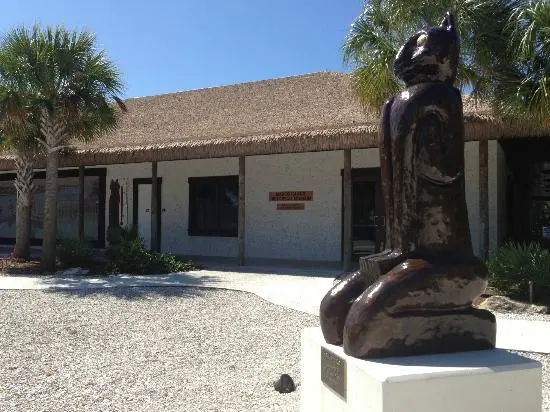
                    Created in 2010, the Marco Island Historical Museum is dedicated to remembering the Calusa. The museum campus was designed to have visitors walk through an interpretation of a Calusa village before they enter the museum.

                    “When you drive down the road, you look over and see a shell mound that’s been built, and we built an estuary system around the shell mound which lowers that area,” says Woodward. “We put cypress trees and native plants down there. Then on the shell mound you have a lagoon area which has a waterfall at one end and a fish weir at the other end, and a bridge crossing it to a chickee hut.”

                    The three large buildings of the museum complex are also designed to resemble a Calusa village. Taking a cue from Disney World, the museum designers used an extruded plastic product to create a thatched roof appearance, rather than actual palm fronds.

                    Woodward says that before visitors to the museum enter the main buildings, they walk from the present into the past.

                    “To get to the shell mound you have to cross the bridge from the parking lot, so you leave the modern world from the parking lot to the shell mound and enter a whole new world. We wanted to bring the inside out. So, unlike a regular museum where it’s all inside, a lot of our museum is outside, too.”

                    As visitors make their way through the village to enter the museum, they encounter a human size bronze sculpture of the Key Marco Cat, one of the most enduring symbols of the Calusa tribe. Inside the museum is a replica of original six-inch wooden figure.

                    “The Key Marco Cat is at the Smithsonian (in Washington, D.C.). It has come to Collier County twice,” says Woodward. “It was in Naples on display as a visiting item, and then it came to Marco Island. When it was at Marco, 18,000 people came to see it, so there’s a huge amount of interest in having it here.”

                    In an effort to have the Key Marco Cat permanently returned to the place it was found, the Marco Island Historical Museum contains a climate controlled cement structure with thick glass windows, specifically designed to house the unique artifact.

                    “The main part of the museum is dedicated to the Calusa, and hopefully, the items that we can get from that (Cushing) expedition,” says Woodward.

                    Some of the Calusa artifacts uncovered on Marco Island in 1896 are currently displayed at the British Museum in London, the University Museum of Philadelphia, and the Florida Museum of Natural History in Gainesville.

                    Dr. Ben Brotemarkle is executive director of the Florida Historical Society and host of the radio program “Florida Frontiers,” broadcast locally on 90.7 WMFE Thursday evenings at 6:30 and Sunday afternoons at 4:00, and on 89.5 WFIT Sunday mornings at 7:00. The show can be heard online at myfloridahistory.org.
                    PDF file(s)
                    Article Number
                    50
                    relevantdate

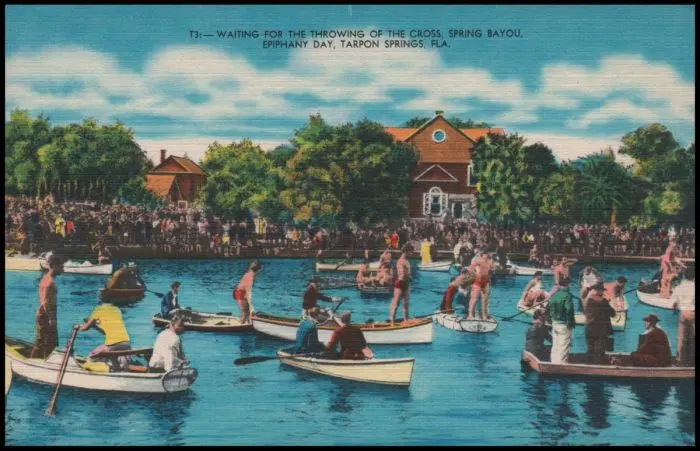
                      Since 1906, hundreds of people have gathered at the water of Tarpon Springs each January 6th to watch young men compete to find a submerged wooden cross. The unique Epiphany celebration is one example of the Greek culture that is still prevalent in Tarpon Springs.

                      In the city of Tarpon Springs you can listen to Greek music played on a bouzouki, try the pastry baklava, have a meal of lamb stew or a Greek seafood dish, sip the licorice flavored alcoholic beverage ouzo, and enjoy many other aspects of traditional Greek culture.

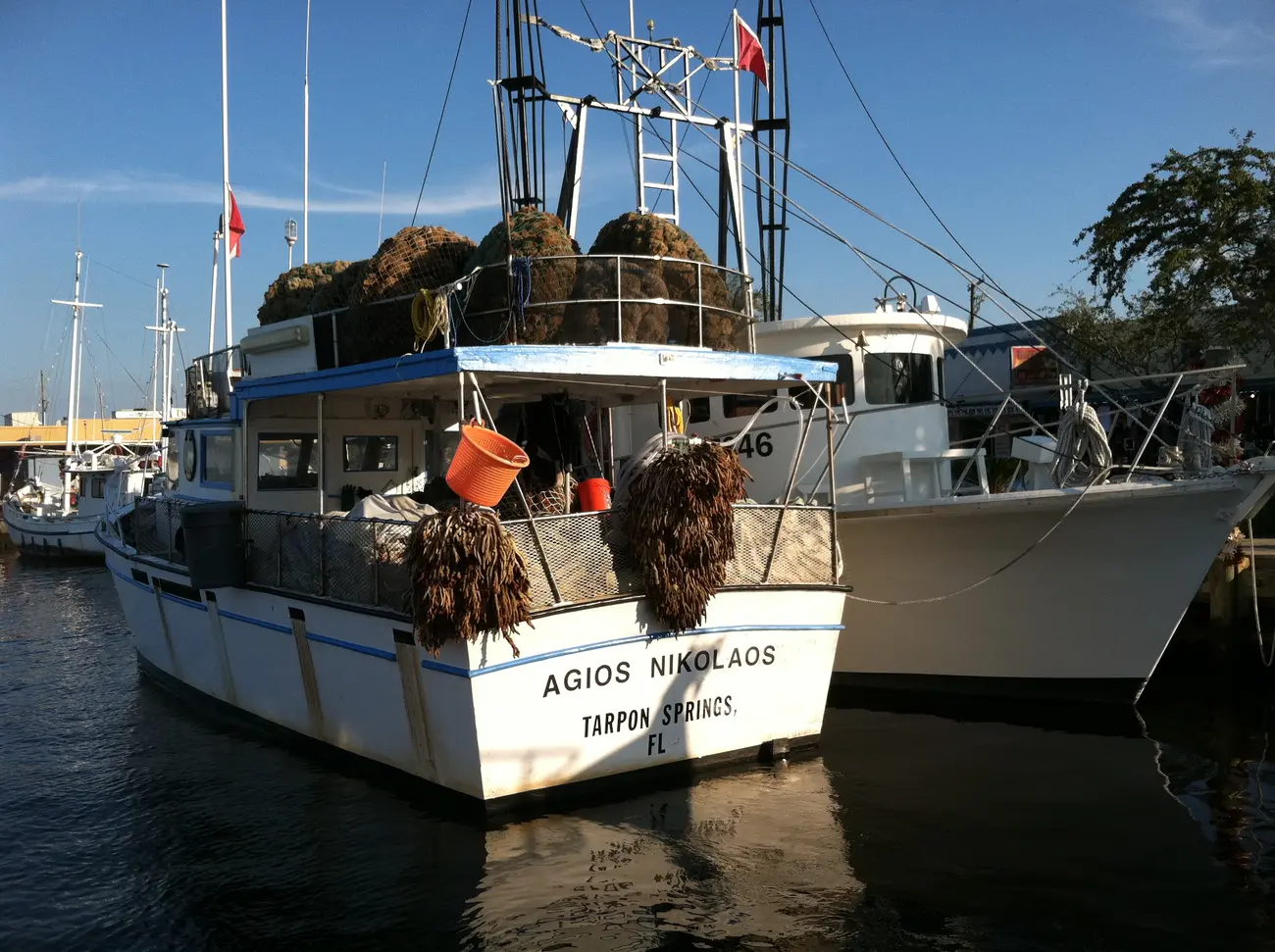
                      You can see the Neo-Byzantine style architecture of St. Nicholas Greek Orthodox Church, and watch the sponge divers unload their catch on the city dock downtown.

                      Tarpon Springs has the largest percentage of Greek Americans of any city in the United States.

                      “Even today, after people have been here four or five generations, there is still a big segment of the population that speaks Greek,” says Tina Bucuvalas, curator of arts and history for the City of Tarpon Springs.

                      When the first Greeks came to Tarpon Springs in 1905, a thriving town was already in place.

                      When Hamilton Disston bought 4 million acres of land for 25 cents per acre in 1881, it included the land that would become Tarpon Springs. To stimulate development, Disston brought businessman Anton Safford to Tarpon Springs.

                      The Victorian home that Safford lived in can be visited today. The Safford House Museum features period furniture and original family artifacts that present the home as it was in 1883.

                      The Orange Belt Railway came to town in 1887. The train depot is now a museum.

                      “The building we’re in was built in 1909 because the original railroad station burned down in 1908. This was restored in 2005,” says Sharon Sawyer of the Tarpon Springs Area Historical Society.

                      “The railroad was brought here by Peter Demens. He brought the railroad from Sanford to Tarpon Springs and then on down to St. Petersburg. Before the railroad came, everybody had to get here by boat or wagon, so the railroad in 1887 made a big difference here in town.”

                      It was the sponge industry that really put Tarpon Springs on the map.

                      By the mid-1800s, there was a thriving sponge industry in the Florida Keys, but by the early 1900s, Tarpon Springs was the largest sponge port in the United States.

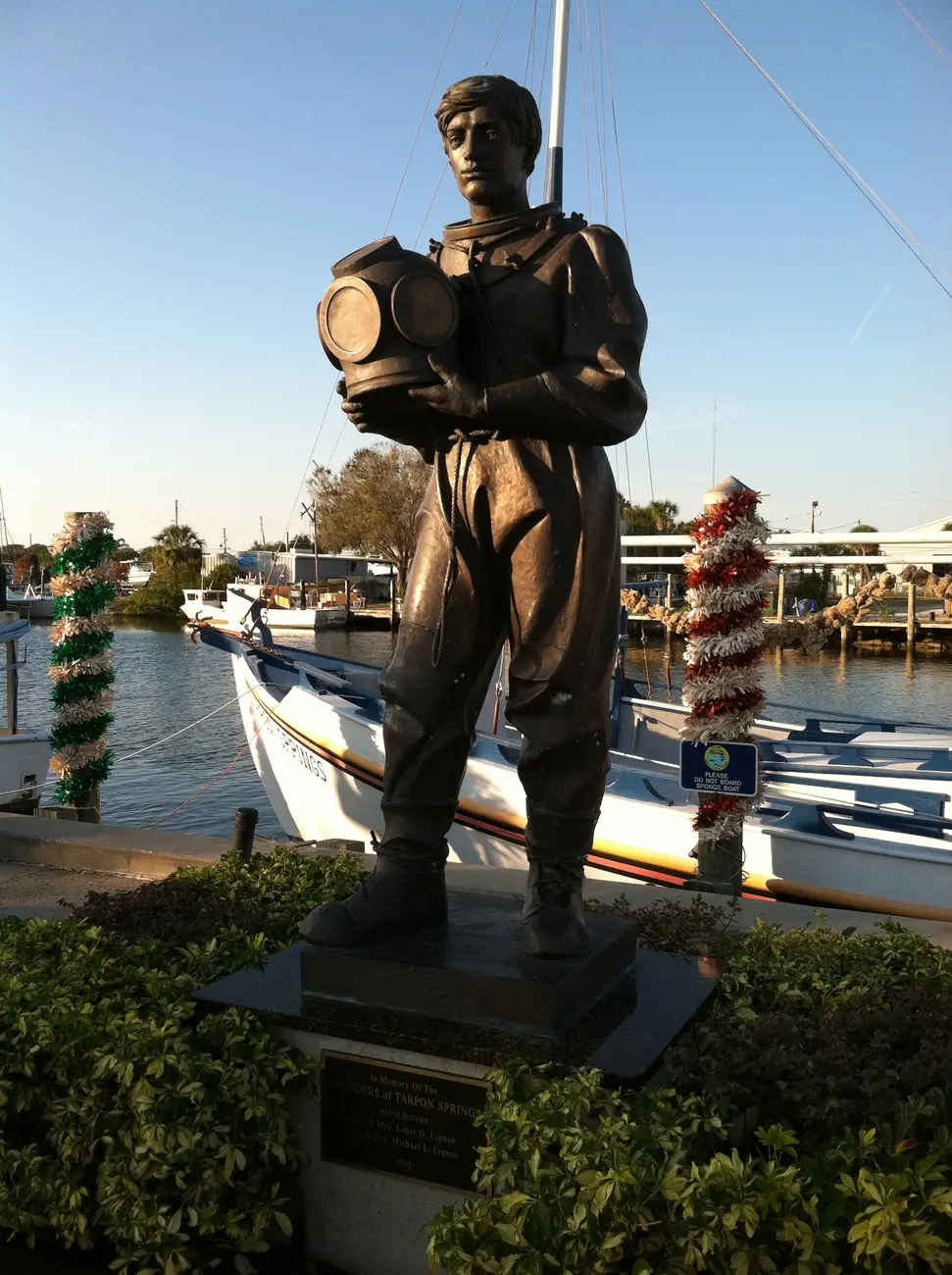
                      While sponges in the Keys were harvested with long poles, in Tarpon Springs, Greek sponge divers donned canvas suits with round metal helmets.

                      “John Cocoris realized that the way that sponges were harvested in Greece would produce far more than the hooking methods they were using in Florida,” says Tina Bucuvalas.

                      “They brought over Greeks. At first 500 came in 1905, and then within a couple of years there were 1,500, and there were a lot of boats. It very quickly made Tarpon Springs the Sponge Capital of the World. Tarpon Springs was a big, important town at a time when St. Petersburg was a wide spot in the road.”

                      With the large influx of Greek sponge divers and their families to Tarpon Springs, businesses and institutions to serve them were established, including restaurants, grocery stores, bakeries, and coffee houses.

                      Today, Tarpon Springs retains a distinctive European flavor.

                      “They get up in the morning and have Greek food, and sweep out their courtyards which have various plants you might see in Greece,” says Bucuvalas. “They’ll have their coffee outside. The old ladies in their head scarves will be going over to St. Michael’s Chapel or St. Nicholas, or down to the bakery.”

                      St. Nicholas Greek Orthodox Church was constructed in 1907 and expanded in 1943 with marble imported from Greece.

                      The unique Epiphany celebration held each January 6th attracts people from around the world. Following a ceremony at the church, the congregation walks to the sponge docks downtown, where a wooden cross is thrown into the water. The young man who retrieves the cross is believed to bring special blessings to his family for the year.

                      The Patriarch of Constantinople, the Greek Orthodox equivalent of Catholicism’s Pope, came to Tarpon Springs in 2006 for the 100th anniversary of the town’s Epiphany ceremony.

                      Dr. Ben Brotemarkle is executive director of the Florida Historical Society and host of the radio program “Florida Frontiers,” broadcast locally on 90.7 WMFE Thursday evenings at 6:30 and Sunday afternoons at 4:00, and on 89.5 WFIT Sunday mornings at 7:00. The show can be heard online at myfloridahistory.org.
                      PDF file(s)