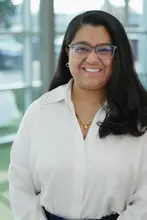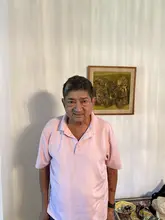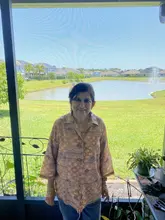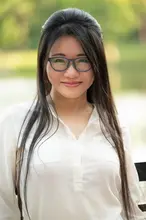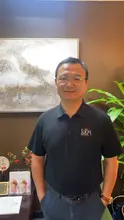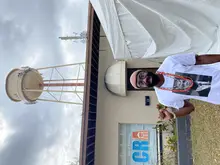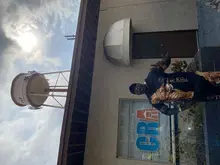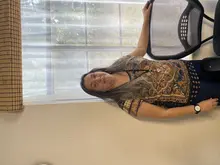
Adriana Collado was born in Havana, Cuba, in 1966. Seven years removed from the start of the Cuban Revolution, Adriana recounted her upbringing in a society transitioning from a capitalistic free model to a communist oriented world. She emphasized how the state forced children to prioritize the leader and follow politics more than anything, including their own families. The idea of the Revolution enticed her parents to stay on the island, as promises of improved healthcare enamored her psychiatrist father, and covering such an unprecedented political and social experiment attracted her journalist mother. Adriana ultimately assumed both her parents’ careers, first attempting psychiatry by attending medical school in Cuba. She explained how the 1983 US invasion of Grenada—in which the Cuban regime claimed as their territory—marked her “wake-up call,” as the government expelled her medical student classmates for opposing the state’s decision not to return the Cubans who resided in Grenada, which included the students’ parents. Discontent with this incident, Adriana left medical school and transitioned into studying journalism in Cuba. She recalled a particularly unique experience in which she confronted Fidel Castro and the Cuban state during a meeting in which she and other journalist students questioned media practices and standards in a communist society. In 1990, Adriana fled the island for fear of persecution since she spoke against the regime during that meeting. She emigrated to New York and lived there for the next fifteen years. She recollected memories about 9/11 and her experiences working in several Spanish newspaper outlets. In 2005, Adriana moved to Orlando to join the Spanish division of the Orlando Sentinel. In 2017, Adriana returned to school to fulfill her lifelong passion of working in the field of psychology/psychiatry. Adriana shared her two-decade observations of Orlando’s changing cultural and ethnic landscape. She underscored the “Other-ing” process she experienced in Orlando and the profound nuances that most immigrants deal with in navigating different societies and cultures and their own fluid identities within them.
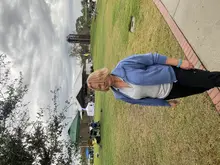
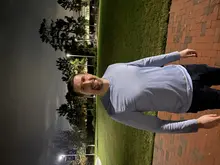
Roksalana Cisyk was born in Ukraine, at the time the former Soviet Union, in 1969. She recounted her experiences growing up in the former Soviet Union. Roksalana shared how her worldview on the United States changed once her aunt, who lived in the US, brought items from the capitalist society. She visited the US several times and permanently emigrated to the country in 1994, three years after Ukrainian independence. Roksalana studied applied mathematics in Ukraine and worked for a major corporation that accredited medical institutions in Chicago. She placed the former Soviet Union’s model of education, particularly in applied mathematics, higher than what she experienced in Chicago. Roksalana and her family moved to Florida in 2008 for personal and familial reasons. She discussed her involvement in the Ukrainian Project Incorporation, the same organization that hosts the Annual Ukrainian Festival in Orlando (where the oral history took place), and how it remains intimately connected with the Russo-Ukrainian War. In 2024, Roksalana returned to Ukraine after fifteen years, and she described the war conditions she observed. Lastly, she outlined her experiences living in Central Florida generally for the past seventeen years.

Volodymyr Chornyy was born in Ukraine in the former Soviet Union in 1981. Volodymyr recalled his experiences growing up in the former Soviet Union, particularly how education changed after the USSR fell in 1991. He fondly remembered the Ukrainian independent spirit of the 1990s, while also emphasizing the economic difficulties many families faced during this transition. Volodymyr studied medicine in Ukraine and shared his professional experiences working as a doctor, particularly in the country's rural regions. In 2007, Volodymyr emigrated to the United States for better educational and career opportunities. He underwent medical residency in New York, finishing his specialization in nephrology at the University of Florida in Gainesville in 2015. Since he attended medical school in Ukraine and the US, Volodymyr compared how medical practice differed between the two nations. In addition to sharing his general observations living in Central Florida, Volodymyr discussed extensively the Apopka branch of the Ukrainian American Youth Association that he co-founded in 2024, and its immense cultural significance for the younger generations who are both Ukrainians and Americans. Lastly, Volodymyr explained his connections with the Annual Ukrainian Festival Vatra Orlando (where the oral history took place), its importance, and the ongoing Russo-Ukrainian War.

Priyanka Chandra Sen was born in Orlando, Florida, in 1994. She recounted her upbringing, particularly her experiences navigating her dual American and Indian identity, from her parents maintaining Indian cultural norms at home while attempting to assimilate her within American society, to her own cultural encounters throughout her K-12 education in Orlando. She specifically remembered how she and the other few Indian girls tried to match a particular “American” aesthetic in an attempt to fit in. In 2013, Priyanka attended the University of Central Florida, initially studying pre-law and finance and switching to social media marketing. In this retelling, Priyanka emphasized the cultural stereotypes regarding professional careers and how she overcame them. After graduating from UCF in 2017, Priyanka worked for several companies in varied social media management positions, including Disney, NBC, and Give Kids the World Village. In addition to explaining the similarities and differences in approaches and skills with each job, Priyanka assessed more broadly the social media landscape and its cultural impact, especially important considering that she studied and worked during a decade in which the medium experienced rapid changes (c. 2010-2025). In 2014, Priyanka joined the Asian Cultural Association (ACA), describing how her role has shifted from photographing events to, at the time of the recording, serving as the director of marketing for the organization. She outlined the importance of the ACA for the Indian community in Orlando. Priyanka also discussed broader cultural changes and continuities in Orlando since the early 2000s.

Subhash Chandra was born in Farrukhabad, Uttar Pradesh, India, in 1944. He recalled how India’s independence in 1947 affected his earlier years and his family more broadly. In addition to the challenges brought with independence, Subhash remembered the financial difficulties his family experienced during his childhood. A fascination with American society and culture, learned through films and word of mouth, and a desire to complete his higher education in the United States prompted him to leave India in 1968. Subhash discussed the similarities and differences between his pre-departure conceptions of the US and what he observed upon arrival at the University of Cincinnati. He specifically emphasized how the larger racial issues during the late 1960s and early 1970s and the Vietnam War conflicted with his idea of America standing as the “most advanced nation in the world.” As a result, Subhash connected with several Civil Rights leaders during this time. Conversely, however, Subhash recounted his amazement when seeing a professor lunching with a janitor, and how that never happened in India as a result of the rigid caste system. In 1974, Subhash graduated from the University of Cincinnati with a doctorate in engineering. In 1978, Subhash fulfilled his intentions of returning to India after completing higher education in the United States. Academic politics in India, however, soured his homecoming, and he returned to the US permanently in 1980. After decades of working with several companies in Connecticut as an R&D engineer, Subhash moved to Orlando, Florida, for his retirement in 2015. Through the Asian Cultural Association (ACA), Subhash connected with the Indian community in Orlando, serving as the organization’s president at one point. He outlined his motivations for serving in the ACA and the importance of its mission more broadly in Central Florida. Lastly, Subhash shared his observations about Florida, highlighting the state’s continuities and ruptures over the past decade, specifically underscoring political concerns and how pivotal the contemporary moment (c. 2025) will prove to be for Florida and American history.

Madhu Chandra was born in Allahabad, Uttar Pradesh, India, in 1947. She recollected memories of her upbringing, particularly how frequently her family moved from various cities across India, given her father’s position in government. Born a few months into the Partition, Madhu remembered stories that her family passed down during her childhood years after the freedom movement ended. She recounted how the event impacted her family specifically and India more broadly at the time. Educational opportunities and reuniting with her husband prompted Madhu to emigrate to the United States, specifically Cincinnati, in 1969. She drew on her childhood experiences of constant relocation during this period of adjusting to a new life in America. Madhu worked in a medical lab at the University of Cincinnati, primarily to alleviate the financial difficulties that she and her husband experienced during this time. Madhu recalled her amazement with the liberal atmosphere at the university during the early 1970s, particularly the anti-Vietnam War and “hippie” movement, and how it compared to her time in India. Madhu explained that she did not need to fully integrate herself into American society, as she and her husband had always intended to return to India after completing their higher education in the United States. In 1978, Madhu returned to India, where work politics quickly soured their experience, leading to Madhu and her family leaving India permanently in 1980. After decades of working in Connecticut for Deloitte in tax services, Madhu moved to Orlando, Florida, for her retirement in 2015. She discussed the cultural differences between living in Connecticut and Florida. Through the Asian Cultural Association, Madhu connected with the Indian community in Orlando, teaching North Indian classical music. She emphasized the significance of music in culture and her role in teaching music to the next generation of Indian Americans. Lastly, Madhu shared her observations about Florida, highlighting her concerns about current statewide and national politics (c. 2025).

Puxiao Cen was born in Guangzhou City, China, in 1968. She recounted her upbringing, particularly her father’s crucial influence in developing an affinity for medicine, as well as her understanding of the centrality of self-critical thinking and questioning while living under the Chinese communist regime during the 1970s and 1980s. In addition to recollecting stories from the Cultural Revolution, Puxiao described witnessing the 1989 Tiananmen Square Event and participating in a student protest while attending Sun Yat-sen University of Medical Sciences. Chinese ideologies about capitalist societies conflicted with her lived experience, prompted her to emigrate to the United States, specifically to New York City, in 1992. 

Xiongwei “Will” Cao was born in Hangzhou, China, in 1977. Will recounted his upbringing, particularly the economic challenges his parents faced as poor communal farmers. He shared stories that his family passed down regarding China’s Cultural Revolution from 1966 to 1976, particularly how the Red Guards tortured his great-great maternal grandmother to death for her “superstitious” medical practices. Will also remembered how the educational curriculum that he learned in primary and secondary schools reflected the transition from the Cultural Revolution to China’s economic liberalism under Deng Xiaoping by the mid-1980s. Additionally, Will recollected memories from the 1989 Tiananmen Square incident, and it affected his parents' arrival home that day. He also reflected on the radio’s role as the chaos unfolded, particularly through BBC and Voice of America (VOA) broadcasts. In 1997, Will attended college, studying English with the hope of working as a reporter, inspired by the BBC and VOA broadcasts he had listened to during his childhood. His deeper passion, however, lay in medicine, and Will explained his sources of inspiration and how he managed to create the Lang Acupuncture Wellness Center, an acupuncture practice in Orlando, Florida, rooted in traditional Chinese medicine. Before practicing medicine, he served in the Inter-Parliamentary Relations Department in China's National People's Congress, representing the country on the world stage and promoting relations with other countries. Environmental concerns, namely heavy pollution, prompted Will to leave China and emigrate to Orlando, Florida, in 2013. Additionally, Will received a scholarship to attend a doctoral program in International Relations at the University of Central Florida, furthering his decision to leave China. In August 2024, Will created the Lang Acupuncture Wellness Center, detailing his underlying reasons. Lastly, Will described his broader observations about Central Florida since 2013, including his connections with the Chinese community, environmental changes over the twelve years, and contemporary challenges the region faces (c. 2025).

Aquanza Cadogan was born on September 20, 1981, in East Flatbush, Brooklyn, New York. At around eight years old, Aquanza and his family moved to Pine Hills, Florida. From East Flatbush, where many West Indian cultures resided (Aquanza’s parents are originally from Georgetown, Guyana—located in South America), Aquanza recalled his difficulties adjusting to Pine Hills. He attended the University of Florida and explained how his college experience remains another “cultural shock” as it widened his worldview. Aquanza shared his perspectives on race relations since his formative years in the 1990s, notably how the death of Trayvon Martin in Sanford, Florida, in 2012 prompted his path toward Black activism, currently materialized in his company, “Time Capsule for the Culture.” In that vein, Aquanza viewed the Zora Neale Hurston Festival of the Arts and Humanities as a central space for the Black community, particularly younger Black people, to understand the importance of Black art, culture, and agency.

Drasa C. Brown was born in Orlando, Florida, on March 30, 1976. He remembered growing up in Orlando during the 1980s and early 1990s, particularly how central Christianity proved for his family and attending Edgewater High School. Drasa also shared his incarceration experience and how transformative it remains for him. He explained what drew him to attend the 2025 Zora Neale Hurston Festival of the Arts and Humanities, highlighting its significance and how the festival has changed even in recent years. As a lifelong resident, he briefly discussed how Orlando has changed generally and within a racial context specifically.