1992 - Between 4:00 and 5:00 a.m. on this date, Hurricane Andrew struck South Florida with winds of 145 mph. Some gusts of 164 to 175 mph were recorded. Andrew was one of only three category 5 hurricanes to hit the United States. As it made its way across the state, the wind velocity dropped to 125 mph, but soon elevated to 145 mph when the storm entered the Gulf of Mexico. Andrew exacted a heavy toll in human life (more than 40 persons) and in physical damage. Up to one-quarter million people were left temporarily homeless in the Miami-Dade area alone.
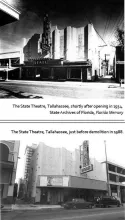
1988 – The State Theatre, located on the north side of College Avenue between Monroe and Adams in Tallahassee, was demolished on this date. The theatre opened in 1934 and closed in 1971. The building was designed in Art Deco style, including a stylish marquee that reached across the entire front of the building, five sculpted panels on the facade, and a two-story tall vertical sign. It was actually the Second state theater on this site (the first burned down) and was built for the Sparks Theatres chains.
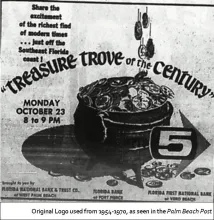
1954 -WJNO TV channel 5 (NBC) in Palm Beach began broadcasting on this date. Switched call letters to WPTV on Nov. 6, 1956, after John H. Phipps bought the station. According to the Palm Beach Post, “Channel 5 went on the air as WJNO-TV, with some partial ownership of radio station WJNO. Studios in Palm Beach in the old “slat-house” on Coconut Row. Later ownership change to Scripps-Howard and changed to WPTV.”
1972 - National Convention of the Republican Party of the United States was held from August 21 to August 23, 1972 at the Miami Beach Convention Center in Miami Beach, Florida. It nominated the incumbents Richard M. Nixon of California for President and Spiro T. Agnew of Maryland for Vice President. The convention was chaired by then-U.S. House Minority Leader and future Nixon successor Gerald Ford of Michigan. The convention was targeted for widespread protests, particularly against the Vietnam War, and the Nixon administration made efforts to suppress it. The U.S.
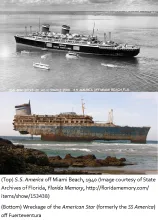
1940 - The SS America stopped at Miami on her maiden voyage as the flagship of the United States Line on this date. The SS America would be commissioned as a troop transport ship shortly after this voyage on May 28, 1941. The newly named USS West Point would go on to transport over 350,000 troops and personnel in both the Atlantic and Pacific theaters, more than any other U.S. Navy troop transport ship during WWII. After the war the SS America would once again carry civilian passengers until it wrecked in the Canary Islands in 1993.
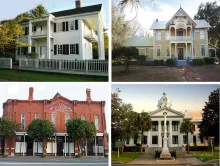
1977 - The Monticello Historic District is designated as a U.S. Historic District on this date. Located in Jefferson County, the district includes an irregular area of 27 blocks along Madison, Jefferson, Dogwood, and Washington Streets and contains 41 historic buildings.
1821 - The Floridian, the first newspaper in Northwest Florida was established on this date. Initially published by Nicholas & Tunstall, the first issue ran on August 18, 1821, with an account of Florida's transfer to the United States. The second page contained Andrew Jackson's proclamation to territory residents and a letter to troops. The paper was bilingual, with an English version in the left-hand column and a Spanish version on the right. Publication stopped in 1822 due to financial issues.
1966 - Pioneer 7 satellite was launched from launch complex 17A at Cape Canaveral on this date. The launch vehicle was Thor-Delta E-1. Pioneer 7 was the second in a series of solar orbiters designed to measure, from widely separated points in space on a continuing basis, interplanetary phenomena such as the Sun's magnetic field, the solar wind, and solar and galactic cosmic rays. In 1986 the Pioneer 7 satellite flew within 12.3 million kilometers of Halley’s Comet and in 1995 it was successfully tracked with one scientific instrument still functioning.
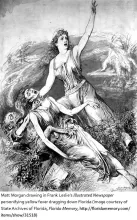
1898 - The order was given to evacuate Key West because of a possible outbreak of yellow fever on this date. All military personnel were ordered out of the city, including the wounded in Convent Hospital. Yellow fever, spread by mosquitoes, swept through many of Florida’s metropolitan areas in the late 19th and early 20th centuries, including a particularly bad epidemic that hit Jacksonville in 1888.
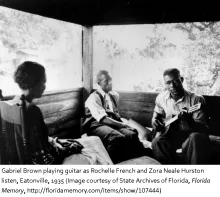
1887 - The Town of Eatonville was established as the FIRST Incorporated African-American municipality in the United States on this date. Located just three miles from downtown Orlando, Eatonville was named after Josiah Eaton, a white landowner who along with Lewis Lawrence donated the property that would become Eatonville.