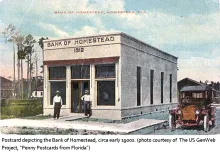
The Bank of Homestead was robbed by the Rice Gang on this date. Four men, Leland Rice, Frank Rice, Hugh Alderman and Jim Tucker made out with $6,500 from the bank and fled into the Everglades. A two week manhunt ensued eventually leaving Leland Rice and Jim Tucker dead, as well as two deputized Dade County Sheriffs, brothers William and Allen Henderson. Hugh Alderman and Frank Tucker were eventually apprehended and sentenced to life in prison for the murders. Alderman served 63 years, dying in prison in 1983.
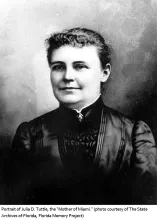
Julia DeForest Tuttle, the “Mother of Miami” died on this date. Mrs. Tuttle first came to the Biscayne Bay area in the 1870s when she was in her 20s to visit her father. Born in Cleveland Ohio on January 22, 1849, and married to a wealthy ironworks magnate in her mid-20s, she returned to Miami to live permanently after her husband’s death in 1891. She bought a parcel of land on the north side of the Miami River and saw great promise in the development of her land into a town.
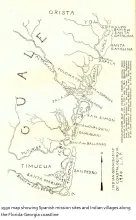
Father Pedro de Corpa, a Franciscan mission priest, was killed on this date by Guale Indians during a revolt at the Tolomato mission in northeast Florida (now southeast Georgia.) The Spanish mission system in Florida and Georgia was originally designed only for the conversion of Native Americans to Christianity, but they became important centers for interaction between Europeans and Native Americans. By the beginning of the 18th century however, most of the Spanish missions in the interior of Florida were abandoned due to the decline and relocation of Native American groups
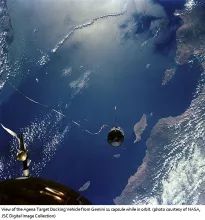
The Gemini 11 rocket lifted off from Kennedy Space Center on this date, landing in the Pacific on September 15th. The two man Gemini crew of Pete Conrad and Richard Gordon completed 44 revolutions of the earth and two EVAs (Extra Vehicular Activities). The crew also achieved the Gemini record for highest altitude at 739.2 nautical miles from the earth. This was the second to the last mission of the Gemini program.
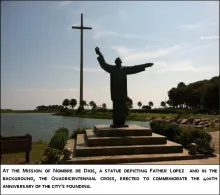
1565 – The city of St. Augustine was established on this date. Pedro Menéndez de Avilés sighted land on August 28. He named the site San Augustin after Augustine of Hippo. Menéndez sailed through the inlet into Matanzas Bay and disembarked near the Timucua town of Seloy on September 7. When Menéndez and his men came ashore, a mass was held by Father Francisco Lopez. St. Augustine would go on to become the oldest continuously occupied European settlement in what would become the United States. The event is memorialized at The Mission of Nombre de Dios.
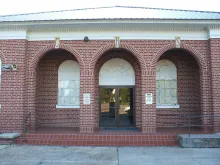
1962 - The Spanish Trail Playhouse opened its curtains for the first time with “Southern Exposure”. The idea for the Spanish Trail Playhouse started when four locals had a dream of bringing live theatre into the little town of Chipley Florida. In the fall 1968, after 7 seasons, the theater closed its curtains for the last time. In August of 2006, a campaign was started to revive the defunct Playhouse. Less than three years later, after fundraisers and renovations, the Spanish Trail Playhouse reopened in its new permanent home, the Historic Chipley High School Auditorium
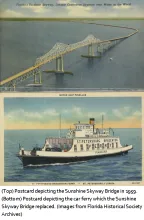
1954 - Governor Charley Johns presided over the opening of the two-lane Sunshine Skyway toll bridge over Tampa Bay. This bridge was Florida’s highest when it was opened. On May 9, 1980, a phosphate carrier toppled the main span of this bridge, causing 35 people to plunge to their deaths. A new bridge was constructed (1982-1986) to replace it. (Cost-$244 million!) The vertical clearance of the latest bridge is 175 feet and spans more than 1200 feet of water.
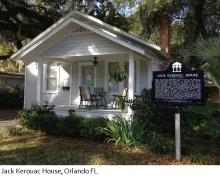
1957 - The novel "On the Road," by Jack Kerouac, was first published. At the time, Kerouac was living in a small cottage in the College Park area of Orlando. It was also the place he typed the original manuscript of his sequel, “Dharma Bums.” Although it was long part of College Park lore that Kerouac had been in residence, it wasn’t until 1997 that the exact location of the property was discovered, and by that time, it was in a state of disrepair. The Kerouac House, as it has come to be known, is now a living, literary tribute to one of the great American writers of the twentieth century.
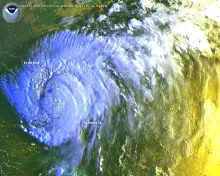
2004 – Hurricane Frances hit the east coast of Florida, just three weeks after hurricane Charley on this date. Frances sat off of the east coast between Fort Pierce and West Palm Beach for most of the day. The storm was large and slow moving, with the eye being almost 80 miles across. The storm would not pick up speed until late the next day, when it finally moved across the state, exiting near Tampa as a tropical storm. But Frances was not done with the Sunshine State. A second landfall was made near St. Marks as the storm headed inland, eventually weakening to a Tropical Depression.
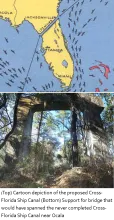
1935 – A $5,000,000 allocation for the cross-Florida ship canal was announced by President Franklin D. Roosevelt on this date. The canal would have connected the Atlantic Ocean with the Gulf of Mexico, which opponents argued would cut down on shipping costs and would be safer than traveling through the Florida Straits. Although the idea of a cross peninsular canal was first introduced as early as the 16th century, it was not until President Roosevelt allocated funds as an economic recovery project that any real construction began.