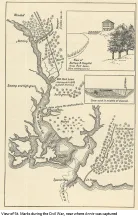
The USS Annie captured the British schooner Paul in the Florida Straits on this date. The Annie was a captured Confederate blockade runner pressed into Union Naval service. During her service in the Union Navy she captured five vessels trying to break through the blockade set up around Florida. She sank on her way from Key West to Charlotte Harbor, apparently from an explosion.
Florida Frontiers
A Tag for nodes that are relevant to Florida Frontiers. For example if an artilce is about Florida Frontiers and you would like a 'View' to sorty by Tag criteria for it... us it.
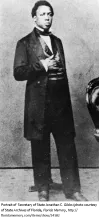
Jonathan Clarkson Gibbs became the first African American Secretary of State for Florida on this date. Gibbs was one of eighteen African American delegates to the 1868 Florida Constitutional Convention. Gibbs was originally from Philadelphia and was only the third black man to graduate from Dartmouth College. He moved south after the Civil War to help the reconstruction effort and eventually came to Florida in 1867. After serving as the Secretary of State until 1873, Gibbs became the Superintendent of Public Instruction in 1873. Jonathan C.
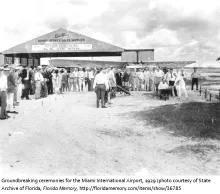
The Miami Municipal Airport groundbreaking ceremonies were held on this date. The airport was originally built by the Glen Curtiss Company, and was later given to the City of Miami. The field is most famous for being the starting point for famed female aviator Amelia Earhart’s around the world flight attempt. The field was named in her honor in 1947.
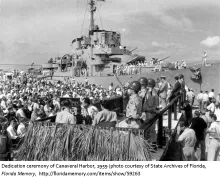
Canaveral Harbor on the east coast of Florida in central Brevard County was dedicated on this date. Canaveral Harbor, now known as Port Canaveral is a cruise, cargo and naval port which has also supported NASA operations since the 1960s including the Mercury, Gemini, Apollo and Space Shuttle programs. The port was entirely manmade between 195 1and 1953 and supported commercial fisheries from the 1950s – 1980s. Today, Port Canaveral is one of the busiest cruise ports in the United States with over 2.8 million passengers annually. Port Canaveral continues to host a U.S.
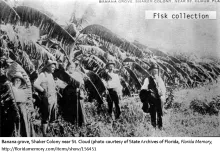
7,046 acres of land was purchased from the Disston Land Company in Osceola County to establish a “Shaker” community on this date. Shakers are a traditionalist Christian religious group with deep roots in early colonial New England and pacifist beliefs as well as a belief in the equality of sexes. The Shaker Colony in Florida settled near the town of Narcoossee and began cultivating a small portion of the land, as universal labor was also a central tenement of their religious beliefs.
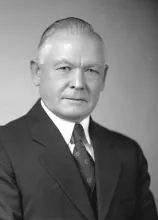
Nathan Mayo was appointed the 5th Florida Commissioner of Agriculture on this date. Mayo moved to Ocala from North Carolina in 1886 and owned a number of agricultural-related businesses. He would became one of the longest serving Commissioners of Agriculture, serving until 1963 when he died while still in office.
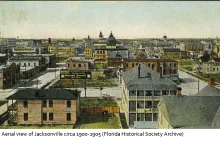
Residents of Jacksonville experienced termers from a small magnitude earthquake on this date. At 11:15 a.m. residents reported seismic activity that lasted no more than 10 seconds and caused little damage to city buildings. Although earthquakes are rare in Florida, a few quakes have caused damage including a January 1879 shock that occurred near St. Augustine causing damage to a number of old Spanish buildings, and the August 1886 earthquake near Charleston, South Carolina which was strong enough to ring church bells in St. Augustine and Jacksonville.
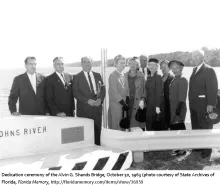
The current Alvin G. Shands Bridge was dedicated on this date. The two lane steal stringer beam-type bridge spans the St. John’s River connecting Orangdale on the eastern shore of the river with Green Cove Springs on the western shore; a total span of 6662 ft. Until the opening of the I-295 Henry Holland Buckman Bridge in 1970, the Shands Bridge was the only crossing between Jacksonville and Palatka.
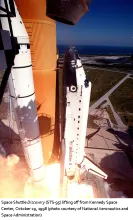
Space shuttle Discovery (STS-95) lifted off from Kennedy Space Center in Cape Canaveral carrying U.S. Senator John H. Glenn on his second mission to space on this date. Glenn was the first American to orbit the earth in 1962 during the Freedom 7 mission, and the STS-95 mission made him the oldest person to travel to space at the age of 77. The flight would help scientist better understands the effects of spaceflight on someone at that age, and compare the effects on the same individual 37 years between spaceflights.
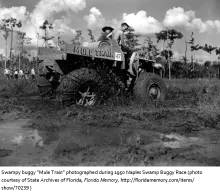
The second annual Naples Swamp Buggy Race was held on this date. Invented by Naples resident Ed Frank and used throughout the Everglades and much of south Florida during the 1930s and 1940s, the swamp buggy proved to be an invaluable companion for early south Florida developers, hunters, and anyone aiming to travel through south Florida’s swamps. The buggies are generally custom built from the ground up, or heavily modified stock vehicles.