Florida Frontiers

A Tag for nodes that are relevant to Florida Frontiers.   For example if an artilce is about Florida Frontiers and you would like a 'View' to sorty by Tag criteria for it... us it.

Major George R. Fairbanks was elected president at the organizational meeting of the Florida Historical Society in Jacksonville.  Although originally founded in 1856 in St. Augustine, the Civil War and Reconstruction forced the Society into a hiatus.  Fairbanks and others realized the need for the creation of the Society to “collect, preserve and publicize documents relating to Florida history.”  Florida did not have a state archive until the 1960s and until that time the Society performed the job of collecting documents, artifacts etc.
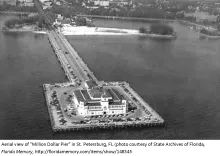
The “Million Dollar Pier” which extends into Tampa Bay from downtown St. Petersburg was dedicated on this date. The first pier structure on the site was built in 1889, and due to its popularity as a tourist destination, new piers were constructed over the course of the next 30 years. It was not until a 1921 hurricane that the pier needed to be completely rebuilt, so the City of St.

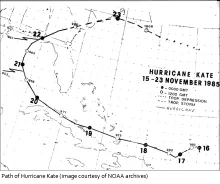
Floridians in the Panhandle began assessing the damage caused by Hurricane Kate on this date. The latest hurricane to ever reach the continental United States, Kate was a category three hurricane which first stuck the Florida Keys killing two and flooding the region, then headed northeast in the Gulf of Mexico making landfall near Panama City. Heavy rain and storm surge in the region destroyed much of the Apalachicola Bay oyster industry, causing many fishermen to lose their jobs. The estimated cost of damage in Florida and Georgia was nearly $300 million.  

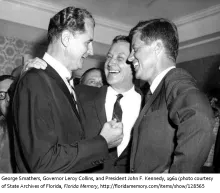
Former United States Senator for Florida George A. Smathers was born in Atlantic City, New Jersey on this date. Smathers and his family moved to Miami Beach in 1919 where he attended Miami High School. He later graduated from the University of Florida. During WWII, Smathers served as an officer in the Marine Corps. In a bitter campaign against Claude Pepper, Smathers was elected to the U.S. Senate on November 7, 1950.  Prior to his senatorial service, he had served as Assistant U.S.

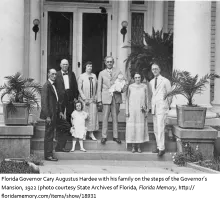
The twenty-third governor of Florida (January 4, 1921-January 6, 1925), Cary Augustus Hardee, was born in Taylor County on this date.  Educated in the public schools, Hardee was a school teacher until 1900, when he was admitted to the state bar and began his legal practice in Live Oak.  From 1905 until 1913, he served as the State’s Attorney. In 1915 and 1917, Hardee served as the Speaker of the Florida House of Representatives.

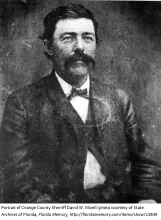
David W. Mizell was born at "Alligator Settlement" (near Lake City). He moved to Orange County with his family in 1858. Mizell fought in the Third Seminole War and the Civil War, attaining the rank of first corporal before receiving a medical discharge in 1863 for cholera (or pneumonia). Appointed as the 8th sheriff of Orange County by Governor Harrison Reed on September 8, 1868. He was shot and killed after being ambushed on February 21, 1870 while on his way to arrest cattleman Moses E. Barber for refusing to pay a tax on cattle.

A ceasefire was signed between the Allies and Germany ending hostilities during the First World War. President Wilson, along with many other allied countries declared the 11th of November Armistice Day, which was later changed to Veterans Day in order to honor all military veterans who have served our country at any time. During WWI, over 42,000 Floridians were called into service, many of whom would never return to the Sunshine State.

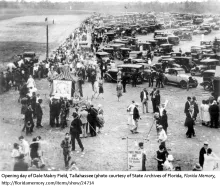
Dale Mabry Field in Tallahassee was dedicated on this date. Large crowds gathered at our state’s capital for a two day event to witness flying demonstrations and enjoy the festivities. The field was named after Tallahassee native and Army Captain Dale Mabry who was killed in a rigid airship crash in 1922. The property was utilized as a municipal airfield until WWII when it was converted into a fighter pilot training school. After the war, commercial flights continued until 1961 when the land was redeveloped into Tallahassee Community College.   

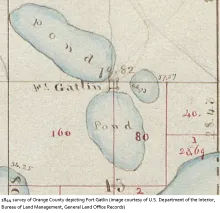
Fort Gatlin, in present day Orlando, was established on this date. Ltc.  Alexander C. W. Fanning and four companies of the 4th U.S. Artillery built the fort as part of a string of fortifications stretching across central Florida during the Second Seminole War (1835-1842.) Although no major military engagements took place at the fort and it was abandoned by the U.S. military in 1839, some early central Florida settlers built up a small community and by 1856 the community of Fort Gatlin became the county seat of the newly formed Orange County.

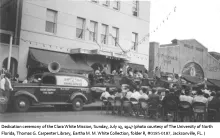
Eartha Mary Magdalene White was born in Jacksonville on this date. Eartha M.M. White was a humanitarian and philanthropists who dedicated her life to the betterment of the poor and needy in Florida, specifically African American communities in Jacksonville. She graduated from the Stanton School in Jacksonville and became a classically trained opera singer in New York around the turn of the century, before moving back to Florida to build the first public school for African Americans in Bayard, a small community in Duval County south of Jacksonville.