Florida Frontiers

A Tag for nodes that are relevant to Florida Frontiers.   For example if an artilce is about Florida Frontiers and you would like a 'View' to sorty by Tag criteria for it... us it.

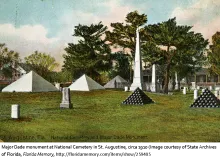
 Major General Francis L. Dade’s column of 110 U.S. troops was ambushed by a group of Seminole Indian warriors resulting in the loss of all but a few U.S. soldiers. The federal troops were traveling from Fort Brooke in present day Tampa to Fort King near present day Ocala on a reinforce and resupply mission. For months prior tensions were high between the Seminoles and the federal government as forced Indian removal initiatives ramped up. The troops were caught completely by surprise in the open prairie which resulted in an overwhelming victory for the Seminoles.
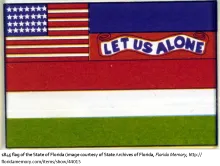
The Florida Senate officially “consented to and adopted” the first flag of the new State of Florida on this date. It was unfurled at Governor Moseley’s inauguration on June 25th of that year, even though the Senate objected to the motto, “Let Us Alone.” It was because of this disagreement and the fact that the State House of Representatives and State Senate acted through different resolutions at different times  that the flag was never officially adopted.

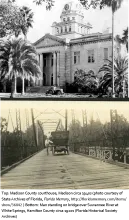
Happy birthday Madison and Hamilton Counties! Florida’s 14th and 15th counties respectively were created on this date. Madison County, named for James Madison, the fourth president of the U.S., located on Florida’s northern border with Georgia, was carved out of Jefferson County and includes the present counties of Taylor, Lafayette and Dixie. The county seat is Madison, although the first seat was San Pedro. The small hamlet of Greenville, famous for being the childhood home of R&B legend Ray Charles is located in Madison County.

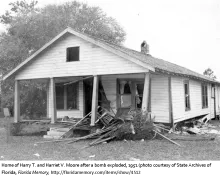
A bomb exploded under the home of pioneering civil rights activists Harry T. and his wife Harriette V. Moore in Mims, fatally wounding the two. Harry T. Moore became a field officer for the NAACP and the group’s president in 1941 where he helped registered tens of thousands of African American voters.  Harry Moore, a school administrator in Brevard County, and Harriette V. Moore, a school teacher, lost their jobs in the county when they advocated an end to educational segregation and equal pay for African-American teachers.

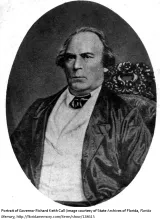
Territorial Governor Richard Keith Call brought his force of 800 volunteer militiamen from north Florida and met General Duncan Clinch at Clinch’s plantation, turned military reservation known as Fort Drane, in modern-day northwest Marion County. The force was being assembled to attack the Seminole Indians, which occurred a few days later on December 31 at the Battle of Withlacoochee.

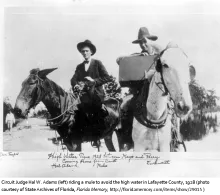
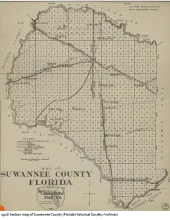
The Florida Legislature formed Lafayette County on this date. It was created from part of Madison County and named after the Marquis de Lafayette, the French general who assisted the Continental Army during the American Revolutionary War. The Suwannee River forms its eastern boundary and the county seat and only incorporated city is Mayo. It remains one of the least populous counties in the state with less than 10,000 residents. The first suspension bridge erected in Florida, the Hal W.

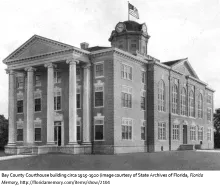
 Construction began on the impressive Bay County courthouse building in Panama City on this date. Completed in 1915, the courthouse featured a large central clock tower and elaborate gabled roof. Unfortunately in 1920 the entire building burned to the ground and a new, simpler Classical Revival design was constructed in its place, which exists today. The courthouse became well known in 1961 when it convicted Clarence Earl Gideon of felony theft and refused to provide him with legal representation, a decision famously overturned by the U.S. Supreme Court in the case Gideon v.

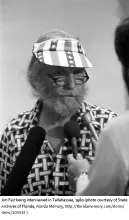
 James Searcy Farrior, better known as Jim Fair was born to a prominent Tampa family on this date. A graduate of the U.S. Naval Academy and a decorated WWII veteran, Fair became famous for his post-Naval career. He opened a Salvation Navy in Tampa which sold novelties and other various items at discounted prices. Fair was known as the “poor man’s friend,” and an eccentric champion for the rights of those he felt were underrepresented in Florida.