Florida Frontiers

A Tag for nodes that are relevant to Florida Frontiers.   For example if an artilce is about Florida Frontiers and you would like a 'View' to sorty by Tag criteria for it... us it.

Article Number
12
relevantdate

    As innocent four-year-old girls in the late 1940s, Katie, who is white, and Delia, an African-American, become best friends despite societal pressures against them. In 1960, when the girls are 16, Kate abandons her childhood friend when she is needed most. In 2006, Kate is working to earn Delia’s forgiveness as danger surrounds the women’s reunion.
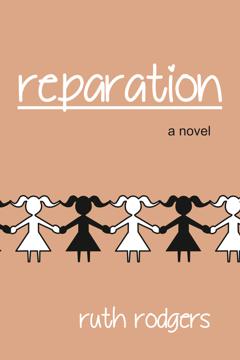
     

    That’s the premise of the new novel “Reparation” by Titusville author Ruth Rodgers. Although the exciting and suspenseful book is not based on specific actual events, it does reflect reality in Florida from the 1940s to the present.

    Ruth Rodgers is a native Floridian, raised on a farm in Madison County. She grew up in rural north Florida in the 1950s and ‘60s, when schools, theaters, restaurants, and other public accommodations were racially segregated. Rodgers says that black families and white families worked side by side in the tobacco fields, but that’s where the interaction ended.

    “We worked with black people, but we never socialized with them,” Rodgers says. “It was very much frowned upon.”

    The novel “Reparation” is written from the first-person perspective of Kate as she flashes back through her childhood relationship with Delia. The reader sees Kate’s convictions about racial equality strengthen over time. Rodgers is the same age as her main character Kate, and shares other traits with her. Both believed in racial equality, but were not outspoken about their views in the 1960s.

    “They were not popular views at that time,” Rodgers says. “I think, looking back, a lot of liberal Southerners feel a sense of guilt that we didn’t do more, that we kept our views to ourselves, and that we let culture dictate to us how to behave.”

    The novel “Reparation” has a warning label on the cover informing readers that the offensive and racially charged “n-word” appears in the book. Use of the word is particularly jarring to modern readers when it comes from four-year-old Katie near the beginning of the story. While presented in an historically accurate context, its use may be too shocking for sensitive readers.

    “She wouldn’t have had any other word to use,” Rodgers explains. “This was the word that her parents used, her grandparents used, her neighbors used, everybody around her used. It was very common in the area in which I grew up. To her it’s just a descriptive term. It’s not a derogatory term, because she has no other word to replace it with.”

    “Reparation” was being prepared for publication just as discussions about race relations in Florida and the nation were reigniting. As design of the book was nearing completion in 2013, President Obama spoke about frustration over the verdict in the Trayvon Martin case; the Supreme Court weakened the Voting Rights Act, and celebrity chef Paula Deen’s career was damaged by her admitted use of the “n-word.” Speakers at the fiftieth anniversary of the March on Washington encouraged people to be diligent about protecting the legacy of the Civil Rights movement of the 1960s.

    Rodgers says that a need exists for continued discussion about the history of race relations in Florida and the nation. She believes that her novel “Reparation” can serve as a catalyst for such conversations. “We’ve come a long way since the 1940s,” Rodgers says, “but we still have a long way to go.”

    The story of Katie and Delia demonstrates that racism and bigotry are learned behaviors that can be overcome, even when they are instilled in children at a very young age and supported by prevailing societal attitudes.

    Beyond providing a particular perspective on racial attitudes in Florida and how they evolved in the last half of the twentieth century, this novel also offers a well written and suspenseful story.
    Relevant Videos
    PDF file(s)
    Article Number
    11
    relevantdate

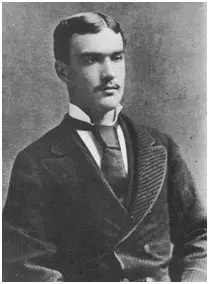
      In 1876, businessman Henry A. DeLand left his home in Fairport, New York, to visit his sister and brother-in-law in east central Florida. DeLand’s relatives, Mr. and Mrs. O.P. Terry, had created a rural homestead in west Volusia County.

      Henry DeLand left New York on a train to Jacksonville. From there he took a steamboat down the St. Johns River to Enterprise. A horse and buggy carried him the rest of the way to the Terry’s isolated home. DeLand was so impressed with the beauty and climate of the area that he decided to start a town there.

      Using the fortune he had accumulated from manufacturing baking soda in New York, DeLand purchased large tracks of land near the Terry homestead. The area was called Persimmon Hollow, but when the scattered settlers heard about DeLand’s plans to establish a town, they voted to name it after him. To entice others to settle in his new town, DeLand made a generous offer.

      Henry DeLand told people that if they moved to his town and decided that they were unhappy there, he would buy back the land that he sold to them.

      Families started moving to the town of DeLand, most growing citrus or other crops. Henry DeLand nicknamed his town “The Athens of Florida,” and worked to foster cultural, religious, and educational opportunities for residents.

      The town prospered quickly. DeLand built a public school that also served as the meeting hall for churches, until each denomination could build their own houses of worship. He brought in entertainers and sponsored special events. In 1883, a college called the DeLand Academy was established.

      One of DeLand’s friends who also contributed greatly to the development of the town was the famous hat manufacturer John B. Stetson. By 1889, Stetson had contributed so much time and money to the development of the DeLand Academy that the name of the institution was changed to Stetson University.

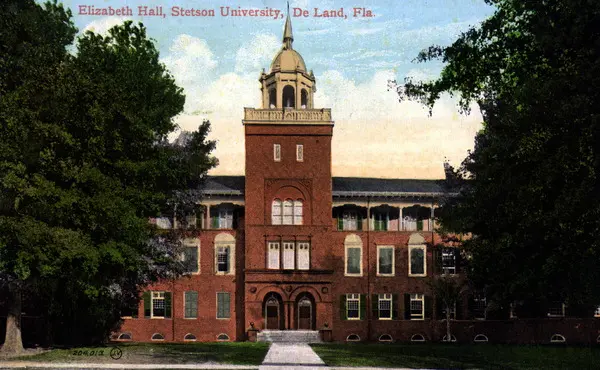
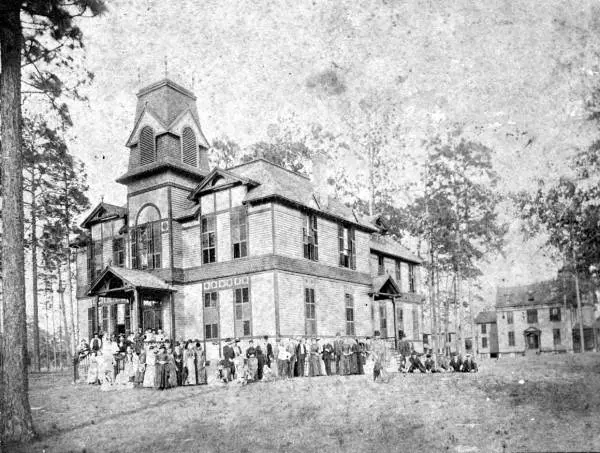
      Stetson University’s DeLand Hall was the first building constructed on the campus and is the oldest building in Florida continuously used for higher education. Elizabeth Hall, the focal point of the school, was named after Stetson’s wife.

      In 1886, A.G. Hamlin bought property from Henry A. DeLand that was located across the street from the college campus. Hamlin was DeLand’s first attorney and developer of the Hamlin orange. The seedless, smooth-skinned Hamlin orange is still popular for both juice and eating.

      Today, Hamlin’s former home is the DeLand House Museum and the headquarters of the West Volusia County Historical Society.

      A fire burned much of downtown DeLand in 1886. The fire started in Wilcox’s Salon and destroyed the 100 block of Woodland Boulevard on both sides. Following the blaze, the town passed an ordinance that allowed only brick buildings to be constructed in the commercial district. Many wooden homes that survived the fire still stand in DeLand.

      The town quickly rebounded from the devastating fire and life returned to normal. The people who DeLand had encouraged to settle in his town remained happy.

      Then came the Big Freeze of 1894-95.

      Twice during that unusually cold winter, temperatures in Central Florida fell as low as 11 degrees, killing nearly all of the area’s orange crops. Farmers living in DeLand were left with no produce to sell, and were no longer content.

      To his credit, Henry DeLand kept his promises. By the time he died in 1908, DeLand had bought back all of the land he had sold from any settlers who did not want to remain in the area. DeLand lost his fortune, as well as his large home in Fairport, New York.

      The Henry A. DeLand House in Fairport, also known as the Green Lantern Inn, is now a catering hall listed on the National Register of Historic Places.

      The DeLand House Museum is located at 137 W. Michigan Avenue in DeLand, Florida. Tours are available Tuesday through Saturday from noon to 3:00 pm.

      Dr. Ben Brotemarkle is executive director of the Florida Historical Society and host of the radio program “Florida Frontiers,” broadcast locally on 90.7 WMFE Thursday evenings at 6:30 and Sunday afternoons at 4:00, and on 89.5 WFIT Sunday mornings at 7:00. The show can be heard online at myfloridahistory.org.

      PDF file(s)
      Article Number
      10
      relevantdate

        Spring has always been thought of as a period of renewal and rebirth. The season also has long been associated with revelry and excess. In the spring, ancient Greeks worshiped Dionysus, the god of wine. At the same time of year the Romans venerated Bacchus, their god of wine. Other pre-Christian pagan fertility rites evolved into contemporary May Day celebrations.

        Since the mid-twentieth century, students in their late teens and early twenties have celebrated the ritual of Spring Break as a modern day Dionysian festival or Bacchanal, and the most popular setting for their pilgrimage has traditionally been Florida.

        Historically, three of the top five Spring Break destinations in the United States are in Florida. Fort Lauderdale, Daytona Beach, and Panama City Beach make the list along with Lake Havana City, Arizona and South Padre Island, Texas.

        In recent decades, Cocoa Beach, Fort Myers, and Tampa-St. Petersburg have also become very popular sites for Spring Break activities.

        Spring Break as we know it today was created in Fort Lauderdale. As early as the mid-1930s, college swim teams gathered in Fort Lauderdale to use the first Olympic-sized pool in Florida, the Casino Pool. When the participating swimmers weren’t training at the pool they were partying on the beach, and a tradition was born. After World War II, other college students caught on to how much fun the swimmers were having in Fort Lauderdale and started joining them there for Spring Break.

        The 1958 Glendon Swarthout novel “Where the Boys Are,” the 1960 film adaptation of the book, and the Connie Francis theme song for the film solidified Fort Lauderdale as the Spring Break mecca for students across the country.

        In “Where the Boys Are,” one of four girls vacationing in Fort Lauderdale gives in to the temptation of premarital sex with a college boy she is attracted to. She is then abandoned by the boy, raped by another, and suffers a nervous breakdown. Despite the severely moral message of the story, what most young people saw in the film were “cool” teenagers having lots of fun at the beach. Attendance at Spring Break in Fort Lauderdale doubled to more than 50,000 and continued growing in subsequent years.

        Spring Break in Fort Lauderdale became so popular, that the city became wary of the annual influx of more than 250,000 students who were ready to party, many of them irresponsibly. By 1985, the city was passing laws to restrict Spring Break activities, and the focal point of the festivities moved north to Daytona Beach.

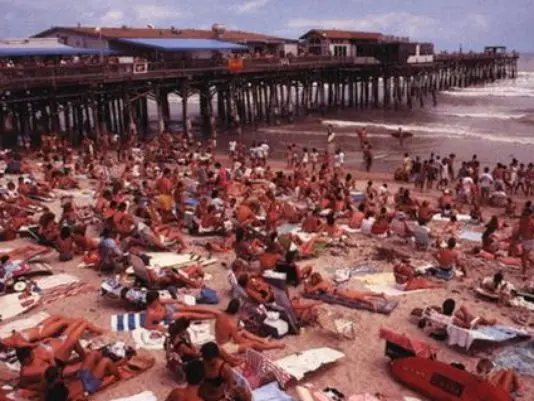
        During the 1980s and into the 1990s, Daytona Beach attracted as many as 350,000 students for Spring Break, while attendance in Fort Lauderdale dropped to around 20,000. In the early 1980s, MTV began televising concerts from Daytona’s historic coquina band shell on the beach, constructed in 1936 as a WPA project. Concerts by the City Band of Daytona and the Daytona Junior Orchestra were replaced with performances by Cheap Trick, Heart, and the Red Hot Chili Peppers. By 1986, the popular “Music Television” network was broadcasting all of their programs from Daytona during Spring Break.

        Like Fort Lauderdale before it, local officials in Daytona eventually decided that the income generated by Spring Break was not equal to the problems caused by underage drinking and property damage incurred each year. By the turn of the century, the exile of MTV and other restrictive rules sent students flocking to Panama City Beach.

        With more than 500,000 students coming to Panama City Beach each year for Spring Break, the city welcomes the annual boost to their economy, at least for now.

        The Florida Historical Society is holding their 2014 Annual Meeting and Symposium in the birthplace of Spring Break, Fort Lauderdale, May 22-24, at the Hyatt Regency Pier Sixty-Six. The classic film “Where the Boys Are” will be shown at the conference. More information is available at myfloridahistory.org/annualmeeting.

        Dr. Ben Brotemarkle is executive director of the Florida Historical Society and host of the radio program “Florida Frontiers.”  The show can also be heard online at myfloridahistory.org.

        PDF file(s)
        Article Number
        9
        relevantdate

          This is not the first column about Florida history and culture to appear in Florida Today. Many longtime residents of east central Florida remember fondly the articles of Weona Cleveland. For more than forty years, Weona Cleveland has written about the people, places, events, and even the plants that make our area unique and have brought us to where we are today.

          Weona Cleveland’s articles first appeared in the Melbourne Times in the 1970s, and later in this newspaper. Her reflections on local history as told through the eyes of everyday people earned her a dedicated following of readers.

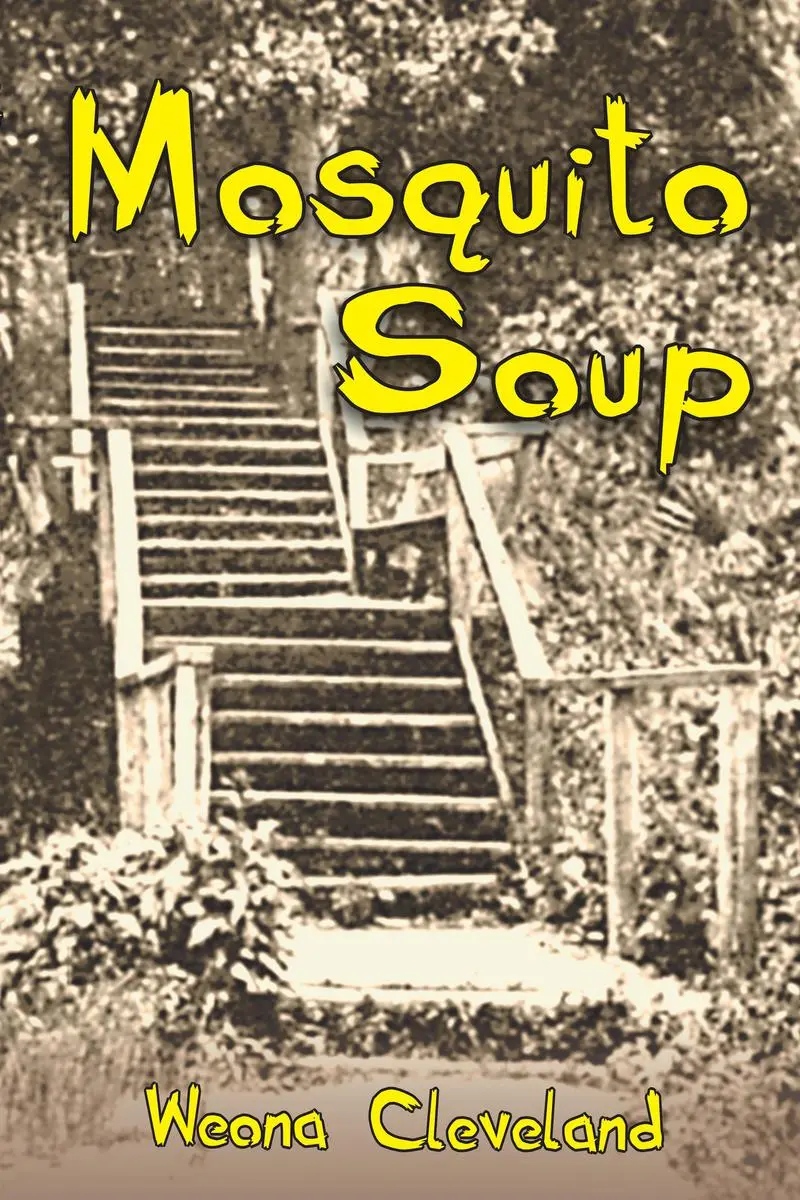
          Some of Weona Cleveland’s best newspaper articles from the past three decades are collected in the new bookMosquito Soup, published by the Florida Historical Society Press. Publication of the book was made possible by the Kellsberger Fund of the South Brevard Historical Society.

          Weona Cleveland will be signing copies of her new book Mosquito Soup, Saturday, March 29, from 2:00 pm to 4:00 pm, at the Historic Rossetter House Museum and Gardens, 1320 Highland Avenue, in Eau Gallie.

          Like most Floridians, Weona Cleveland came here from somewhere else. Born in 1925, she moved to Melbourne, Florida, from Atlanta, Georgia, in 1961. The following decade she started writing for local newspapers. Her previous books and booklets include Melbourne: A Century of Memories (1980), Crossroad Towns Remembered: A Look Back at Brevard and Indian River Pioneer Communities (1994), and A Historical Tour of Melbourne (1999).

          In addition to her numerous articles and other writing projects, Cleveland researched and wrote the text for most of the historical markers located throughout Melbourne and Eau Gallie. She says that her proudest personal accomplishment is the walking tours of old Eau Gallie and Melbourne that she gave for many years.

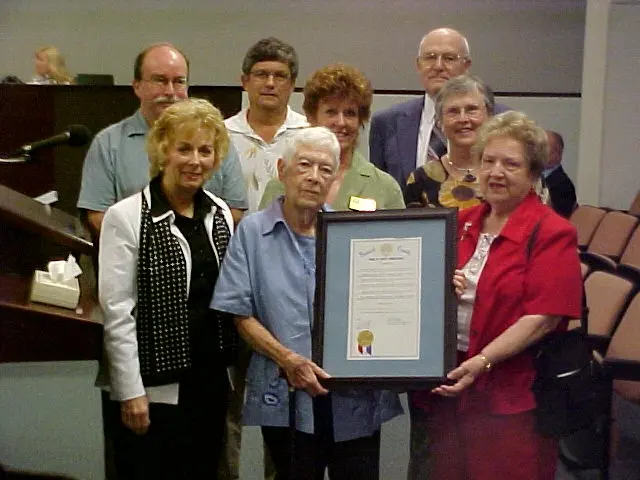
          In 2006, the Brevard County Commissioners named Cleveland the first Honorary Brevard County Historian. In 2009, Cleveland received the Julius Montgomery Pioneer Award from Florida Technical Institute for her research on the local African American community. In 2011, the South Brevard Historical Society recognized her accomplishments with an Honorary Lifetime Membership.

          The book Mosquito Soup is a collection of Cleveland’s articles about pioneer life in Brevard, Osceola, Orange, and Indian River counties, including stories from Haulover Canal, Cape Canaveral, Bovine, and Rockledge. She takes the reader to cemeteries and individual graves that provide clues to the history of Merritt Island. We hear personal accounts of the 1919 fire that destroyed downtown Melbourne. We meet people like Archie Phillip, who began working as a gardener for Carrie and Ella Rossetter in 1966, and later became their chauffeur. We learn about a tragic airplane wreck in the waters off of Melbourne Beach in 1928, which draws comparisons to the Challenger disaster fifty-eight years later. There are hundreds of other fascinating stories in the book.

          Although she is in her eighty-ninth year, the new book Mosquito Soup is not the final achievement of Weona Cleveland’s long and distinguished career. Even in retirement Cleveland continues to write about the local history and culture that she loves. She still frequently writes articles for the Indian River Journal, published by the Brevard County Historical Commission.

          In the most recent edition of the Indian River Journal, Weona Cleveland writes about traditional folk remedies passed down for generations in Melbourne’s African American community. By interviewing longtime residents, Cleveland discovered that if someone stepped on a nail; bacon fat was placed on the foot because it “drew the poison out.” She discovered that cobwebs were used as makeshift bandages to help speed the healing of cuts. To reduce a fever, castor bean leaves were put on the head.

          The work of Weona Cleveland continues to inform and enlighten readers.

          Dr. Ben Brotemarkle is executive director of the Florida Historical Society and host of the radio program “Florida Frontiers." The show can also be heard online at myfloridahistory.org

          PDF file(s)
          Article Number
          8
          relevantdate

            Five hundred and one years ago, Juan Ponce de León set sail from Puerto Rico in search of undiscovered land, slaves, and gold. His fleet of three ships included the Santiago, the San Cristóbal, and the Santa María de la Consolación.

            The ships reached the northern end of the Bahamas by March 27, 1513, which was Easter Sunday. Ponce and his crew sailed for another few days until they sighted land on April 2. Because it was the Easter season, which the Spanish called the “Festival of Flowers,” and because of the beautiful landscape, Ponce named the land he saw “La Florida”—the land of flowers. The next day, on April 3, 1513, Ponce came ashore to claim this land for Spain.

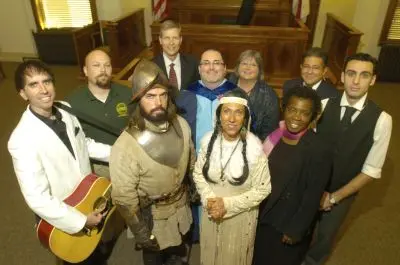
            But where was he? Where, exactly, did Ponce come ashore? That is the question explored in the original courtroom drama “Ponce de León Landed HERE!!” The production can be seen online at myfloridahistory.org/ponce.

            For centuries, scholars, historians, students, and others have been arguing about where, exactly, Ponce de León landed on Florida’s east coast in 1513, when he gave our state its name.

            We know that Juan Ponce de León was born in Spain in 1474 to a noble family, where he became an experienced soldier. He joined Christopher Columbus on his second expedition to the New World in 1493. In 1504, Ponce successfully enslaved the native population of Hispaniola, and was named Governor.

            A few years later, Ponce was named Governor of the neighboring island of Puerto Rico. It was from there that Ponce set sail for Florida. King Ferdinand II signed a contract with Ponce in 1512, granting him permission to search for “the islands of Benimy.” The contract included instructions for how Ponce was to distribute any gold and slaves that he acquired, and declared that he would be Governor for Life of any lands he discovered. Ponce assembled a crew of two hundred people that included women and free people of African descent, and sailed toward Florida.

            Ponce’s first contact with the native population of Florida set in motion a process that would destroy the lives of people who had lived here for thousands of years. These people had developed sophisticated cultures that would not survive the continued European contact to follow.

            When Ponce came to Florida, it changed the course of world history. Not only did he give this land the same name we use for it today, Ponce’s “discovery” of the Gulf Stream would lead to the first European colonization of what would become the United States, long before Jamestown was established and long before the Pilgrims landed at Plymouth Rock.

            With the approach of the milestone 500th anniversary year of Ponce’s first voyage to Florida, residents of several areas along Florida’s east coast voiced enthusiastic claims that their town was where Ponce de León first made landfall when he gave our state its name in 1513. Each claimant could point to various interpretations of the available facts to support their position.

            The Florida Historical Society staged the original courtroom drama “Ponce de León Landed HERE!!” to present the available information in an entertaining way. The performance that can be seen online was recorded at the Historic Volusia County Courthouse on January 12, 2013. An audience in Tallahassee watched the proceedings in DeLand “live” as they were projected on a screen at the Museum of Florida History.

            In the production, actual lawyers and judges present different arguments supporting the St. Augustine area, Ponce Inlet, Melbourne Beach, and Jupiter Inlet as the most likely landing place of Ponce and his crew.

            The jury hears testimony from early Florida archaeologist Clarence B. Moore, who laments that there is no physical evidence to support any of the claims. The Ais Queen testifies that she was there when Ponce came ashore, but cannot help us identify the spot where it happened because the landscape has been altered beyond her recognition. Then the jury hears from Ponce himself.

            The claims about where, exactly, Ponce landed in 1513 are inconclusive and open to debate. Thanks to “Ponce de León Landed HERE!!” you can view the evidence and decide for yourself.

            For more information watch the courtroom drama “Ponce de León Landed HERE!!” at myfloridahistory.org/ponce and read the book The Voyages of Ponce de León: Scholarly Perspectives by James Cusick and Sherry Johnson.

            Dr. Ben Brotemarkle is executive director of the Florida Historical Society and host of the radio program “Florida Frontiers."  The show can also be heard online at myfloridahistory.org.

            Article Number
            7
            relevantdate

              People who lived in Brevard County, Florida during the first half of the twentieth century will tell you shocking stories of dealing with mosquitos before DDT was developed as an insecticide. For example, they say that if you put your hand on a window screen on the shady side of a house, it took only a few seconds for the mosquitos to form a solid black mirror of your hand as they attempted to bite you through the wire mesh. Everyone had window screens, because there was no air conditioning.

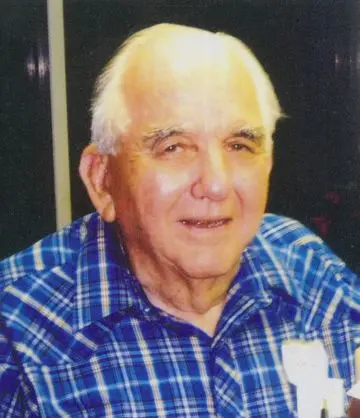
              Brevard County native George “Speedy” Harrell graduated from Rockledge High School in 1945, with thirty-two classmates. Harrell remembers using a “mosquito beater” to keep the blood suckers off of his mother as she put laundry on the line to dry, and to protect his brother as he milked a cow. Florida pioneers like the Harrell family would lash together palm fronds to create “mosquito beaters” to brush away swarms of the biting insects.

              In 1986, when George “Speedy” Harrell decided to organize an annual gathering for people who lived in Brevard County prior to 1950, he chose to name the group Mosquito Beaters. Harrell says, “I thought it would be great if we had one day that we get together, not a funeral or a wedding.” The Twenty-ninth Annual Gathering of the Mosquito Beaters will be held Friday March 14 and Saturday, March 15, at the Walter Butler Community Center in Cocoa.

              Every year, about 1,000 people attend the Mosquito Beaters Annual Gathering. The event is so popular that local high school class reunion activities are planned to coincide with it. There are no formal presentations or academic discussions. The gathering is just a large group of friends and family coming together to remember old times and talk about the way it used to be in East Central Florida.

              Prior to 1950, there were more mosquitos in Brevard County than people. The primary jobs here before World War II were in citrus groves or commercial fishing. In 1948, the Banana River Naval Air Station was converted to Patrick Air Force Base and in 1949; President Harry Truman established a long-range proving ground for missiles at Cape Canaveral. By 1959, NASA was launching lunar probes from Brevard County.

              In 1950, the population of Brevard County was only 23,000, but by 1960 that number had exploded by more than 371 percent.

              While the Mosquito Beaters was originally formed for people who had lived in Brevard County prior to 1950, that requirement has relaxed in recent years. Harrell explains, “If we stayed with ‘before 1950’ they’d all be dead and I’d be there talking to myself.” He says that now anyone is welcome to attend the gathering, “if they don’t tell us how they done it back home.”

              There have been many poignant moments at Mosquito Beater Annual Gatherings over the years. Friends who had not seen each other since going to war in the 1940s, former high school teammates, and estranged family members have all been reunited through the Mosquito Beaters. Harrell says, “There has been several occasions that one person would come to it and I would see them enjoy themselves enough to pay me for what work I’ve done on the thing.”

              The Mosquito Beaters are dedicated to preserving the history of Central Brevard County, including Cocoa, Rockledge, Merritt Island, Cocoa Beach, Cape Canaveral, and the surrounding area. They collect photographs and stories in an annual publication called the Central Brevard Mosquito Beaters Memory Book. The publication is sold at Florida Books and Gifts, located in the Library of Florida History in Cocoa.

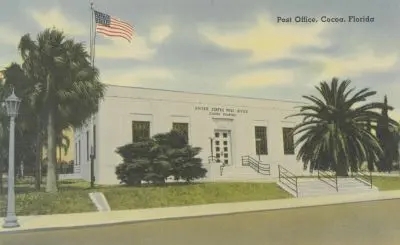
              The Mosquito Beaters have an office in the Library of Florida History, where their collection of photographs and documents is held. The building was originally a 1939 WPA-era post office, where Speedy Harrell worked as a postman before his retirement in 1982 as a Post Office Superintendent in Brevard County. Now, Speedy Harrell can be found there almost every day, working as a volunteer.

              The twenty-ninth Annual Gathering of the Mosquito Beaters will be held Friday, March 14, 2014 from 6:00 pm to 10:00 pm. Attendees are asked to bring “finger food” to share. The event continues Saturday, March 15 from 10:00 am to 2:00 pm, with food provided by Kay’s BBQ. The Walter Butler Community Center is located at 4201 N. Highway 1, Cocoa.

              Dr. Ben Brotemarkle is executive director of the Florida Historical Society and host of the radio program “Florida Frontiers.”  The show can also be heard online at myfloridahistory.org

              PDF file(s)
              Article Number
              6
              relevantdate

                The Florida Historical Society (FHS), whose statewide headquarters are in Cocoa Village, is announcing today the establishment of a new department focusing on the intersection of history and archaeology. March is Florida Archaeology Month and just in time for the celebration, FHS is launching the Florida Historical Society Archaeological Institute (FHSAI).

                Established in 1856, the Florida Historical Society has been supporting archaeology in the state for more than a century.

                FHS was the first state-wide organization dedicated to the preservation of Florida history and prehistory, as stated in their 1905 constitution. It was the first state-wide organization to preserve Native American artifacts such as stone pipes, arrowheads, and pottery, and the first to actively promote and publish archaeological research dating back to the early 1900s.

                As archaeology was just beginning to emerge as a discipline in the late 1800s and early 1900s, Clarence B. Moore traveled down the St. Johns River on the steamboat Gopher, stopping to investigate Native American burial mounds and other sites. Like most archaeology enthusiasts of his generation, Moore often did significant damage to the sites he explored, digging with reckless abandon instead of following the methodical procedures used by trained archaeologists today. Moore’s contributions to the study of Florida archaeology are important, though, because he meticulously documented what he found with detailed notes and illustrations.

                Clarence B. Moore became a Member of the Florida Historical Society in 1907, and donated his written works to the Library of Florida History.

                From the early twentieth century to the present, leading Florida archaeologists have had their work published in the FHS journal, The Florida Historical Quarterly. The Florida Historical Society was instrumental in the creation of the position of State Archaeologist and the establishment of the Florida Anthropological Society (FAS) in the 1940s, and served as host of the Florida Public Archaeology Network (FPAN) East Central Region from 2010 through 2013. Under the direction of FHS, the East Central Region was one of FPAN’s most successful.

                Today, FHS is continuing its long tradition of supporting archaeology in the state with the Florida Historical Society Archaeological Institute (FHSAI). The mission statement says that FHSAI “is dedicated to educating the public about Florida archaeology through research, publication, educational outreach, and the promotion of complimentary work by other organizations.”

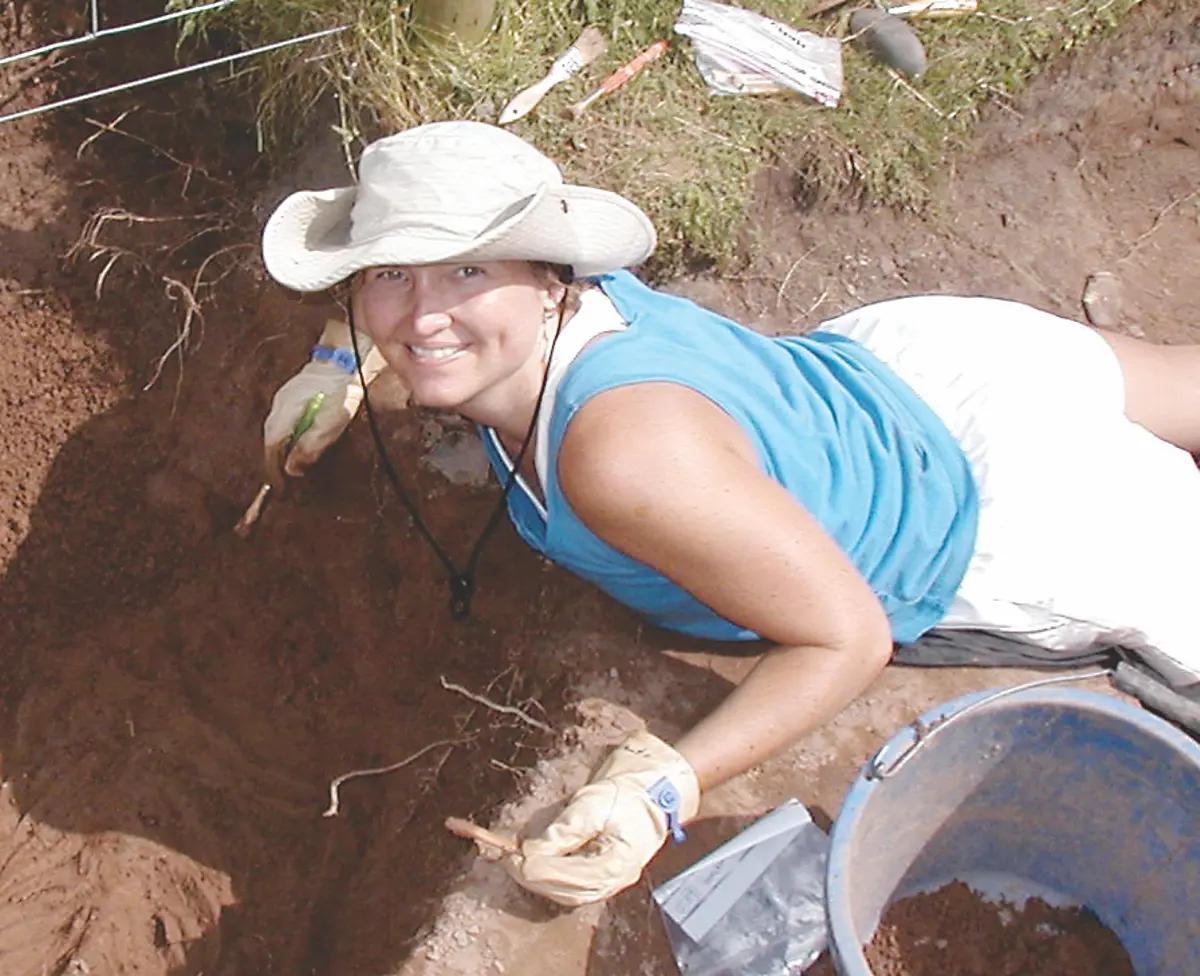
                Dr. Rachel K. Wentz is director of the new Florida Historical Society Archaeological Institute. She is former director of the Florida Public Archaeology Network (FPAN) East Central Region, and author of several books on Florida archaeology, including Chasing Bones: An Archaeologist’s Pursuit of Skeletons and Life and Death at Windover: Excavations of a 7,000-Year-Old Pond Cemetery. Her latest work, Searching Sand and Surf: The Origins of Archaeology in Florida is the first “official” publication of FHSAI, and will be released later this month.

                To celebrate Florida Archaeology Month, FHSAI is presenting a series of free public lectures each Friday night in March at 7:00 pm, at the Library of Florida History, 435 Brevard Avenue, Cocoa. March 7, Chuck Meide from the Lighthouse Archaeological Maritime Program (LAMP) in St. Augustine will discuss the excavation of a Florida shipwreck from the American Revolution. March 14, University of Central Florida graduate student Patrisha Meyers will give a presentation on forensic anthropology. March 21, University of South Florida professor Brent Weisman will talk about historical archaeology. March 28, FHSAI director Rachel Wentz will discuss her new book Searching Sand and Surf: The Origins of Archaeology in Florida.

                In addition to offering a regular series of public lectures at the Library of Florida History in Cocoa, FHSAI will give frequent presentations at other venues throughout the state, publish books and articles through the FHS Press, and promote archaeology on Florida Frontiers: The Weekly Radio Magazine of the Florida Historical Society.

                For more information on the Florida Historical Society Archaeological Institute (FHSAI) contact Dr. Rachel Wentz at 321-690-1971 ext. 222 or rachel.wentz@myfloridahistory.org, and visit the web site at www.fhsai.org.

                Dr. Ben Brotemarkle is producer and host of “Florida Frontiers: The Weekly Radio Magazine of the Florida Historical Society.” The show can also be heard online at myfloridahistory.org.


                PDF file(s)
                Article Number
                5
                relevantdate

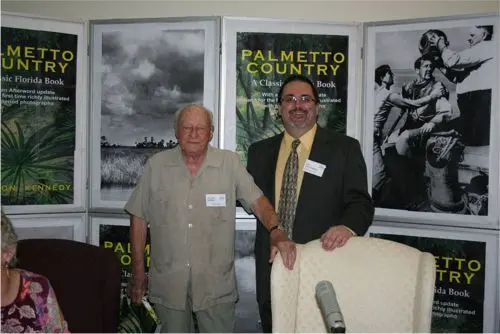
                  Carrying a cumbersome audio recorder that he called “the thing,” Stetson Kennedy traveled through rural backwoods, swamps, and small towns from north Florida to Key West, collecting oral histories, folktales, and work songs. He spoke with the diverse people of Florida including Cracker cowmen, Seminole Indians, Greek sponge divers, African American turpentine still workers, and Latin cigar rollers.

                  The result of Stetson Kennedy’s trek through Florida’s multicultural communities was the classic 1942 book Palmetto Country.

                  Born in Jacksonville in 1916, Stetson Kennedy traveled the world but always returned to Florida. He left his studies at the University of Florida in 1937 to join the Works Progress Administration’s Florida Writers Project, and was soon named the head of the unit on folklore, oral history, and socio-ethnic studies. During this period he was the supervisor of writer, folklorist, and anthropologist Zora Neale Hurston, who also collected material for the WPA.

                  Stetson Kennedy’s work helped to establish the collection of oral history as a valid method of historical research among twentieth century historians. In a 2009 interview, Kennedy reflected on his role as an early oral historian: “I am a great believer in oral history because [of what] I call…the ‘Dictatorship of the Footnote.’  The academicians are quoting each other instead of going out and getting first-hand primary source material.  And oral history, of course, is [the perspective of] a participant and a witness, at least, and seeing it with all their sensory organs, and for that reason it has more validity from my point of view.”

                  While collecting oral histories in Florida’s diverse communities, Stetson Kennedy was particularly moved by the plight of African Americans suffering under the state’s restrictive “Black Codes” and the South’s tradition of “Jim Crow” laws. A social activist as well as an author, Kennedy risked his life by infiltrating the Ku Klux Klan and exposing their secrets. Using the name John Perkins, Stetson Kennedy was able to gather information that helped lead to the incarceration of a number of domestic terrorists. These experiences led to the 1954 book I Rode With the Klan, which was later republished under the title The Klan Unmasked

                  Much has been made of Kennedy’s creative choice in The Klan Unmasked to blend information obtained by another KKK infiltrator with his own experiences, presenting them with one narrative voice. The accuracy of the information in his book cannot be effectively challenged, just the style in which the facts are presented. 

                  In 2009, Kennedy recalled his covert study of the KKK: “I first infiltrated during the war, when the Klan was afraid that President [Franklin Delano] Roosevelt might prosecute them under the War Powers Act.  So they didn’t put on their robes, and they changed their names to various things like American Shores Patrol and American Gentile Army, and things like that, so that’s how it all began.  And, yes, it was exciting, to put it mildly.  When I went overseas some years later, I thought I’d get away from my nightmares, you know, of being caught.  But in Paris, it was raining frequently, and the French traffic cops wore white rubber raincoats with capes and hoods, and their hand signals were very much like the Klan signals, so I kept on having nightmares.”

                  Stetson Kennedy continued working until his death in 2011, at the age of 94. His last book, The Florida Slave, was published posthumously. He wrote eight books, and his work as an author, activist, and folklorist has been deservedly well recognized. Kennedy received the Florida Heritage Award, the Florida Governor’s Heartland Award, the NAACP Freedom Award, the Florida Historical Society’s Dorothy Dodd Lifetime Achievement Award, and he was inducted into the Florida Artist’s Hall of Fame.

                  For more information read Stetson Kennedy’s books including Palmetto Country, The Klan Unmasked, Jim Crow Guide to the U.S.A., After Appomattox: How the South Won the War, and The Florida Slave.

                  Dr. Ben Brotemarkle is producer and host of “Florida Frontiers: The Weekly Radio Magazine of the Florida Historical Society.”  The show can also be heard online at myfloridahistory.org.

                  PDF file(s)
                  Article Number
                  4
                  relevantdate

                    Moses Barber had simply had enough of his cattle going missing. He believed that David Mizell and his friends were periodically stealing from his herd. His rage reached a point where Barber publically declared that if David Mizell set foot on his property again, he would be shot.

                    On February 21, 1870, David Mizell became the first casualty of the Barber-Mizell Family Feud. He was shot and killed on Barber property near Holopaw, Florida, in Osceola County.

                    Moses Barber first settled in North Florida in the 1830s. As the Seminoles were pushed to the south, Barber expanded his cattle operation into Central Florida. Some members of the Barber family built homes on the south end of the cattle run, near Fort Christmas. By the time the Civil War began in 1860, Moses Barber was a prominent and successful cattleman.

                    During the Civil War, Florida was the primary supplier of beef to the Confederate Army, and the Barber family had one of the largest cattle businesses in the state. Once the war was over, some of Barber’s fellow cowmen were taking part in the Reconstruction government, which he saw as a betrayal.

                    David Mizell, who had fought for the Confederate Army, was named sheriff and tax collector of Orange County after the war. Moses Barber refused to pay what he believed were unfair taxes to the U.S. government. Mizell responded by taking some of Barber’s cattle to compensate for the unpaid debt. Tensions between the Barber family and the Mizell family escalated during the late 1860s, with other cattle families taking one side of the argument or the other.

                    Moses Barber believed that Mizell family friend George Bass had stolen some of his cattle, and confronted him about it. The Mizells controlled the sheriff’s office and the courts, so Barber and members of his family were charged with “false imprisonment” for holding Bass against his will. After decades of lawlessness on Florida’s frontier, Mizells charged Barbers with a series of crimes including arson, polygamy, and tax evasion. At the heart of the dispute was control over Florida’s cattle industry.

                    David Mizell ignored Moses Barber’s warning to stay off his land. Mizell, his son Will, and his brother Morgan ventured onto Barber property. As they crossed Bull Creek on their horses, shots were fired from behind some bushes, and David Mizell was killed.

                    As he lay dying, David Mizell asked that his death not be avenged. His brother John had other plans.

                    John Randolf Mizell, David’s brother, was the first judge of Orange County. Despite his position, Judge Mizell wanted swift justice for the men he was convinced were behind his brother’s death. Within weeks, Moses Barber’s son Isaac was shot and killed, allegedly while trying to escape arrest and Moses Jr. was drowned by vigilantes. Barber family friends William Yates and Lyell Padgett were shot and killed as fleeing suspects.

                    William Bronson, a family friend of the Mizells, was reportedly shot by Burrell Yates, a friend and relative of the Barbers. Allegedly, Yates was trying to prevent Bronson from burning evidence that would incriminate the Mizells and their associates in the wrongful deaths of the Barbers.

                    According to Barber family history, a total of thirteen Barber men were killed by the Mizell family during the Barber-Mizell Family Feud of 1870, but this claim can not be verified by public records.

                    No one is sure what happened to Moses Barber during and after the feud. Some records indicate that he died in 1870, while others have him alive and living in Texas in 1877.

                    Remnants of this colorful chapter of Florida history remain today. The Mizell family homestead is located in what is now Harry P. Leu Botanical Garden in Winter Park. The oldest grave in the small family cemetery there belongs to David Mizell. The Yates family homestead, originally located on Taylor Creek, has been relocated to Fort Christmas Historic Park. Needham Yates and William Yates were both killed in the Barber-Mizell Family Feud. The rural Volusia County town of Barberville was founded by James D. Barber, a descendent of Moses Barber.

                    Today, the Barber and Mizell families have merged through marriage. Several generations have blood from both sides of this bitter dispute.

                    For more information on the Barber-Mizell Family Feud of 1870, read the historical novel Florida’s Frontier: The Way Hit Wuz by Mary Ida Bass Barber Shearhart.

                    Dr. Ben Brotemarkle is producer and host of “Florida Frontiers: The Weekly Radio Magazine of the Florida Historical Society.”  The show can also be heard online at myfloridahistory.org.

                    PDF file(s)
                    Article Number
                    94
                    relevantdate

                      This Friday night, a woman who was ritualistically buried in Brevard County more than 7,000 years ago will be brought back to life.

                      Using some of the same forensic reconstruction techniques used to identify modern crime victims from skeletal remains, artist Brian Owens has created the Windover Woman sculpture that will be unveiled this weekend.

                      “This was a fun project,” says Owens. “I usually work in bronze, so this more lifelike silicone material was a new challenge for me.”

                      Owens had measurements and computer generated images created from scans of a Windover skull to guide his work. The resulting bust sculpture will allow visitors to look into the eyes of a prehistoric Floridian.

                      In the mid-1980s, nearly 200 remarkably well-preserved human burials together with artifacts from the Archaic Age were discovered near the intersection of I-95 and SR50. The remains were wrapped in the oldest woven cloth found in North America. The anaerobic environment and the Ph balance of the pond cemetery allowed even brain matter to be preserved in 91 of the burials.

                      “The Windover site is actually the most important burial site in North America,” says Patrisha Meyers, director of the Brevard Museum of History and Natural Science and the Florida Historical Society Archaeological Institute.

                      “One of the things that make it so significant is the unique type of burial. It’s a pond burial; we don’t see that as often, and this is the most complete population that has been excavated from this period, about 7,000 to 8,000 years ago. They were able to excavate 168 individuals ranging in age from infancy to old age, and because of that, we were able to learn a great deal about these early lifeways.”

                      The event Friday evening from 6pm to 9pm is a fundraiser for the Brevard Museum of History and Natural Science and the Florida Historical Society Archaeological Institute that is based there.

                      The $75 VIP ticket includes live Native American music, gourmet food, beer and wine. Attendees will have one-on-one time with Owens, as well as archaeologists who have preserved and studied the Windover materials. They will be the first to see the improved and expanded “People of Windover” exhibition, including the Windover Woman sculpture.

                      Thanks to a grant from the Florida Humanities Council, the public is invited to the museum at no expense this Saturday to attend the panel discussion “Windover Archaeology: The Next Generation.” 

                      Panelists will include Dr. Rochelle Marrinan, Windover archaeologist and chair of the anthropology department at Florida State University; Dr. Geoffrey Thomas, specialist faculty member in the FSU anthropology department; and Dr. Rachel Wentz, author of the book “Life and Death at Windover: Excavations of a 7,000 Year-Old Pond Cemetery.”

                      For the past three decades, most of the Windover remains and artifacts have been housed at Florida State University in Tallahassee. During that time, outstanding research has been done that expands our understanding of Archaic Age people.

                      “It’s really done a good job in terms of interacting faculty, undergraduate, and graduate students, because everyone’s interested in slightly different things,” says Geoffrey Thomas. “The more individuals with different interests that branch out and look at different things, access different diseases, different health statuses, demographics, growth and development, every new study really does broaden the general picture of the whole population.”

                      DNA testing was in its infancy when the Windover Dig took place, and other technological advancements have been made. Study of the Windover people and artifacts will continue to provide new information about our prehistoric past.

                      “There are a lot of different kinds of techniques that archaeologists are using these days,” says Rochelle Marrinan. “At the moment, I think the most pressing need is the genetic one. We’re hopeful that there will be new techniques that will allow us to retrieve material that can be genetically used to sequence this population, each individual if possible. That will give us the most information, and also show their relatedness to others in Florida.”

                      The improved and expanded People of Windover exhibition includes a refreshed recreation of the archaeological dig, a new interactive lab with “hands-on” activities, new interpretative panels, a new video presentation, and the Windover Woman sculpture.

                      More information about “Windover Weekend” is available at myfloridahistory.org.

                      PDF file(s)