Geology

Article Number
190
relevantdate

    Florida used to be located at the South Pole.

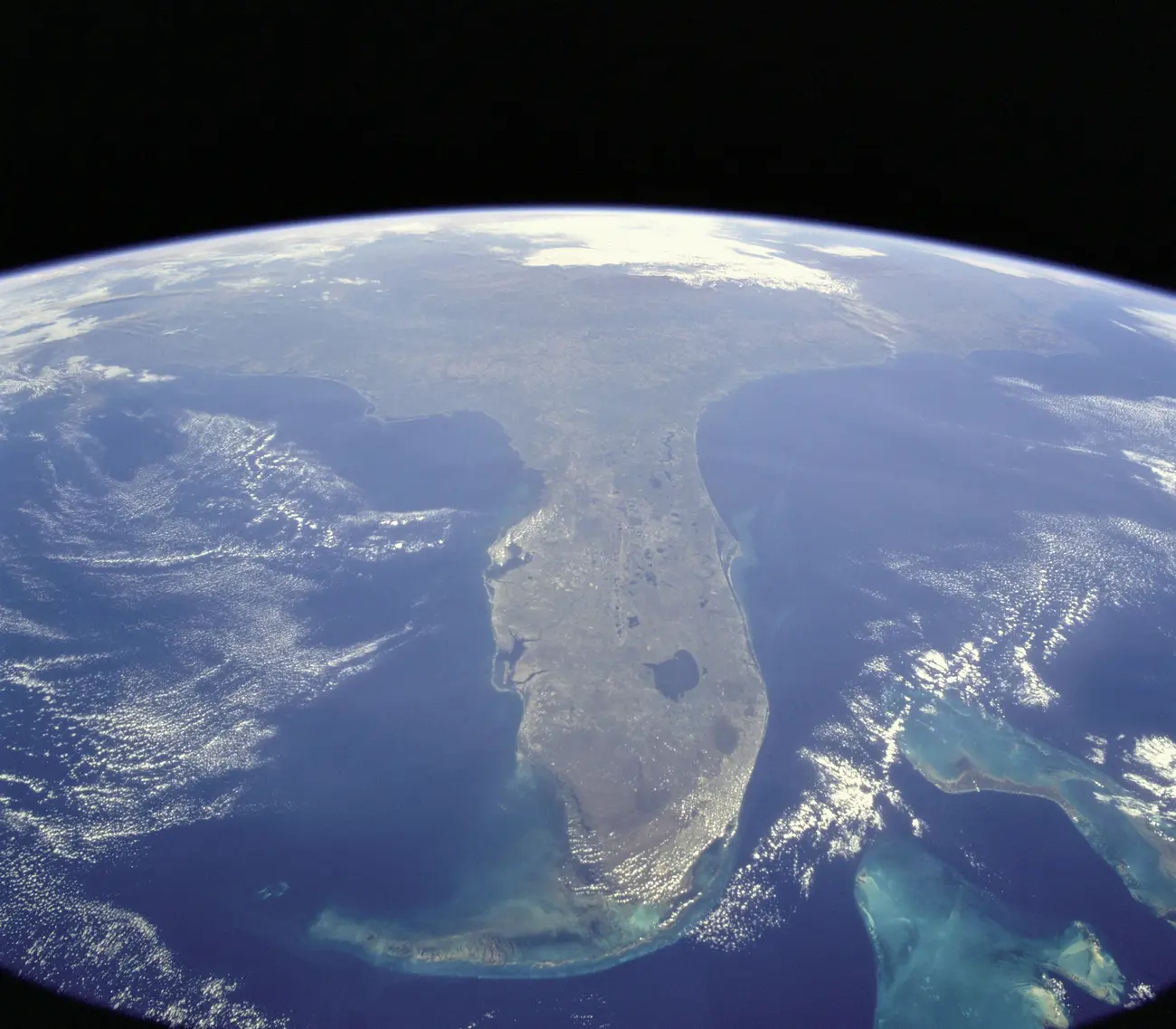
    As part of the continent Gondwana 650 million years ago, the foundation of Florida was tucked between the land masses that would become South America and Africa. The rest of eastern North America was then part of another continent called Laurentia. As the Earth’s tectonic plates shifted, the basement rocks of our modern continents moved across the globe.

    About 300 million years ago, Gondwana and Laurentia collided, forming the Appalachian Mountains in what would become North America and the Mauritanide Mountains in what would eventually be Africa. The Florida portion of Gondwana joined with Laurentia at a line that runs southwest to northeast through modern south Alabama, south Georgia, southern South Carolina, and eastern North Carolina.

    By about 200 million years ago, Gondwana and Laurentia had sutured together to form the supercontinent Pangea. At this point Florida’s basement rock was located north of the equator, much closer to its current position, but was surrounded by land. Florida was near the middle of the Pangea supercontinent, far from any ocean, probably surrounded by desert. Pangea did not last long from a geological perspective, breaking up after just 85 million years.

    The breakup of Pangea resulted in the creation of Florida as a peninsula.

    “North America separated from Africa, South America separated from Africa, Europe and Asia did their own thing, India broke away and slammed into the south side of Asia, creating the Himalaya mountains,” says Albert C. Hine, professor of Marine Science at the University of South Florida and author of the book “Geologic History of Florida: Major Events That Formed the Sunshine State.”

    “So it was a period of time where there was a significant reorganization of the continental masses on earth, and during that time the basement rocks that created the Florida peninsula were isolated and left alone, and then on top of the basement rocks, the limestones have accumulated that we see, and the rocks and sediments that we see that form our beaches have occurred over the past 200 million years,” Hine says.

    For tens of millions of years, most of Florida was separated from the rest of North America by the Georgia Channel Seaway. Eventually, the water receded and Florida became a visible extension of North America, but with a distinctly different foundation than the rest of the continent. The Suwannee Basin and the Florida-Bahama Blocks that make up the foundation of the Florida peninsula have much more in common with the rocks of northwest Africa than with the bedrock of the rest of North America.

    At different points in geologic history, Florida has been totally submerged, but it has also been twice as wide as it is now.

    “During glacial events, the huge ice sheet, it’s called the Laurentide Ice Sheet, covered most of North America, and the Fenno-Scandanavian Ice Sheet covered most of Europe,” says Hine. “Water was extracted from the ocean and snowed on land. Over thousands of years, that snow built up into thick ice sheets. So water was withdrawn from the ocean as much as 400 feet. So sea level dropped about 400 feet, 130 meters. As a result, Florida being topographically low and flat, that exposed a huge portion of the Florida platform to the air, and became dry.”

    Prehistoric animals and probably Pre-Columbian people lived on dry land that is now submerged under 200 feet of water in the Gulf of Mexico.

    Hine says that rising sea levels are an inevitable part of Florida’s future.

    “It’s a function of global warming and global climate change,” says Hine. “Scientists realize, of course, it’s been politicized, to our chagrin, but the data are real, and the predictive models are the best we can possibly make them, and they’re getting better with time. That’s been demonstrated. All that clearly shows that sea level is going to rise in Florida in time periods that are important to humans. Not thousands of years or millions of years, but in decades. As a result, we have to start to plan how we’re going to deal with that. As we’re planning, we continue to try to make the science better, and to make the predictions better.”

     

    Article Number
    141
    relevantdate

      As part of the continent Gondwana 650 million years ago, the foundation of Florida was tucked between the land masses that would become South America and Africa. The rest of eastern North America was then part of another continent called Laurentia. As the Earth’s tectonic plates shifted, the basement rocks of our modern continents moved across the globe.

      About 300 million years ago, Gondwana and Laurentia collided, forming the Appalachian Mountains in what would become North America and the Mauritanide Mountains in what would eventually be Africa. The Florida portion of Gondwana joined with Laurentia at a line that runs southwest to northeast through modern south Alabama, south Georgia, southern South Carolina, and eastern North Carolina.

      By about 200 million years ago, Gondwana and Laurentia had sutured together to form the supercontinent Pangea. At this point Florida’s basement rock was located north of the equator, much closer to its current position, but was surrounded by land. Florida was near the middle of the Pangea supercontinent, far from any ocean, probably surrounded by desert. Pangea did not last long from a geological perspective, breaking up after just 85 million years.

      The breakup of Pangea resulted in the creation of Florida as a peninsula.

      “North America separated from Africa, South America separated from Africa, Europe and Asia did their own thing, India broke away and slammed into the south side of Asia, creating the Himalaya mountains,” says Albert C. Hine, professor of Marine Science at the University of South Florida and author of the book “Geologic History of Florida: Major Events That Formed the Sunshine State.”

      “So it was a period of time where there was a significant reorganization of the continental masses on earth, and during that time the basement rocks that created the Florida peninsula were isolated and left alone, and then on top of the basement rocks, the limestones have accumulated that we see, and the rocks and sediments that we see that form our beaches have occurred over the past 200 million years,” Hine says.

      For tens of millions of years, most of Florida was separated from the rest of North America by the Georgia Channel Seaway. Eventually, the water receded and Florida became a visible extension of North America, but with a distinctly different foundation than the rest of the continent. The Suwannee Basin and the Florida-Bahama Blocks that make up the foundation of the Florida peninsula have much more in common with the rocks of northwest Africa than with the bedrock of the rest of North America.

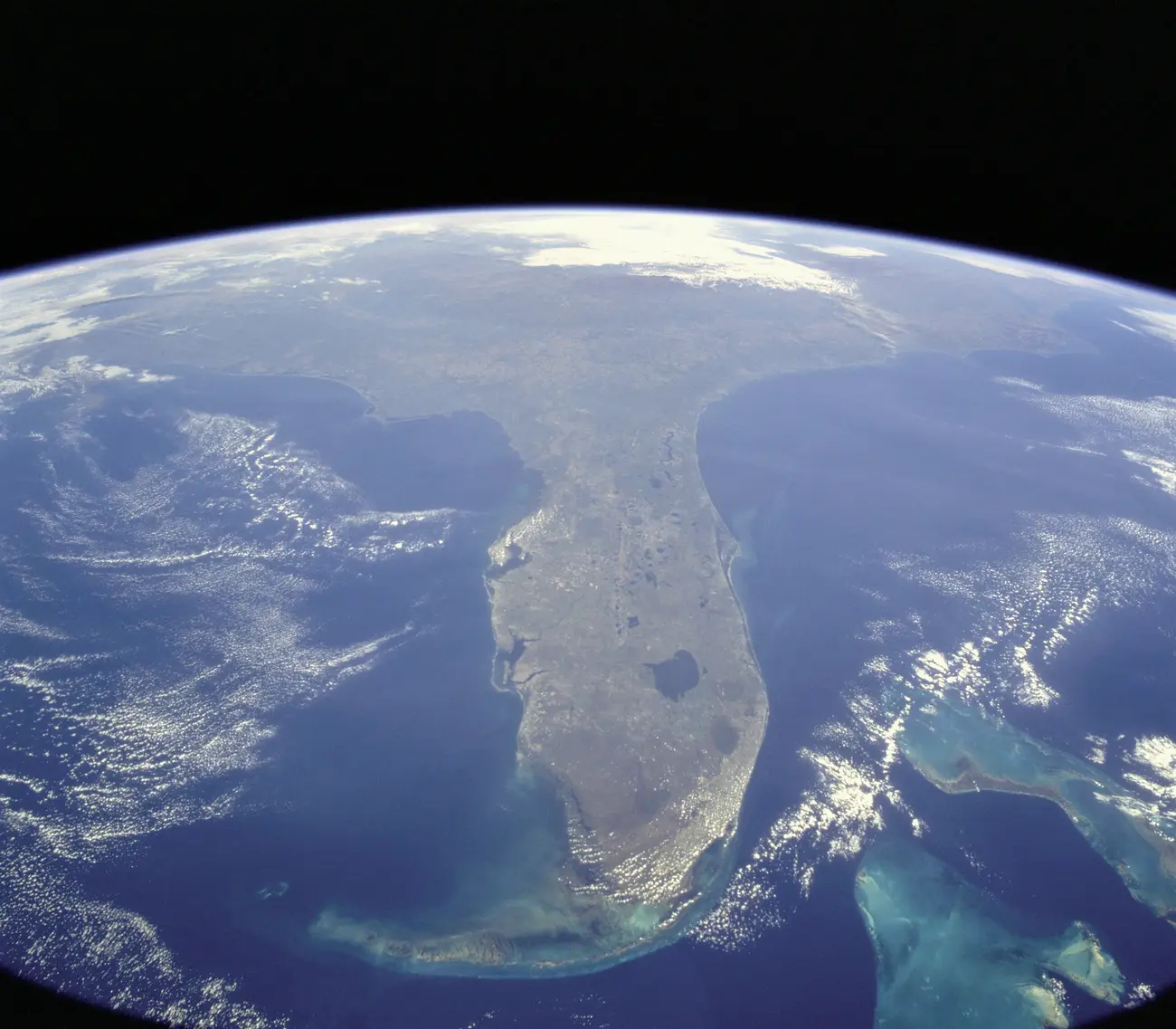
      At different points in geologic history, Florida has been totally submerged, but it has also been twice as wide as it is now.

      “During glacial events, the huge ice sheet, it’s called the Laurentide Ice Sheet, covered most of North America, and the Fenno-Scandanavian Ice Sheet covered most of Europe,” says Hine. “Water was extracted from the ocean and snowed on land. Over thousands of years, that snow built up into thick ice sheets. So water was withdrawn from the ocean as much as 400 feet. So sea level dropped about 400 feet, 130 meters. As a result, Florida being topographically low and flat, that exposed a huge portion of the Florida platform to the air, and became dry.”

      Prehistoric animals and probably Pre-Columbian people lived on dry land that is now submerged under 200 feet of water in the Gulf of Mexico.

      Hine says that rising sea levels are an inevitable part of Florida’s future.

      “It’s a function of global warming and global climate change,” says Hine. “Scientists realize, of course, it’s been politicized, to our chagrin, but the data are real, and the predictive models are the best we can possibly make them, and they’re getting better with time. That’s been demonstrated. All that clearly shows that sea level is going to rise in Florida in time periods that are important to humans. Not thousands of years or millions of years, but in decades. As a result, we have to start to plan how we’re going to deal with that. As we’re planning, we continue to try to make the science better, and to make the predictions better.”

      PDF file(s)
      Article Number
      120
      relevantdate

        Florida has a diverse wealth of geological resources.

        People have enjoyed the sands of Florida’s beaches for more than 12,000 years. Prehistoric people in Florida used chert to make weapons and tools. Later indigenous people used clay to create bowls and storage containers.

        Coquina rock provided a practical building material for Spanish colonists. The Castillo de San Marcos in St. Augustine was originally constructed in 1672 using coquina and the fort remains undefeated in battle.

        The Seminole Indians and runaway slaves sought refuge among the stalactites and stalagmites in the caverns of north Florida.

        As early as the late 1800s, automobile races were held on the firm sands of Ormond Beach and Daytona Beach.

        Phosphate, used as fertilizer and in some explosives, was discovered in abundant quantities in the late nineteenth century. By the early twentieth century, phosphate mining was a major industry in Florida. Today, Florida provides about 80 percent of the phosphate used in the United States, and about 25 percent of the phosphate used around the world.

        It took tens of millions of years for Florida’s geological resources to develop. Millions of years ago, North America looked much different than it does today, because Florida was completely submerged.

        “During the early part of the Cenozoic Period which was about 65 million years ago, Florida was for the first 10 to 15 to 20 million years of that, completely underwater, and the limestone deposits which are underneath our feet here were being deposited at that time,” says Harley Means, assistant state geologist and co-author of the book “Roadside Geology of Florida.”

        A prehistoric version of what is now called the Gulf Stream helped to keep Florida under water for millions of years.

        “It kept all of the sediments that were being shed off of the Appalachian mountains, things like clays and silica sands, it kept them shunted away from the carbonate deposit that was going on in Florida,” says Means. “Florida’s limestones from that time period are very pure with respect to calcium carbonate. They’re 99 percent pure and that makes them sought after for numerous industries that would look to exploit them.”

        Over millions of years, deposits did start to accumulate to create the Florida we know today. At different points in time, Florida would have appeared to be a series of islands, as sea levels fluctuated and our coastline shifted. At other points in time our state was twice as wide as it is now.

        “Over the past 2.6 million years, during a period we call the Pleistocene Epoch, sea levels have fluctuated greatly,” says Means. “They were between 60 and 100 feet higher than they are today, and at some point, probably at multiple points, it was as low as 350 to 400 feet lower than it currently is today. So, the broader part of Florida, which we call the Florida Platform, is actually about twice as large as what the currently exposed, above sea level portion is today. So when the first Floridians came to Florida, they had a lot wider area to roam.”

        Fossil evidence shows that land animals have inhabited Florida for 30 million years. The remains of mastodon, giant sloth, sabre tooth tigers, and armadillos the size of small cars have been discovered. Skeletons of Ice Age creatures can be seen at the Brevard Museum of History and Natural Science in Cocoa.

        In the past, sea levels have risen to the point where only the highest portions of the Florida peninsula were exposed. Means says that Floridians today need to be aware that the same conditions are in Florida’s future.

        “Sea level and climate change is inevitable,” says Means. “Sea levels have fluctuated all through geologic time, so too have climates. Really, the only debate is what is the extent of the impact of human activity on climate change. Unfortunately, we as Floridians live in a state that has very little topography. Many of us like to live right on the coast, so the first people that are going to be impacted by sea level rise, are going to be Floridians. We need to be thinking about this. I can’t tell you when, but I can tell you it is coming.”

        PDF file(s)