When Juan Ponce de León sailed into the mouth of the Miami River in 1513, he encountered a large Tequesta Indian village.
Pedro Menéndez de Avilés attempted to convert the Tequesta to Christianity, establishing a short lived mission at the village in 1567. Another failed mission was established there in 1743. The Spanish could not persuade the Tequesta to abandon their ancient belief system.
The native people of Florida were almost completely wiped out by unfamiliar diseases brought by the Europeans.
“With weakened tribes, the Spanish borders of Florida were fully breached by the English who instigated Creek raids as far south as Key West, enslaving thousands of Indians for the plantations of the Carolinas and Georgia,” says archaeologist Robert S. Carr. “By 1763, when the Spanish ceded Florida to England, the Tequesta and the Keys Indians had migrated to Cuba and become extinct as a culture. The last of the Tequesta moved to villages outside of Havana.”
In the late nineteenth and early twentieth centuries, the banks at the mouth of the Miami River were found to be covered with remnants of the Tequesta culture, including extensive shell middens, black earth middens, and at least four burial mounds.
In the 1940s, archaeologist John M. Goggin gave the name “Glades culture” to the archeological remains found in Dade County. In the 1970s, the Granada site was excavated on one side of the mouth of the Miami River, uncovering evidence of year-round habitation by the Tequesta Indians and their ancestors.
Today, the only Tequesta site at the mouth of the Miami River that has not been destroyed by development is the Miami Circle located at Brickell Point, across from the Granada site.
In 1998, Robert S. Carr was conducting a routine salvage excavation of the Brickell Point site in advance of the construction of two high rise apartment buildings. Other apartment buildings from 1950 were torn down to make room for the new construction. Carr and his team uncovered Glades culture artifacts of shell, stone, bone, and pottery.
In January 1999, the announced discovery of the Miami Circle sparked imaginations around the world.
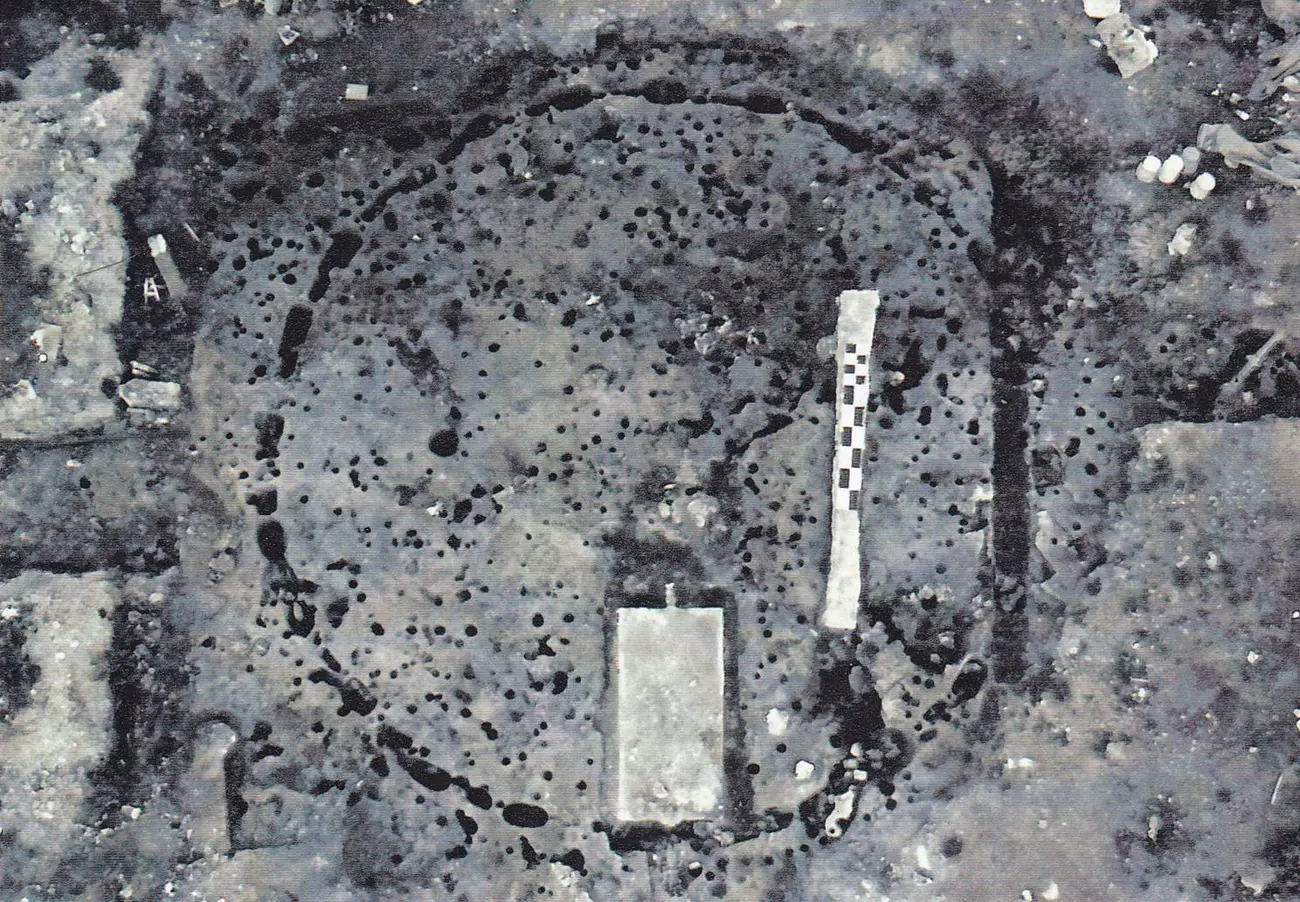
At the Brickell Point site, archaeologists uncovered a circle, about 28 feet across, defined by a series of postholes carved into the limestone bedrock. Carr said that the Miami Circle “may be of national significance as it is believed to be the only cut-in-rock prehistoric structural footprint ever found in eastern North America.”
Public speculation about what structure had been built on top of the Miami Circle was rampant, ranging from a Tequesta Indian Council House to an astronomical observatory constructed by transplanted Mayan people.
While there were undoubtedly prehistoric artifacts discovered at the Brickell Point site, not everyone is convinced that the Miami Circle was one of them.
“They don’t like me a lot in Miami,” says archaeologist Jerald T. Milanich, author of the book Handfuls of History: Stories about Florida’s Past.
When Milanich first saw the Miami Circle, he was surprised that a rectangular septic tank was inside of it.
“I think at that point, the research question should have been, how did that septic tank get there?” says Milanich. “Did it go with the apartments that were built in the 1940s? Did it go with one of the earlier Brickell houses that were there? Was there perhaps, a circular structure of some kind built over that septic tank?”
Milanich found an early twentieth century postcard of Brickell Point that shows a round structure that may be over the septic tank.
“I think what needs to be done still, to this day, is more research there, to try to answer the question of when that septic tank was put in, and what it was attached to,” says Milanich. “Clearly, that’s not a very popular idea, especially to people in Miami who worked so hard to get the government to buy the land and preserve the site.”
The Miami Circle is now protected as public land.
“All that’s left of this huge, complex archaeological site is that little bit that’s now preserved in the Miami Circle park area,” says Milanich. “I think that’s a good thing for the public, and certainly for our understanding of the past.”