Trains

Article Number
84
relevantdate

    The Labor Day Hurricane that struck the Florida Keys on September 2, 1935 is the most powerful storm to ever hit the United States. With wind gusts estimated up to 225 miles per hour and a storm surge bringing waves as high as 20 feet ashore; the hurricane was devastating.

    Nearly half of the 1,000 people who were on the Florida Keys when the hurricane arrived were killed. Among the dead were about half of the 300 World War I veterans working on road construction projects there for the federal government.

    “In 1935, this is the height of the Great Depression, so a number of Americans were out of work,” says Ben DiBiase, archivist at the Library of Florida History. “FDR and the federal government were trying to get a lot of people back to work. Unfortunately, these veterans were working in the Keys at the wrong time, during the height of the hurricane season.”

    Tragically, by the time a decision was made to send a train from Miami to rescue the veterans and others living in the Keys, it was too late.

    “The train left late and on its way down it had to stop at the Miami River because the drawbridge was raised to let holiday traffic through,” says Tom Knowles, author of the book Category 5: The 1935 Labor Day Hurricane. “Then it had to stop in Homestead to turn the engine around so they could back it down. The idea was to have the engine in the lead when it came back so it could use its headlight.”

    Unfortunately, the delays for the rescue train’s arrival did not stop there.

    “At Windley Key, the cab of the locomotive struck a cable that was normally hung over the railroad, but because of the hurricane had sagged down,” says Knowles. “It took about another hour to break that loose. By the time the train got down to Islamorada it was a little before 8:30, and that was when the storm surge came over.”

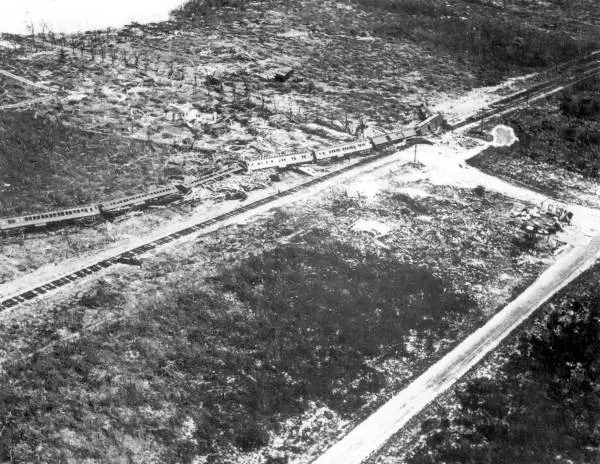
    The storm literally pushed the train off of its track. All cars but the engine and its tender were turned over on their sides.

    Renowned Florida writer Marjory Stoneman Douglas, best known for her classic book Everglades, River of Grass, wrote about the 1935 Labor Day storm in her book Hurricane:

    “At the veterans’ barracks the men packed up and moved out to huddle along the railway embankment, waiting for the train. They had to cover their faces because the stinging sand began to draw blood. Every once in a while one would say, ‘It’s coming. I hear it.’ It was the wind coming in faster and faster over the bent trees with the high shaking hurricane rumble that sounds exactly like the never-ending passing of a freight train.”

    The rescue train would never arrive.

    Acclaimed writer Ernest Hemingway was living in Key West when the hurricane hit, and he participated in the effort to rescue survivors of the devastating storm. In an article he wrote for the magazine “The New Masses,” Hemingway implied that the Florida Emergency Relief Administration did not act quickly enough to evacuate the veterans.

    On January 22, 1912, Henry Flagler realized his dream of completing the Overseas Railway, linking Miami to Key West. The Labor Day Hurricane of September 2, 1935 destroyed 42 miles of East Coast Railway track, and the rail link to the mainland was never rebuilt.

    People driving to the Keys today can see portions of the Overseas Railway bridges rising from the water, disconnected from the land and leading nowhere.

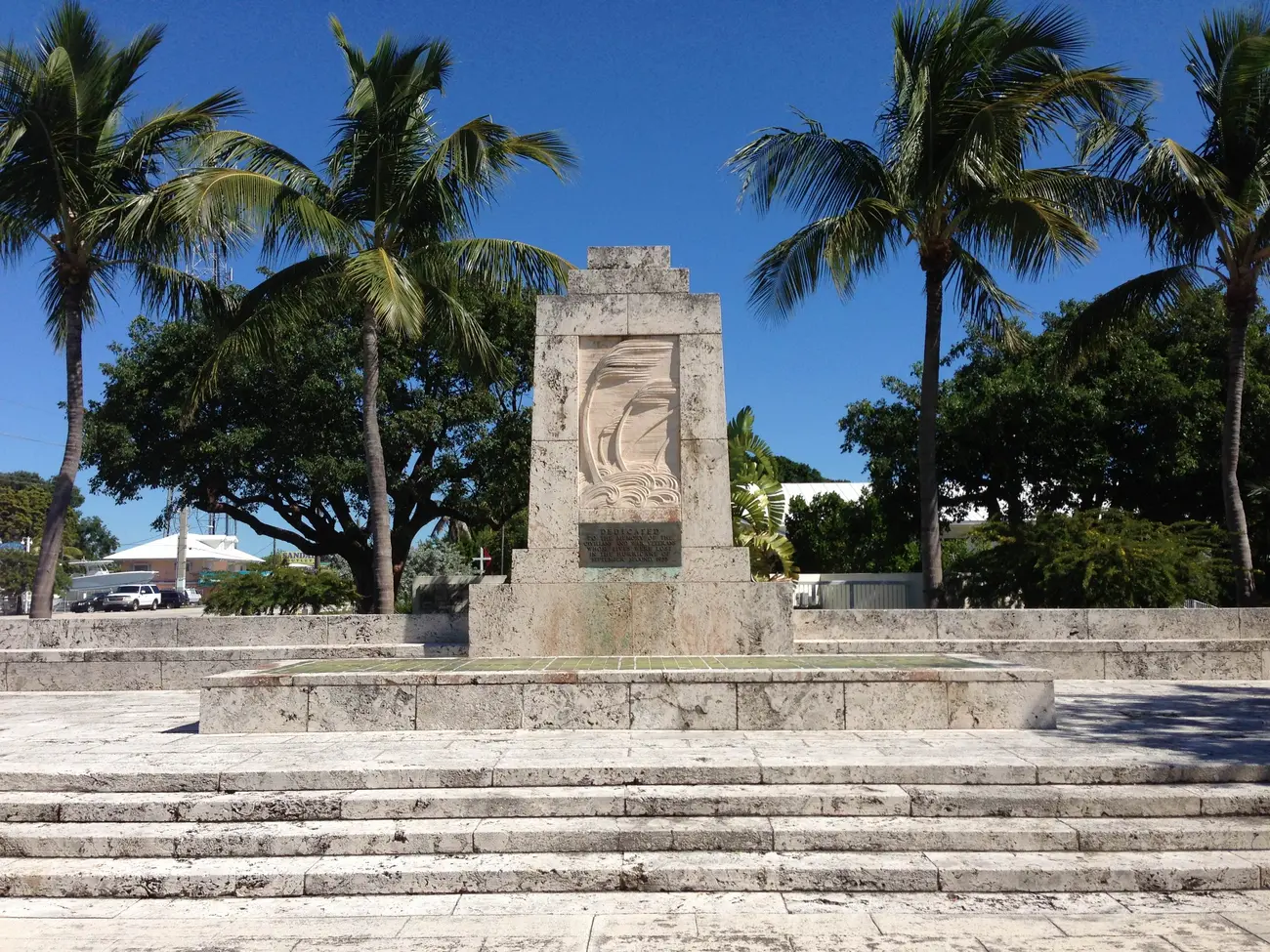
    A memorial to the people killed in the 1935 hurricane stands on Islamorada between the old state road 4A highway and U.S. 1 at mile marker 81.5.

    “Islamorada, which was a small community at that time, was completely wiped off the map,” says DiBiase. “It simply disappeared. The citizens who were living in the Upper Keys, they only numbered a few hundred, many of them lost their lives or at the very least lost everything that they owned.”

    About 1,000 people were in the Keys in 1935, and could not be successfully evacuated. Today, an estimated 80,000 people would need to leave for a similar hurricane.
    PDF file(s)
    Article Number
    75
    relevantdate

      The Plant system of railroads helped to create modern Florida.

      When Henry B. Plant was born in 1819, Florida was still under Spanish control. By 1821, Florida was named a United States Territory, and in 1845 it became a state. Before his death in 1899, Plant helped to develop Florida with railways, steamships, and luxury hotels.

      In discussions of railroads and their impact on Florida’s growth, Henry Flagler usually is the first person mentioned. Henry Plant and Henry Flagler were friendly competitors who sometimes worked together.

      “They were equally as important,” says Sally Shifke, Museum Relations Coordinator for the Henry B. Plant Museum in Tampa. “I think the reason that Henry Plant doesn’t get quite as much recognition as Henry Flagler is that Henry Flagler’s personal money was in Palm Beach.”

      “Flagler moved down to Palm Beach, had many children that continue the Flagler name today. On the other hand, Henry Plant came to the west coast of Florida, but he always remained in New York and Connecticut. He had one surviving son that lived in New York City, and when Henry Plant passed away, there was no one really to carry the torch for him. His family eventually sold off his holdings in Florida,” Shifke says.

      Henry Flagler’s railway extended from Jacksonville down Florida’s east coast, eventually linking the mainland to the Keys. He built luxury hotels along his train route, stimulating tourism. Flagler created the town of Palm Beach, and provided opportunities for development in south Florida.

      Similarly, Henry Plant linked central and west Florida to the rest of the country with his railway.

      “Plant’s railroads went up and down the southeastern United States,” says Shifke. “He started buying up bankrupt railroad lines after the Civil War, and eventually they worked themselves down to the middle of Florida and then crossed over to the west coast and went all the way down to Fort Myers.”

      Plant also operated a steamship line. After bringing his railway to Tampa, Plant used his steamship line to link west Florida to Key West and Cuba. This allowed for the transportation of both goods and people via train and steamship.

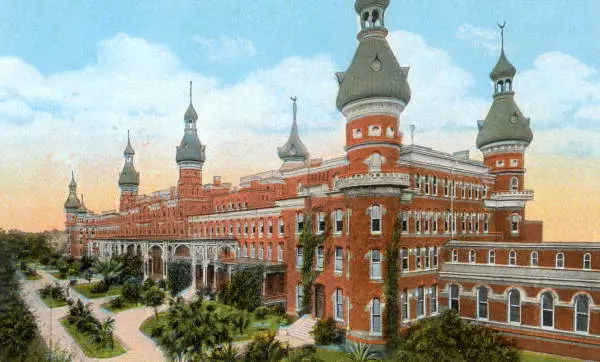
      With Tampa Bay the hub of Plant’s transportation system, in 1891 he constructed the huge and luxurious Tampa Bay Hotel.

      “When he got here in the early 1880s, there were only 750 people living here,” says Shifke. “It was a sleepy little town going nowhere. Henry Plant built the port, and eventually brought the railroads. The first hotel that he built was the Inn of Port Tampa which was only 40 rooms, and then he went on to build this colossal palace with over 511 rooms, the Tampa Bay Hotel.”

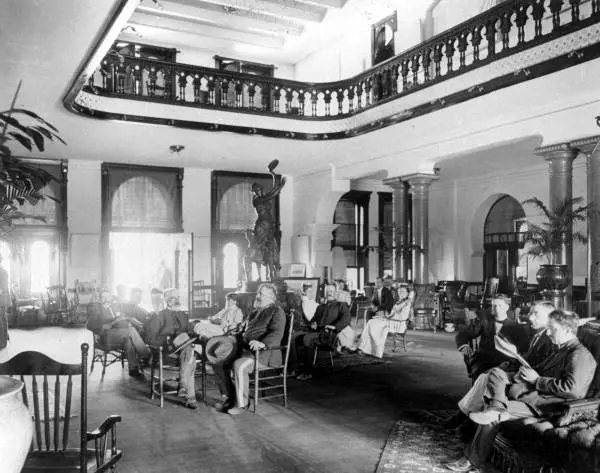
      Visitors to what is now the University of Tampa can still imagine what the Tampa Bay Hotel must have been like in its heyday. A series of silver minarets inspired by Middle Eastern architecture reach up to the sky from an elaborately ornamented brick Victorian building.

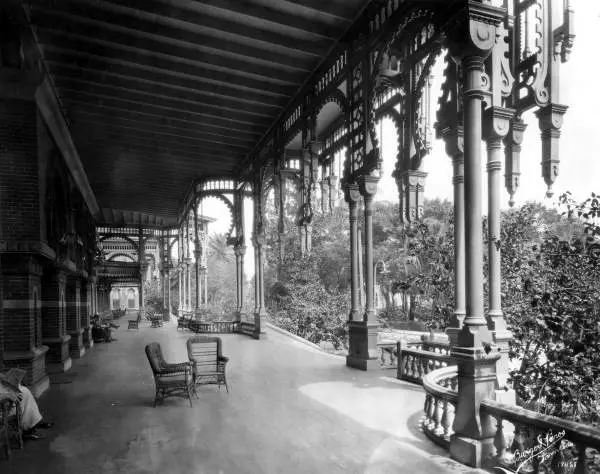
      A huge covered porch extends across the front of the former Tampa Bay Hotel. Photographs from the late 1800s and early 1900s show wealthy northerners sitting on the porch enjoying the shade. The interior of the hotel featured unique comforts for the day, such as electricity and an elevator.

      “It was one of the first buildings to be electrified in the state of Florida,” Shifke says. “He actually had to build a power plant on the grounds.”

      Plant wanted his Tampa Bay Hotel to compete with the grand hotels of his rival Henry Flagler, so visitors were offered every possible amenity. He built a golf course, tennis courts, boathouse, and horse racing track for the amusement of his guests. The floor of his 2,000 seat performing arts center and casino would roll away during the day to reveal a 50 by 70 foot swimming pool.

      The opulent Tampa Bay Hotel continued operating even after Plant’s death. It was purchased by the city of Tampa 1905. With the Great Depression of the 1930s, the Tampa Bay Hotel closed.

      In 1933, the University of Tampa took control of the building, and since that time a wing of the former hotel has been operated as the Henry B. Plant Museum.

      PDF file(s)
      Article Number
      72
      relevantdate

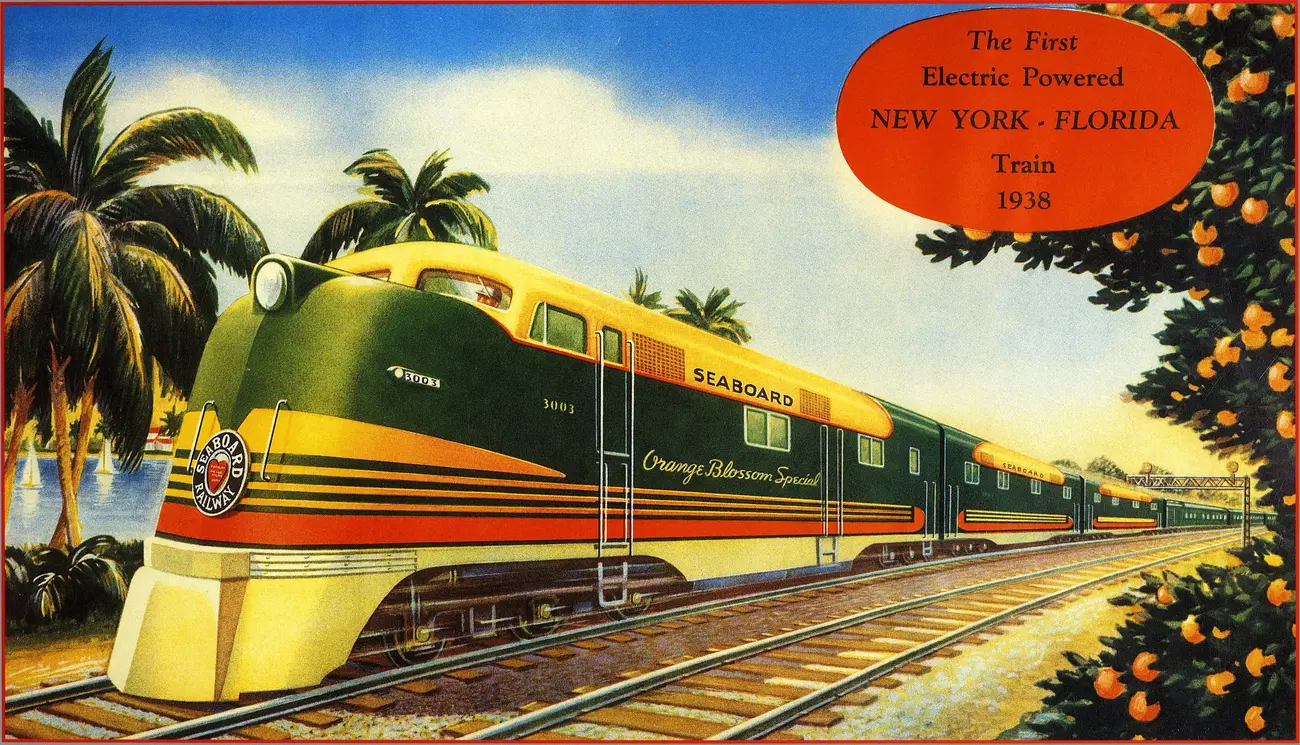
        From 1925 through 1953, the luxury passenger train Orange Blossom Special traveled from New York City to Miami and back.

        Other Florida stops included Jacksonville, Ft. Lauderdale, and Hollywood before the train returned north via Winter Haven, Bradenton, Tampa, St. Petersburg, Orlando, Gainesville, and Tallahassee.

        The Orange Blossom Special came to Florida between mid-December and mid-April. Even more famous than this luxurious train and its wealthy passengers is the song “Orange Blossom Special.”

        Tradition holds that the music to the song “Orange Blossom Special” was written by renowned fiddlers Chubby Wise and Irvin T. Rouse, and that the words were written later by Rouse’s brother Gordon.

        “As the story goes, both Chubby Wise and Irvin Rouse visited the Orange Blossom Special when it passed through Jacksonville on an exhibition tour in 1938,” says Randy Noles, author of the book Fiddler’s Curse: The Untold Story of Irvin T. Rouse, Chubby Wise, Johnny Cash and the Orange Blossom Special.

        “It’s hard to imagine now, but this was a huge deal. This train had brand new diesel electric locomotives and Pullman cars, and it was on an exhibition tour between Washington and Miami that stopped in every city of any size along the way for people to look at it. Now we think ‘Well gee, it was just a train,’ but at the time it was like the space shuttle coming through town.”

        When the Orange Blossom Special stopped in Jacksonville, schools closed so children and their families could visit the train. In the two days that the train was parked there, approximately 30,000 people came to see it.

        “They were just awestruck by it because of its design and its technology and everything it represented, and Chubby and Irvin were not immune to that,” says Noles. “They visited the train when it came through on the exhibition tour, and as the story goes, they were inspired to write the song.”

        Even though Irvin T. Rouse is the only name that appears on the copyright for the music portion of “Orange Blossom Special,” the story that Chubby Wise co-wrote the song has gained widespread acceptance.

        Before his death in 1996, Chubby Wise repeated his claims of co-writing “Orange Blossom Special.”

        “I said ‘if you can do anything with it it’s all yours.’ I remember them very words as if it was yesterday, and Irvin did something with it,” said Wise. “I didn’t have nothing to do with the words. He and his brother Gordon wrote the words on it.”

        Chubby Wise is considered to be one of the greatest fiddlers in country music. At age 15, Wise started playing in Jacksonville night clubs, and joined the Jubilee Hillbillies in 1938. In 1942, he started playing at the Grand Ole Opry with Bill Monroe’s Bluegrass Boys, and recorded with many other artists over the years. In 1984, he moved back to Florida, recording and performing infrequently.

        Irvin T. Rouse lived from 1917 to 1981, and is also considered to be a great fiddle player. Irvin worked with his brother Gordon, traveling from Florida to New York to record and perform. Irvin suffered from mental illness and alcoholism, spending the last decades of his life playing in remote clubs near the Everglades for tips.

        Irvin’s brother Gordon Rouse always maintained that Chubby Wise did not co-write “Orange Blossom Special.”

        “It’s very easy to say you done something that you didn’t do,” said Rouse. “You tell people you did it and people don’t know if you did it or not.”

        During research for his book Fiddler’s Curse, Randy Noles concluded that the story of Chubby Wise co-writing “Orange Blossom Special” is false.

        “It’s the story that made it into the history books and that Chubby propagated repeatedly over the years. It turns out not to have been true, because the song had been written and copyrighted prior to the exhibition tour to Jacksonville, so it couldn’t possibly have happened the way Chubby described.”

        What is indisputably true is that Chubby Wise’s outstanding fiddle playing helped to popularize the song “Orange Blossom Special” around the world.  It is a standard of the country music repertoire, and has been played and recorded by rock bands and symphony orchestras.

        PDF file(s)