Florida Frontiers

A Tag for nodes that are relevant to Florida Frontiers.   For example if an artilce is about Florida Frontiers and you would like a 'View' to sorty by Tag criteria for it... us it.

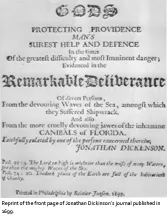
The ship Reformation wrecked off of the east coast of Florida near resent day Hobe Sound on this date. Onboard was a Quaker merchant traveling from Port Royal Jamaica to Philadelphia with his family named Jonathan Dickinson. The shipwrecked survivors were harassed and at times held captive by some of the Native American tribes including the Ais and the Jaega. Dickinson and the surviving members of their party traveled north along the undeveloped east coast of Florida finally reaching Spanish St. Augustine on November 15th.

John Bartram, famous naturalist and explorer died on this date. Considered the “father of American botany,” Bartram first came to East Florida in the winter of 1765/66 and collected numerous plant species, noting the faunal species as well. His account of the expedition was published in the Journal in London and many of his specimens were sold to collections back in England. His son William would become even more famous for his exploration of Florida and the southeastern U.S. and his book Travels.   

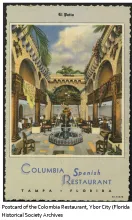
The Columbia Restaurant opens its doors! The Columbia Restaurant is the oldest continuously operated restaurant in Florida, the oldest Spanish restaurant in the United States and one of the largest Spanish restaurants in the world. The restaurant, which began in Ybor City as a small 60-seat corner café, now has 1,700 seats in 15 dining rooms taking up 52,000 ft² over an entire city block. Founded by Cuban immigrant Casimiro Hernandez, Sr., the landmark restaurant and its 7 additional locations are still owned and operated by fourth and fifth generation Hernandez/Gonzmart family members.

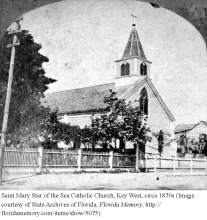
The Saint Mary Star of the Sea Catholic Church in Key West burned down on this date. Although the first official Catholic mass in Key West was held at the City Hall building in October of 1846, a dedicated church was not constructed until 1852. It was this 1852 structure which was completely destroyed by the fire, which was believed to be an act of arson. In 1905 the current church was dedicated and is now known as the Basilica of Saint Mary Star of the Sea.  

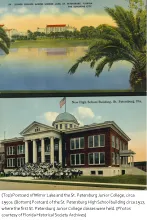
The charter forming the St. Petersburg Junior College was signed on this date. SPJC was the first two-year institution of higher learning of its kind in the state. In 1927, city leaders saw the need to provide local access to higher education for students with limited means. Initially a private institution, the first classes were held in an abandoned wing of the St. Petersburg High School building. In 1931 SPJC became fully accredited and by 1948 it became a public institution. Now known as St.

1928 – Rueben O’Donovan Askew, the 37th Governor of Florida was born on this date in Muskogee Oklahoma. Askew moved to Escambia County in 1930s and attended Pensacola High School. He graduated from both The University of Florida and Florida State University and served in both the Florida House of Representatives and the Florida Senate before being elected Governor in 1971. Askew served two consecutive terms in office (1971-1979), and his governorship was known for its stance on racial justice, capital punishment, and tax reform.

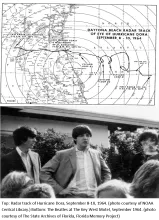
1964 – Hurricane Dora, the first hurricane on record to make landfall on the extreme northeast coast of Florida, struck just north of St. Augustine on this date. The storm had sustained winds of 120 mph and caused five deaths and $200 million in damage. The Beatles were scheduled to play a concert in Jacksonville but were forced to divert to Key West because of the storm.

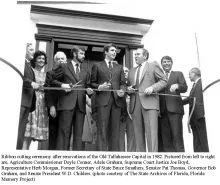
1982 – The Old State Capital re-opened its doors to the public today. The structure was originally built in 1845 and was restored to its 1902-version when the new State Capital was built directly behind the old building. One can still visit and tour the many displays and exhibits that make up the Florida Historic Capital Museum throughout year! Check out http://www.flhistoriccapitol.gov/ for more information. 

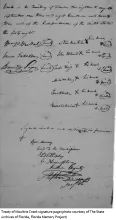
1823 – The Treaty of Moultrie Creek was signed on this date between the Seminole Indians and the U.S. government as a result of the U.S. acquisition of Florida two years earlier. Terms stipulated in the treaty included the concentration of the Seminoles onto a reservation in central Florida, thus relinquishing all other lands to the U.S., and also the promise by the Seminoles to apprehend all slaves and other fugitives found in this new reservation.  The Indians were promised farming implements and funds to help develop this new land.