


Welcome to "Today in Florida History"
Sponsored by The Florida Historical Society andThe Library of Florida History
All material in this section for history on a date may be duplicated and used freely without the further permission of The Florida Historical Society or the Library of Florida History. Teachers, newspapers and other media outlets are encouraged to make wide use of this material to further the study of Florida History. The only request we have is that the Florida Historical Society be credited in any publication or use of this material.
JANUARY 1
1836 On this
date, the Seminole people were supposed to migrate to Oklahoma.
The Second Seminole War started on December 28 to forestall this
activity.
1862 Union
guns on Santa Rosa Island opened fire on an unnamed steamer brought into the
Navy yard by Confederate forces in Pensacola.
Although the Confederates suffered no casualties, a large storehouse was
hit by an exploding shell and burned to the ground.
1862 Governor
John Milton called the “Columbia Trapiers” into service today. This unit is commanded by Captain J. R. Francis.
1862 Two
Federal blockade ships, the U.S.S.
Rhode Island and the U.S.S.
South Carolina, were sighted in the Gulf of Mexico near Pensacola.
1863 The
Battle of Murfreesboro (Stone’s River) continued today as Confederate forces
under General Braxton E. Bragg do battle with Union forces under the command of
General William S. Rosecrans. The
Florida 4th Infantry Regiment suffered 55 casualties, killed or
wounded, but captured 250 enemy weapons.
1863 The
Federal ship U.S.S.
Gem of the Sea captured the Confederate sloop Ann six miles east of Jupiter Inlet.
1864 The U.S.S. Rosalie put into Charlotte Harbor today after a
rendezvous with the U.S.S. Gem of the
Sea in the Gulf of Mexico.
1883 The
City of Eustis was incorporated.
1885 The
City of Lakeland was incorporated today.
1885 Florida’s
fifth Constitution, created by a Constitutional Convention that met in
Tallahassee on June 9, 1885, went into effect today and remained the basic law
of the Sunshine State until 1968. The
1885 Constitution replaced the “Carpetbag” Constitution of 1868.
1895 The
Tampa Tribune began daily
publication today.
1914 The first scheduled commercial airplane flight was made today from St. Petersburg to Tampa. Tony Jannus, a pioneering aviator, opened the service with his flying boat, the Benoist, which could haul one passenger and a small amount of freight. A. C. Pheil, former mayor St. Petersburg, purchases the first passenger ticket for $500.00. Jay Dee Smith was Jannus’ mechanic. Two daily round trips were flown for 28 consecutive days.
1935 Bucknell
University defeated the University of Miami 26-0 in the first every Miami Orange
Bowl game.
1936
Cypress Gardens, the longest continuously operating tourist attraction,
was opened today by Mr. and Mrs. Richard D. Pope, Sr. Cypress Gardens closed in 2003 and is under consideration for
purchase by the State of Florida.
1946 The
University of South Carolina suffered a 26-14 loss to Wake Forest University in
the first-ever Gator Bowl.
1960 Indian
River Community College at Fort Pierce was established today.
1978 Anne
Cawthon Booth was appointed the Judge of the First District Court of Appeal
(Tallahassee) by Governor Reubin O’D. Askew today.
Ms. Booth became the first woman to serve as an appellate judge in the
State of Florida.
TODAY IN FLORIDA HISTORY
JANUARY 2
1830 Henry
Morrison Flagler, founder of the Florida East Coast Railway and developer of the
East Coast’s tourist industry, was born today in Hopewell, New York.
Flagler, whose interest in Florida stemmed from visits to St. Augustine,
combined his railroad interests with hotels and steamships.
An early partner with John D. Rockefeller in Standard Oil, Flagler spent
millions on his Florida projects, eventually constructing the longest railroad
over water with his Florida Overseas Railroad, which connected the mainland with
Key West. Flagler eventually
planned to span the Straights of Florida to connect his Key West terminus with
the island of Cuba.
1847 Nathaniel
P. Bemis took office as Florida’s Comptroller today.
1848 Julia
A. Tuttle, the so-called “Mother of Miami,” was born today in Ohio. An early (1872) settler
in the present-day Miami area, Ms. Tuttle was reported to have lured Henry
Flagler and his railroad south when she sent him a branch of blooming orange
blossoms during the devastating freeze of 1894-95. (See entry for September 14).
1861 The
artillery duel between Confederate and Union forces at Pensacola continued until
about 4 o’clock this morning. Casualties
were minimal for both sides.
1861 General
Robert E. Lee has asked Brigadier General J. H. Trapier to increase the number
of cannons and manpower on Cumberland and Amelia Islands to protect Fernandina
from a Union attack.
1863 Florida
units with the Confederate Army of Tennessee were still engaged in the Battle of
Murfreesboro (Stone’s River) in Tennessee.
Captain Augustus O. MacDonnell of the 1st and 3rd
Florida Consolidated narrowly escaped serious injury when his sword was
shattered by a shell fragment.
1864 The
Confederate Congress has approved the following Floridians as adjutants in
Florida regiments and battalions:
James B. Johnson, 5th Infantry Regiment
R. J. Reid, 2nd Infantry Regiment
W. McR. Jordan, 3rd Infantry Battalion
B. F. Parker, 4th Infantry Battalion
James O. Owens, 6th Infantry Battalion
George Dawson, 7th Infantry Regiment
F. Philips, 1st Cavalry Regiment
C. B. Paslay, 7th Infantry Regiment
1865 Senators
Augustus E. Maxwell and James M. Baker, along with Representative Robert B.
Hilton, join other Confederate legislators as the Confederate Congress
re-convenes after a one-day New Year’s Day recess.
1877 George
Franklin Drew, the twelfth governor of Florida (1877-1881) was inaugurated
today. (See entry for August 6 for
more information)
1898 Booker
T. Washington, the noted African-American leader, addressed an audience in
Jacksonville today. His speech
stressed that the development of commercial and industrial project held the key
for the advancement of the American Negro.
1917 Ernest
Amos took office as Florida’s Comptroller today.
1917 Sidney
Johnston Catts, Florida’s Prohibition governor, took the oath of office today
as the state’s twenty-second governor. (For
more information, see entry for July 31.)
1933 David
Sholtz became Florida’s twenty-sixth governor today in inauguration ceremonies
in Tallahassee. (For more
information about Sholtz, see the entry for October 6.)
1945 Millard
Fillmore Caldwell was inaugurated as Florida’s twenty-ninth governor today in
Tallahassee. (For more information,
see entry for October 23.)
1979 On this
day, “Bob” [D. Robert} Graham was inaugurated as the Sunshine State’s
thirty-eighth governor. He would
succeed himself as governor on January 4, 1983.
Graham was born on November 9, 1936 in Coral Gables.
Graham graduated from the University of Florida in 1959 and received a
law degree from Harvard Law School in 1962.
He served in a variety of executive positions in the Sengra Corporation
(The Graham Companies), was a developer of Miami Lakes, and helped administer
the family’s cattle holdings.
As governor, Graham supported a number of environmental measures to save
the state’s Everglades, sea shores, and barrier islands.
Governor Graham engendered a strong public support through his personal
program of “workdays,” a program he still practices as Senator.
1979 George
Firestone assumed the position of Florida’s Secretary of State.
He was succeeded on August 5, 1987 by Jim Smith, who was appointed by
Governor Bob Martinez.
1979 Jim
Smith assumed office as Florida’s Attorney General on this date.
TODAY IN FLORIDA HISTORY
JANUARY 3
1823 Joseph
M. Hernandez was seated as the first Territorial Representative to the United
States Congress from the Territory of Florida.
1861 Delegates
to the Florida Secession Convention meet in Tallahassee to take up the question
of secession. Edmund Ruffin of
Virginia arrived to confer with Governor Madison Starke Perry and members of the
convention.
1863 John
Branch, the sixth Territorial Governor of Florida, died today in Enfield, North
Carolina. (For more information,
see entry for August 11.)
1863 The
Battle of Murphreesboro (Stone’s River) came to an end today. General Braxton E. Bragg withdrew from the battle despite
apparent victory during the first two days.
Florida units in the Army of Tennessee suffered a large number of
casualties. (See entry for December
31.)
1865 The U.S.S. Kanawha today captured the Confederate schooner Mary
Ellen today in the Gulf of Mexico off the coast of Florida.
1877 William
D. Bloxham assumed office as Florida’s Secretary of State.
He will hold this position until he was succeeded by F.W.A. Rankin, Jr.
on October 1, 1880.
1877 George
P. Raney was sworn in as the Attorney General of Florida.
1893 Henry
Laurens Mitchell was inaugurated as Florida’s sixteenth governor (1893-1897)
today. (See entry for
September 3 for more information.)
1893 William
N. Sheats became the state’s Superintendent of Public Instruction today, while
C. B. Collins was sworn in as Treasurer.
1897 W. H.
Reynolds took office as Florida’s Comptroller.
1905 Napoleon
Bonaparte Broward, “Florida’s Fighting Democrat,” was inaugurated as
Florida’s nineteenth governor today. (For
more information about Broward, see entry for October 1.)
1905 William
M. Holloway became Florida’s Superintendent of Public Instruction
today.
1924 The
“Southern Jewish Weekly” was founded today in Jacksonville.
1925 The
first races at St. Petersburg’s Derby Lane greyhound track were run today.
The track, operated by the Kennel Club, was the oldest greyhound track in
the world.
1933 J. M.
lee assumed the office of Comptroller today.
1941 J.
Edward Larson was sworn in as the Treasurer of Florida today.
1961 Cecil
Farris Bryant took office today as the Sunshine State’s thirty-fourth
governor. (For more information on
Bryant, see entry for July 26.)
1961 Doyle
E. Connor was sworn in as Florida’s Commissioner of Agriculture today, and Tom
Adams was installed as Secretary of State.
1966 Dr.
Earl S. Weldon assumed the presidency of Seminole Junior College, which was
chartered in 1965.
1967 Claude
Roy Kirk, Jr. was installed as Florida’s thirty-sixth governor today. Kirk was born on January 7, 1926, in San Bernardino,
California. He lived in a variety
of locales during his youth, and graduated from high school in Montgomery,
Alabama, when he was seventeen. He
enlisted in the Marine Corps and, after officer training at Quantico, Virginia,
was commissioned as a second lieutenant. He
left the Marines in 1946 and entered law school. He received his law degree in 1949.
Kirk returned to active duty
in 1950 and served in combat in Korea. After
the war, he entered the insurance and investment business in Jacksonville,
eventually heading up the Kirk Investments Company.
A former democrat, Kirk led the “Floridians for Nixon” campaign in
1960. In 1964, he waged an
unsuccessful race for the U.S. Senate. In
1966, he was successful in his campaign for the governorship and became the
first Republican to hold this position since the end of Reconstruction.
In 1978, he ran an unsuccessful campaign for governor as a Democrat.
In 1988, he failed in his bid for the U.S. Senate as the Democratic
nominee.
1987 John
Wayne Mixon served only three days as Florida’s thirty-ninth governor. Mixon, the Lieutenant Governor, succeeded Bob Graham, who
resigned three days before the end of his second term to take his position in
the United States Senate. Mixon was
born June 16, 1922, near Brockton, Alabama.
He entered public service in 1967 when he was elected to the first of six
consecutive terms of office in the Florida House of Representatives.
Mixon served in the United States Navy during World War II. He attended Columbia University in new York, the Wharton
School of Finance at the University of Pennsylvania, and graduated in 1947 from
the University of Florida.
1989 Tom
Gallagher took the oath of office as Florida’s Treasurer today.
TODAY IN FLORIDA HISTORY
JANUARY 4
1847 The
appointment and licensing of port and harbor pilots by Dade County officials
authorized by state government.
1861 Governor
Madison Perry and his advisors made the decision to seize Federal properties in
Florida.
1862 The
Union blockader, U.S.S. Sagamore,
was sighted near Santa Rosa Island.
1863 William
Dunn Moseley, Florida’s first governor under statehood (1845-1849), died
today. Moseley was born at Moseley
Hall, Lenoir County, North Carolina, on February 1, 1795.
He attended the University of North Carolina with such notables as James
K. Polk, later president of the United States.
After college, he practiced law in Wilmington, North Carolina, and
entered public service as a state senator.
He was defeated in the North Carolina gubernatorial race of 1834.
In 1835, Moseley purchased a plantation in Jefferson County, Florida, and
resided there until 1851. A member
of the Territorial Legislature, Moseley defeated Richard Keith Call, the third
and fifth Territorial governor of Florida, in the contest to become the first
governor of the new state of Florida. In
1851, Moseley moved to Palatka, where he was a planter and fruit grower.
1881 William
Dunnington Bloxham, the thirteenth (1881-1885) and seventeenth (1897-1901)
governor of Florida, was inaugurated today.
Born in Leon County on July 9, Bloxham’s first administration was
marked by the sale of the Disston Land Purchase.
He died at Tallahassee on March 15, 1911.
(For more information, see the entry for July 9.)
1901 The
first issue of the “Daytona News” was published today.
1921 Rivers
Buford was sworn in as Florida’s Attorney General today.
1925 Cary
Augustus Hardee, the 23rd governor of Florida, was inaugurated today.
During his administration, the convict leasing system was outlawed.
Hardee died ion November 21, 1957. (For
more information, see the entry for November 13.)
1949 Fuller
Warren, the thirtieth governor of Florida, was inaugurated today. A native of Blountstown, Warren was born on October 3, 1905,
and died in Miami on September 23, 1973. (For
more information, see the entry for October 3.)
1949 Richard
W. Ervin took office as Florida’s Attorney General, and Thomas D. Bailey
assumed office as the Superintendent of Public Instruction.
1961 Thomas
LeRoy Collins, the thirty-third governor of Florida, took the oath of office
today. Collins was born on march
10, 1909, in Tallahassee. A
graduate of Leon High School, Collins attended the Eastman School of Business at
Poughkeepsie, New York, and received a law degree from Cumberland University.
He married Mary Call Darby, the great-granddaughter of two-time
Territorial Governor Richard Keith Call. Collins
was elected as Leon County’s representative
to the Florida House in 1934, 1936,
and 1938. He was elected to the
Florida Senate in 1940 an re-elected in 1942.
He resigned to serve in the U.S. navy, and was re-elected in 1946 and
1950. Collins was first elected
governor to complete the two remaining years of the term of the late Governor
Dan McCarty. He was elected for a
full term in 1956.
Collins’ term was marked by the rise of the civil rights movement in
Florida, and through his leadership, Florida avoided much of the violence and
turmoil that marked desegregation in other Southern states.
Following his terms as governor, Collins served as Undersecretary of
Commerce in the Johnson administration. He
was unsuccessful in a bid for the U.S. Senate in 1968. He died on March 25, 1991.
1978 Janet
Reno became Florida’s first State Attorney when Governor Reubin O’D. Askew
appointed her to head up the Eleventh Judicial District (Miami) when Richard
Gerstein resigned. Ms. Reno was
the Attorney General of the United States during the administration of
President Bill Clinton.
TODAY IN FLORIDA HISTORY
JANUARY 5
1836 Lewis
Cass requests an appropriation of $80,000 from the U.S. House of Representatives
for “the expenses attending the repression of the hostilities commenced by the
Seminole Indians in Florida.”
1861 The
Quincy Guards, commanded by Colonel Duryea, seized the Chattahoochee Arsenal
today. The troops confiscate
500,000 rounds of musket cartridges, 300,000 rounds of rifle cartridges, and
50,000 pounds of gunpowder.
1861 The
Florida Secession Convention reconvened today.
John C. McGehee, a passionate state-rights planter from Madison County,
was elected permanent chairman. McQueen
Macintosh of Apalachicola introduced a resolution declaring Florida’s right to
secede and urged the passage of a proclamation declaring that the state was no
longer a part of the United States.
1863 Crews
from the U.S.S. Sagamore seized
the British blockade runner Avenger
in Jupiter Inlet. The Avenger
was carrying a cargo of coffee, gin, salt, and other goods.
1865 An
expedition from the U.S.S. Winnebago
seized two copper kettles used for distilling turpentine, 1,280 copper pipes,
and four sloop-rigged boats in the Gulf of Mexico today.
1887 An inch
of snow fell at Pensacola today.
1929 Gene
Sarazin won the $750 first prize at the Miami Open Golf Tournament.
His score was 294 for 72 holes. The
monetary prize was $750.
1941 Frederick
Preston Cone took the oath of office today to become Florida’s 27th
governor. (See entries for July 28
and September 28.)
1965 William
Hayden Burns took the oath of office today to become Florida’s 35th
governor (1965-1967). Burns was
born on March 17, 1912 in Chicago, Illinois.
he attended Jacksonville public schools and Babson College.
During World War II, Burns served in the U.S. navy.
In 1949, he won his first election to public office when he was elected
Mayor-Commissioner of Jacksonville, a position he won in 1951, 1955, 1959, and
1963. In 1960, he finished third in
a race for the Democratic nomination for governor. In 1964, he achieved the office.
Although eligible for a second two-year term, he was defeated by Claude
Roy Kirk, Jr., a Republican, in 1966.
In 1971, Burns was defeated in his bid for election as Mayor of
Jacksonville.
Burns died in Jacksonville on November 22, 1987.
1965 Earl
Faircloth was installed at the Attorney General of Florida today.
1971 Reubin
O’Donovan Askew, the thirty-seventh Governor of Florida, was inaugurated today
for the first of his two consecutive terms as governor.
(For more information, see entry for September 11.)
1971 Thomas
D. O’Malley assumed office today as Florida’s Treasurer, and Robert L.
Shevin was inaugurated as Attorney General.
Richard B. Stone was inaugurated as Secretary of State.
1979 Jim
Smith took the oath of office today for the position of Florida Attorney
General.
TODAY IN FLORIDA HISTORY
JANUARY 6
1836 Casualties
from the Seminole uprising continue. Authorities
report that sixteen East Florida plantations have been laid to waste.
1839 E. L.
Drake of Escambia County became the first Speaker of the Florida Territorial
House of Representatives today.
1855 The
Internal Improvements Fund was established today.
This created the mechanism by which improvements can be funded through
the sale of public lands.
1861 U.S.
Senator Stephen F. Mallory of Florida recommends that the state’s Secession
Convention secede. This declaration
followed a caucus of Southern senators called by Jefferson Davis and John
Slidell of Mississippi.
1863 The U.S.S. Pocahontas captured the blockade runner Antona
today off Cape San Blas, Florida.
1863 The U.S.S. Ariel today
captured the sloop Good Luck, a
blockade runner from New Smyrna near Key Biscayne Bay.
1885 Edward
Aylsworth Perry became the fourteenth governor of Florida (1885-1889) today.
(See entry for October 15 for more information.)
1895 The
first Sunday edition of the Tampa Tribune
was published today.
1925 John
Wellborn Martin took the oath of office today as Florida’s twenty-fourth
governor. Martin was born on June
21, 1884, in Marion County. Admitted
to the bar in 1914, he began the practice of law in Jacksonville.
From 1917 until 1924, martin was the Mayor of Jacksonville.
Martin presided over the end of the Florida “Boom” and the
Florida “Bust.” During
his administration, Florida began an expansive program of highway construction,
direct State appropriations to finance public schools, and the distribution of
free textbooks to students in grades 1-6. In
1928, he was defeated in his bid for a United States Senate seat.
In 1932, he lost a bid to regain the governor’s office.
In the 1940s, Martin served as a co-receiver and trustee for the Florida
East Coast Railroad.
He died in Jacksonville on February 22, 1958.
1953 Daniel
Thomas McCarty was inaugurated as the state’s 31st governor today.
McCarty was born in Fort Pierce on January 18, 1912.
On February 25, 1953, McCarty suffered a debilitating heart attack and
died on September 28. (See entry
for September 28 for more information.)
1985 A
Pensacola abortion clinic was bombed today marking a significant turn of
direction in the anti-abortion movement’s opposition to legalized abortion.
1987 Robert
“Bob” Martinez of Tampa became the 40th governor of Florida
today. Martinez was born in Tampa
on December 25, 1934. He attended
the University of Tampa and the University of Illinois.
A high school teacher for seven years, Martinez also served as the
Executive Director of the Hillsborough [County] Classroom Teachers Association
until he took over the family business, the Cafe Sevilla.
In 1979, Martinez was elected Mayor of Tampa as a Democrat, and
re-elected as a Republican in 1983.
Martinez alienated many Floridians through his anti-abortion stance,
because of his reneging on a campaign promise not to raise taxes, and because of
his somewhat imperious leadership style. He
also campaigned against the creation of a state lottery system, but approved the
measure after it was passed by the Florida legislature.
He was defeated for re-election by Lawton Chiles in 1990.
Following his tenure as governor, he served briefly as the head of the
Drug Enforcement Agency under President George Bush.
TODAY IN FLORIDA HISTORY
JANUARY 7
1821 The
first organized Baptist congregation, Pigeon Creek Baptist Church, was organized
today near Callahan (Northeast Florida). The
congregation consisted of both black and white parishioners.
1841 Company
I, 3rd Artillery, United States Army engaged in fighting with
Seminole Indians near Ft. Lauderdale today.
One enlisted man was wounded and subsequently died from his wounds on
January 22.
1848 William
R. Hayward was sworn in as the Treasurer of the State of Florida.
1861 Federal
soldiers guarding Fort Marion (Castillo de San Marcos) in St. Augustine
surrender the post to a company of local volunteers.
In Tallahassee, the Secession Convention, after hearing appeals from
Edmund Ruffin of Virginia, E.C. Bullock of Alabama, and L.S. Spratt of South
Carolina, approves the McIntosh resolution by a vote of 62-5 for immediate
secession. A committee of 13 was
appointed to prepare the official secession ordinance.
1903 Florida
author Zora Neale Hurston was born today. Some
controversy exists as to the actual place of her birth.
Some authorities claim it was in Eatonville (east of Orlando), but the
latest scholarship places her birth place in Alabama.
Regardless of where she was born, Hurston certainly considered Eatonville
her home and centered many of her stories there.
1911 Thelma
(Butterfly) McQueen was born today in Tampa.
McQueen gained enduring fame for her portrayal of “Prissy” in the
1939 epic, “Gone with the Wind.”
1913 Park
Trammell, the 21st governor of Florida (1913-1917), took the oath of
office today. Trammell, who was
born on April 9, 1876 in Macon County, Alabama, attended grade school in Polk
County. During the Spanish-American
War, he served in the Quartermaster Corps in Tampa.
After studies at Vanderbilt University, Trammell received a law degree
from Cumberland College (also the alma
mater of LeRoy Collins) in 1899. A
citrus grower and attorney in Lakeland, he served two terms as Mayor of the
city. He was elected to the Florida
House of Representatives in 1903 and to the Florida Senate in 1905.
He served as President of the Senate.
In 1908, Trammell was elected Attorney general, and in 1912, he was
elected governor. The hallmark of
the Trammell administration was campaign spending reform and the equalization of
property tax assessments in all counties. In
1916, he was elected to the United States Senate and served in that capacity
until his death in Washington on May 8, 1936.
1913 Thomas
F. West took the oath of office as the Attorney General of Florida today, while
William N. Sheats was installed as the Superintendent of Public Instruction.
1941 Spessard
Lindsey Holland was sworn in as the 28th governor (1941-1945).
He was born at Bartow on July 10, 1892 and died on November 6, 1971.
(For more information see entries for July 10 and November 6.)
1941 J. Tom
Watson took the oath of office as Attorney General today.
Watson was somewhat frustrated as Attorney General since Florida was a
“right to work” state and Federal war industries contracts recognized the
rights of unions to organize laborers. Despite
a lawsuit and strong protests by Watson, the Federal government persisted in
this policy. As soon as World War
II was over, Watson immediately and successfully sought to restore the “right
to work” law.
1969 Floyd
T. Christian assumed office as the first Commissioner of Education in Florida.
The Constitution Revision of 1968 provides for this new title, which was
a change from the previously Superintendent of Public Instruction.
1975 Bruce
A. Smathers was installed as Florida’s Secretary of State today, and Gerald
Lewis took the oath of office as the Comptroller of Florida.
TODAY IN FLORIDA HISTORY
JANUARY 8
1848 Holmes
County was established as Florida’s 27th county today.
The county took its name from Holmes Creek, the eastern boundary of the
county. County
Seat: Bonifay
1853 Sumter
County, Florida’s 29th county, was created today.
The county was named in honor of General Thomas Sumter, a native of South
Carolina who was prominent in the Revolutionary War. County Seat:
Bushnell
1853 David
Levy Yulee and his financial partners incorporated the Florida Railroad Company
today. The railroad was planned to
run between Fernandina and Cedar Key.
1861 Governor
Madison Starke Perry ordered the occupation of Fort Clinch (Amelia Island) by
Florida troops. He also authorized
Colonel William Chase to seize the Federal forts at Pensacola if he can.
1861 In the
Secession Convention, the Ordinance of Secession was introduced for debate.
The efforts of George T. Ward of Leon County and Jackson Morton of Santa
Rosa County to defer secession until Georgia and Alabama have seceded were
defeated.
1863 In a
rather busy day of activity, the Union Navy ships of the Blockading Squadron
engaged in efforts along the entire coast of Florida. In
North Florida, the U.S.S. Uncas
reported an attack by land-based Confederates as it moved along the Nassau
River. Three Federals were wounded.
In Tampa Bay, the U.S.S. Tahoma
captured the blockade runner Silas
Henry with a cargo of cotton. The
Silas Henry had run aground in
Tampa Bay. The U.S.S. Sagamore seized the British sloop Julia
ten miles north of Jupiter Inlet with a cargo of salt.
The Julia was the ship
suspected for carrying away the light from the Cape Florida lighthouse.
1864 Two
armed boats from the U.S.S. Roebuck
were dispatched to Jupiter Inlet to halt the influx of small blockade-runners
from the Bahamas.
1885 C. M.
Cooper was installed as the Attorney General of Florida.
1888 William
B. Lamar took the oath of office as Attorney General of Florida.
1889 Francis Philip Fleming, the 15th governor of
Florida (1889-1893), took office today. Fleming
was born at Panama Park, Duval County, on September 28, 1841 and died in
Jacksonville on December 20, 1908. (For
more information, see entries for September 28 and December 20.)
1889 F. J.
Pons was sworn into office today as the Treasurer of Florida.
1901 William
Sherman Jennings, the 18th governor of Florida (1901-1905), was sworn
into office today. Jennings was
born at Walnut Hill, Illinois, on March 24, 1863.
He was a cousin of three-time Democratic presidential nominee, William
Jennings Bryan. He came to Florida
in 1885 to complete his training as an attorney and later opened a practice in
Brooksville. He was appointed
Circuit Court Commissioner in 1887 and County Judge in 1888. In 1893, he resigned the judgeship to serve as a member of
the Florida House of representatives, where he became Speaker in 1895.
The primary election system, which replaced the nominating convention,
was instituted during his administration. Jennings
was credited with saving 3,000,000 acres of public land and for espousing the
reclamation of the Everglades. He
died in St. Augustine on February 27, 1920.
1914 Mrs. L.
A. Whitney became the first woman to fly aboard a scheduled airline when she
flew from St. Petersburg to Tampa on the Benoist,
piloted by Anthony Jannus.
1929 Doyle
Elam Carlton took the oath of office today to become Florida’s 25th
governor (1929-1933). (For more
information, see entries for July 6 and October 25.)
1965 Jack
“Murph the Surf” Murphy and a companion were arrested today in Miami. They were suspects in the American Museum of natural History
robbery last October in which the fabled “Star of India,” the world’s
largest sapphire, was stolen.
1965 A
three-judge Federal court ordered Florida to complete reapportionment by July 1.
1969 In a
daring ploy, 81 Cubans shoot their way past Cuban guards at Guantanamo Bay Naval
Base. They seek asylum in Florida.
1987 Construction
started today on the Orlando Arena, the home of the Orlando Magic, the National
Basketball Association franchise.
TODAY IN FLORIDA HISTORY
JANUARY 9
1855 Manatee
County, Florida’s 31st county, was established today.
It was named in honor of the manatee or sea cow, an endangered species.
County Seat: Bradenton
1861 Federal
troops in Pensacola make ready to defend Federal forts against confiscation by
Florida troops.
1861 Floridians
were in a quandary about the news that South Carolina troops had fired on the
Union vessel Star of the West, which
was carrying reinforcements for Fort Sumter in Charleston Harbor.
1861 In
Tallahassee, the final debate on the Ordinance of Secession concludes in late
afternoon. Delegates agree to
postpone a final vote until tomorrow.
1862 Elias
Yulee, brother of David levy Yulee, was nominated by Confederate President
Jefferson Davis for a commission as major in the Confederate Army.
1863 According
to federal dispatches, an empty and unmanned schooner, the Flying Cloud, has been boarded near the St. Lucie River.
1863 The U.S.S. Ethan Allen today destroyed a large salt works south
of St. Joseph’s Bay. The works
were capable of producing 75 bushels of salt per day.
1876 The
Union Congregational Church, now the Arlington Congregation Church, of
Jacksonville was organized today.
1990 Shuttle
launch STS-32 was launched today from Cape Canaveral.
TODAY IN FLORIDA HISTORY
JANUARY 10
1800 A
survey party measured 5 inches of snow today at Point Peter, near the mouth of
the St. Mary’s River. This was
the highest recorded total in Florida history.
1839 The
first Florida Constitution was adopted in the assembly at St. Joseph’s today.
Governor
Madison Starke Perry read a telegram from Florida’s congressional delegation
that informed them that “Federal troops are said to be moving or about to move
on Pensacola forts.” This
warning, given just before the final debate on the state’s secession
ordinance, creates a sense of urgency among the delegates.
After two hours of debate, the Secession Convention approves the measure
by a vote of 62-7. Florida thus
becomes the third state to leave the Union.
In Tallahassee, crowds dance in the street.
Fireworks, a large parade, and the ringing of church bells join together
to manufacture an atmosphere of celebration and joy.
Similar demonstrations were held in Tampa, St. Augustine, Madison,
Pensacola and Jacksonville.
In Pensacola, the commanding
officer of Federal forces consolidates his men in Fort Pickens. Later that evening, Union Lieutenant H. Erben leads a raiding
party which batters in the gates of Fort McRea. The Union raiding party spikes the guns of the fort and dumps
about a dozen barrels of gunpowder into the sea.
1863 The
Confederate War department authorized the formation of a new cavalry regiment in
Florida to be composed on men not subject to conscription to operate in Florida
and Alabama west of the Apalachicola River.
1864 Boat
crews from the U.S.S. Roebuck,
under the command pf Acting Master John Sherrill, captured the blockade-running
Confederate sloop, Maria Louise,
with a cargo of cotton off Jupiter Inlet, Florida.
1880 Construction
started today on the South Florida Railroad in Sanford.
1885 Voters in Plant City approved the incorporation of that city today.
The vote was 49-1.
1888 Henry
Flagler’s famous Ponce de Leon Hotel, one of the earliest luxury resorts in
Florida, opened today in St. Augustine.
1959 Gold medal Olympic runner Chandra Cheeseborough was born today in
Jacksonville.
1968 Floridians
and other Americans joined together to lament the end of the 141 year-old Saturday
Evening Post. The magazine,
which frequently came into Florida homes, was a staple in the literary diet of
rural Floridians.
TODAY IN FLORIDA HISTORY
JANUARY 11
1839 Florida’s
first constitution was signed by members of the constitutional convention
meeting in St. Joseph’s today. Although
the document would not become the law of the land in 1839, it provided the basic
framework for the first state constitution in 1845.
1861 The
Ordinance of Secession, approved by the Secession Convention yesterday, was
signed today. Florida became an
“independent nation” until it joined the Confederate States of America on
January 28. Soon-to-be governor,
John Milton, unfurls the new flag of Florida, a white silk banner with three
stars. The stars represent the
three southern states that have seceded—South Carolina, Mississippi, and
Florida.
1864 The U.S.S. Honeysuckle, under the command of Acting Ensign Cyrus
Sears, captured the British blockade runner, Fly, near Jupiter Inlet.
Boat crews from the U.S.S.
Roebuck, under the command of Acting Master Sherrill, captured the
British Blockade runner, Susan,
and its cargo of salt at Jupiter Inlet.
1880 Former
President Ulysses S. Grant visited the Silver Springs resort today. Grant was part of a group of northern tourists who took the
steam boat Osceola up the
Oklawaha River to the Springs.
1966 The
Constitutional Commission to revise the 1885 state constitution was organized
today. The Commission delivered its
recommendations to the Legislature on December 13.
TODAY IN FLORIDA HISTORY
JANUARY 12
1828 The City of Key West was incorporated today by the
Territorial government of Florida.
1861 Confederate
forces seize the U.S. Navy Yard at Pensacola.
Forts McRee and Barrancas were also taken.
Federal forces garrisoned Fort Pickens on Santa Rosa Island.
1877 Columbus
Drew was sworn in today as the Comptroller of Florida.
1911 The
Jacksonville YWCA was founded today.
1930 Don Grooms, contemporary Florida Folk singer, was born today in the Cherokee region of North Carolina. Don later moved to Florida and taught at the School of Journalism at the University of Florida. A staple at the folk festivals in the state, Don Grooms wrote many songs including "Walk Proud My Son", "Winnebago" and "Vitachuco." He died in January 1998 and was laid to rest in the hills near the place of his birth in North Carolina.
1942 Lieutenant
Alexander (Sandy) Nininger, Jr. of Fort Lauderdale was killed in action today at
Bataan, Philippine Islands. He
became the first United States soldier to be awarded the Congressional Medal of
Honor in World War II.
1969 Joe
Namath and the New York Jets defeated the heavily favored Baltimore Colts in the
first ever Super Bowl in Miami. The
score was 16-7.
1986 Representative
Bill Nelson, a resident of Brevard County, rode into space today aboard the
shuttle Columbia (STS 61-C),
which was launched from Cape Canaveral.
1988 The
first Florida lottery tickets went on sale today.
Thousands of citizens from
Alabama and Georgia crossed state lines to purchase tickets.
TODAY IN FLORIDA HISTORY
JANUARY 13
1849 Putnam
County was established today. Putnam
County was named for Benjamin Alexander Putnam, a lawyer, politician, and judge.
He was the first president of the Florida Historical Society.
Putnam was born on Putnam Plantation near Savannah, Georgia.
He attended Harvard University, studied law privately in St. Augustine,
and practiced there. In the
Seminole War (1835-1842), Putnam served as a major, colonel, and adjutant
general. From 1849 until 1854, he
served as the Surveyor General of Florida.
He died at his home in Palatka on January 25, 1869.
County Seat:
Palatka
1861 Shots
from the Federal garrison in Fort Pickens forced a Confederate reconnaissance
detachment to abandon their effort to reconnoiter the area around the fort.
1863 Benjamin
F. Allen assumed office as Florida’s Secretary of State.
Allen was appointed by Governor John Milton to replace Fred L. Villepigue,
who was ruled ineligible for the office by the Florida Attorney General because
he held a commission in the Confederate Army.
Allen, who was a private in the Florida Light Artillery Company, was
seeking a discharge in order to assume his new office.
1863 A
Confederate officer from Lake City met with the commander of the U.S.S.
Norwich, operating in the St. John’s River, in an effort to re-open
postal routes between Florida and northern states. Confederate officials, by command of General Joseph J.
Finegan, forward letters from northern
1864 Boat
crews from the U.S.S. Two Sisters,
under the command of Acting Master Thomas Chatfield, captured the schooner William
off the Suwannee River today. The William carried a cargo of salt, bagging, and rope.
1881 W. D.
Barnes took office today as Florida’s Comptroller General.
1939 The
first concert in Miami’s Lummus Park was given today by the 20-piece Miami
Federal orchestra.
1963 More
than 100 U.S. citizens arrived today from Castro’s Cuba.
1964 The
Stephen Foster Center in White Springs observed the 100th anniversary of the
composer’s death.
1974 The
Miami Dolphins won Super Bowl VIII by defeating the Minnesota Vikings 24-7.
1982 A
twin-engine Air Florida jet, bound for Tampa, crashed into the Potomac River
today immediately after takeoff from Washington’s national Airport.
Some seventy-eight persons were killed.
The jet, encumbered by ice on the wings, crashed into the 14th Street
Bridge, struck a truck and at least four cars.
Six persons died on the bridge. Horrified
commuters and emergency personnel
worked to rescue the passengers from the icy waters of the river.
Traffic was so snarled that emergency vehicles were forced to resort to
using the sidewalks to reach the crash scene.
Some investigators suspected that the mass firing of the air controllers
by the Reagan administration five months earlier contributed to the disaster,
although the final report of the national Transportation safety Board did not
place any blame on this occurrence.
1993 Space
Shuttle launch STS-54 was sent into space today from Cape Canaveral.
TODAY IN FLORIDA HISTORY
JANUARY 14
1861 The
United States Senators from Florida, David Levy Yulee and Stephen F. Mallory,
were officially informed today of Florida’s secession from the Union.
1862 The
bodies of three Union sailors were recovered on the beach at St. George’s
Island and given a military burial.
1864 Small
boats from the U.S.S. Roebuck
chased the blockade-running British sloop, Young
Racer, and forced her aground north of Jupiter Inlet.
The sloop, which was carrying a cargo of salt, was destroyed by her crew.
1864 The U.S.S. Union, under the command of Acting Lieutenant Edward
Conroy, captured the blockade-running steamer, Mayflower, and its cargo of cotton near Tampa Bay today.
1874 The
Florida Medical Association was founded today in the office of Dr. Abel Seymour
Baldwin in Jacksonville.
1892 Pensacola
report four-tenths of an inch of snow today.
1941 Oscar-winning
actress Faye Dunaway was born today in Bascom.
1949 Lawrence
Kasdan, award-winning screenwriter, was born today in Miami Beach.
1968 The
Oakland Raiders lost to the Green Bay Packers (33-14) before an estimated 75,000
fans in the first Super Bowl held in Miami’s Orange Bowl.
1973 The
Miami Dolphins won Superbowl VII today by defeating the Washington Redskins by a
score of 14-7.
TODAY IN FLORIDA HISTORY
JANUARY 15
1811 The
United States Congress authorized the U.S. Army to occupy Florida.
1859 Lake
City, formerly known as “Alligator,” was incorporated today.
1864 The
federal schooner, U.S.S. Beauregard,
today captured the British schooner, Minnie,
about twenty miles south of Mosquito Inlet.
The captured ship was carrying a cargo of salt, liquors, and earthenware.
1865 Florida
units attached to the Army of Northern Virginia (Confederate) were engaged in
heavy fighting today at Petersburg, Virginia.
1864 Captain
John Westcott of the 2nd Florida Infantry Battalion has been promoted to major
by the Confederate War Department. His
effective date of rank will be January 24, 1863.
1873 Clayton
A. Cowgill assumed office as the Comptroller of Florida today.
1897 The
Royal Palm, Henry Flagler’s luxury hotel, opened today in Miami.
The Royal palm featured a swimming pool and other amenities.
1918 Country
and western singer/songwriter Hank Locklin was born today in McLellan.
1925 Hialeah
Race Track opened today.
1936 The
Florida branch of the Colonial Dames of the XVII Century was chartered today in
New Port Richey.
1949 Ronnie
Van Zant, the leader of the Jacksonville rock band, Lynyrd Skynyrd, was born in
Jacksonville today.
1959 Embry-Riddle
Aeronautical University in Daytona Beach was incorporated today.
1979 J. H.
Williams of Ocala was appointed
Deputy Secretary of Agriculture by President Jimmy Carter today.
TODAY IN FLORIDA HISTORY
JANUARY 16
1792 William
Augustus Bowles and a band of Creek warriors today captured the Panton, Leslie
and Company trading post near St. Marks.
1862 Union
sailors and soldiers took possession of Sea Horse Key and Cedar key today. Although there were no casualties, Union forces destroyed the
railroad depot and wharf, several box cars loaded with supplies, several ships
and boats, and a considerable supply of guns and ammunition.
Capture of Cedar Key effectively ends the importance of the newly
constructed railroad from Fernandina to this Gulf town.
1864 The U.S.S. Roebuck captured the Confederate sloop Caroline
today as it was attempting to run the blockade into Jupiter Inlet. The Caroline was
carrying a cargo of salt, gin, soda, and dry goods.
1864 The U.S.S. Stars and Stripes captured the British blockade runner
Laura off the Ocklockonee River
with a cargo of whiskey, cigars, and assorted merchandise.
1873 William
A. Cocke was sworn in today as Florida’s Attorney General, while Charles H.
Foster took the oath of office as State Treasurer.
1935 Ma
Barker and her gangster family were killed by agents of the Federal Bureau of
Investigation, led by Melvin Purvis, in
a bloody shootout today in Oklawaha near Lake Weir.
1936 A
“photo-finish” camera was used for the first time today at Hialeah Race
Track.
1944 Country
music singer Jim Stafford was born today in Eloise.
TODAY IN FLORIDA HISTORY
JANUARY 17
1821
Ossian Bingley Hart, the first Florida-born governor of the state, was
born today in Jacksonville. Hart’s father, Isaiah David Hart, was a founder of
Jacksonville. Ossian B. Hart was an attorney who initially practiced law in
Jacksonville, but eventually moved to Fort Pierce to become a farmer. In 1845,
he represented St. Lucie County in the Florida House of Representatives. In
1846, he moved to Key West and resumed the practice of law. In 1856, he moved to
Tampa. Although the son of a slave-owner, Hart was opposed to Florida’s
secession and actively opposed it. His opposition earned him a great deal of
trouble during the Civil War. In 1868, Hart was appointed an Associate Justice
of the Florida Supreme Court. In 1870, he was defeated in a bid for Congress. He
was elected governor as a Republican in 1872, but died of pneumonia in 1874.
1861
Jackson Morton of Santa Rosa County, Patton Anderson of Jefferson County,
and James B. Owens of Marion County were appointed as Florida’s delegates to
the Southern Convention scheduled to meet in Montgomery, Alabama, on February 4.
1862
The U.S.S. Connecticut captured
the British blockade-runner, Emma, off the Florida Keys.
1863
A Federal naval officer reported that he had found 45 bags of salt on a
conch bar near Jupiter Inlet. It
was also reported that a small boat with two Confederates has been captured near
the St. Lucie River.
1866
John Beard assumed office today as Florida’s Comptroller.
1873 S. B.
McLin was installed as Florida’s Secretary of State today.
1884 The
first issue of the Florida Baptist Witness
was published today.
1919
Florida’s first Veterans of Foreign Wars, Post #30, was chartered today
in St. Petersburg.
1964
James W. Kynes took the oath of office today as Florida’s Attorney
General.
1981
Snow fell in Fort Lauderdale and Miami today.
TODAY IN FLORIDA HISTORY
JANUARY 18
1856 Detachments
of Companies C and L of the 2nd United States Artillery, consisting of six men,
were attacked today by Seminole Indians near Fort Deynaud.
1861 Despite
demands by Confederate forces in Pensacola, Union Lieutenant Adam Slemmer
refuses to surrender Fort Pickens to them.
1862 The
Federal gunboat Sagamore,
operating off the Gulf Coast near the Apalachicola River, sent several boats
ashore to investigate conditions on St. Vincent’s Island. The Federal officer
in charge reported that the fort on the island had been burned and abandoned.
1864 The U.S.S. Stars and Stripes captured the British blockade-runner
Laura today off the Ocklockonee
River after a chase of nearly seven hours. The Laura
was carrying a cargo of cigars, whiskey, and general merchandise.
1908 The
Jewish Congregation Sons of Israel was chartered today in St.
Augustine.
1912 Daniel
Thomas McCarty, the 31st Governor (1/6-9/28/53), was born today near Fort
Pierce. For more information, see the entries for January 6 and September 28.
1941 Singer
Bobby Goldsboro was born today in Marianna.
TODAY IN FLORIDA HISTORY
JANUARY 19
1861 A
Federal force under the command of Brevet Major L. G. Arnold occupied Fort
Jefferson in the Dry Tortugas today. In St. Augustine, Colonel G. C. Gibbs
announced that the city was preparing its defenses against a Federal attack.
1862 The U.S.S. Itasca, under the command of lieutenant Charles H. B.
Caldwell, today captured the Confederate ship, Lizzie Weston, off the coast of Florida enroute to Jamaica
with a cargo of cotton.
1863 The
effectiveness of the Federal blockade of the Southern coast was revealed in this
captured letter from Nassau: “There are men here who are making immense
fortunes by shipping goods to Dixie…Salt, for example, was one of the most
paying things to send in. Here in
Nassau it is only worth 60 cents a bushel, but in Charleston brings at auction
from $80 to $100 in Confederate
money, but as Confederate
money is no good out of the Confederacy they send back cotton or turpentine,
which, if it reaches here, is worth proportionally as much here as the salt is
there….It is a speculation by which one makes either 600 or 800 per cent or
loses all.”
1864 The U.S.S.
Roebuck today captured the British blockade-runner Eliza
about a mile inside Jupiter Inlet with a cargo of fourteen bales of
cotton. Roebuck
also captured the British sloop Mary
inside Jupiter Inlet later in the day. The Mary had a cargo of 31 bales of
cotton.
1926
The first
broadcast from Radio Station WIOD, originating from Collins Island near Miami
Beach, was aired today.
1957 National
Football League running back Ottis “O.J.” Anderson was born today in West
Palm Beach.
TODAY IN FLORIDA HISTORY
JANUARY 20
1827 Jefferson
County was created today by the Florida Legislature.
Jefferson County was the thirteenth county created in the state and was
named for President Thomas Jefferson, who died on July 4, 1826.
County Seat:
Monticello
1874 The
public library, reading room, and historical association of St. Augustine was
chartered today.
1885 C. M.
Cooper assumed office as the Attorney General of Florida today.
1890 The St.
John’s River railroad bridge, the first major steel railroad bridge in
Florida, opened to traffic today.
1920 Today
is the birthday of former U.S. Congressman Sam M. Gibbons of Tampa. A highly decorated combat veteran in World War II, Gibbons
had a distinguished career in the Florida House of representatives, the Florida
Senate, and was first elected to the U.S. House of Representatives in November
1962. He served until 1996.
1924 Country
and western singer “Slim” Whitman was born today in Tampa.
1969 Alan S.
Boyd, the first Federal Secretary of Transportation (appointed January 16, 1967
by President Lyndon Baines Johnson), left office today.
Boyd, a native of Jacksonville, was born on July 20, 1922.
After successful stints as the general counsel for the Florida Turnpike
Authority and as a member of the Florida Railroad and Public Utilities
Commission in the Collins administration, Boyd served on the U.S. Civil
Aeronautics Board. He was appointed
first to the position of Undersecretary of Commerce for Transportation by
Johnson, and when that position was elevated to a separate Cabinet department,
he was promoted. After his Federal
service, Boyd served as the President of the Illinois Central Gulf Railroad.
He subsequently returned to Federal service as the Chairman and Chief
Executive Officer of AMTRAK, a position he held until June 20, 1982.
1977 Today
Florida residents as far south as Cutler Ridge in Dade County saw snow. The extreme cold and numbing wind brought about widespread
power failures, hundreds of traffic accidents, several deaths and the loss of a
large part of the state’s citrus and vegetable crops.
1978 Although
appointed on January 4 as State Attorney, Janet Reno began her tenure today as
the first female State Attorney in Florida.
TODAY IN FLORIDA HISTORY
JANUARY 21
1861 Florida’s
United States senators David Levy Yulee and Stephen R. Mallory, along with U.S.
Representative George S. Hawkins, formally withdraw from the United States
Congress today. This following
Florida’s secession from the Union.
1861 Florida’s
Secession Convention adjourns in Tallahassee.
1863 The
Federal steamer U.S.S. Uncas in
the St. John’s River fired on Confederate pickets near Cedar Creek. A Parrott gun on board the Union vessel exploded, seriously
wounding one man whose arm was shattered and amputated.
1865 The U.S.S. Honeysuckle arrived in Cedar key today with the
British schooner Augusta in
tow. The British vessel will be
taken to key West and claimed as a war prize by Acting Ensign Charles N. Hall
and his crew.
1862 The
Confederate schooner Olive Branch
bound from Cedar Key to Nassau with a cargo of turpentine was captured by the U.S.S. Ethan Allen.
1881 Jno. L.
Crawford took the oath of office today as Florida’s Secretary of State.
1927 Today
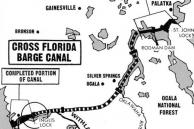
President Calvin Coolidge signed the Act to Survey A Waterway from Cumberland
Sound, Georgia, and Florida to the Mississippi River.”
This act was the forerunner of the later Cross-Florida Barge Canal
legislation.
SOME FLORIDA POPULATION
FACTS:
Year
Population
1830 34, 730
1840 54,477
1850 87,445
1860 140,424
1870 187,748
1880 269,493
1890 391,422
1900 528,542
1910 752,619
1920 968,470
1930 1,468,211
1940 1,897,414
1950 2,771,305
1960 4,951,560
1970 6,789,443
1980 9,746,324
1990 14,500,000
TODAY IN FLORIDA HISTORY
JANUARY 22
1863 The
Federal steamer U.S.S. Bibb
left the St. John’s River for Port Royal, South Carolina, today.
It carried a white refugee named Jackson, who reported to Federal
officials that the Confederates had a man-of-war carrying eight guns on the
Chattahoochee River. He also
reported that the steamer Cuba
was preparing to run the blockade via the Suwannee River.
1863 It was
reported that Federal Brigadier General Adam J. Slemmer was captured in the
recent Battle of Murfreesboro, Tennessee. Slemmer
first came to the attention of Floridians when he was a Lieutenant in command of
Fort Barrancas in January 1861. It
was Slemmer who ordered Federal troops to concentrate in Fort Pickens on Santa
Rosa Island in Pensacola Harbor.
1880 Residents
of key West were awakened today by aftershocks from the earthquakes that struck
the island of Cuba.
1912 The
first train arrived in Key West, marking the completion of the Florida East
Coast Railway. Henry Flagler
arrived in his private car, “Moultrie.”
The Overseas Extension of the Florida East Coast system spanned 127.84
miles from Homestead to Key West. Seventy-five
miles were over marsh or water. The
longest viaduct of the system, between Knights Key and Bahia Honda Key, covered
seven miles. Building the extension
from Miami to key West required a labor force of 3-4,000 men and seven years of
work. The railroad extension was
abandoned after the destructive hurricane of 1935, but was eventually adapted
for use as a major highway.
1935 Snow
started falling late today in the Florida Panhandle.
1973 The
Orlando “Sentinel” and the Orlando “Evening Star” were combined as the
“Sentinel Star” today.
1984 The
Oakland Raiders scored a 38-9 win over the Washington Redskins in Super Bowl
XVIII, which was held in Tampa.
1985 Ninety
percent of Florida’s citrus crop was destroyed by the worst freezing weather
in the 20th Century in the state. Governor
Bob Graham declared a “state of emergency” since the Weather Bureau
predicted more cold weather.
1992 The
space shuttle (STS 42) was launched today from Cape Canaveral.
FLORIDA FACT:
1908 In
Jacksonville, the Kalem Company, organized in 1907, produced what is regarded as
the first dramatic film in Florida. The
picture was entitled, “A Florida Feud.”
TODAY IN FLORIDA HISTORY
JANUARY 23
1837 The
Seminole Indian leader Osuche and his son were killed by U.S. Army troops near
Lake Apopka.
1851 The
State of Florida today appropriated $1,000 to build a wagon road from Miami to
Indian River in St. Lucie County.
1851 Florida’s
first Board of Agriculture was established today.
1861 Confederate
garrisons at St. Augustine removes lenses from the St. Augustine and Jupiter
Inlet lighthouses forcing them to shut down.
1865 The
British blockade runner Fannie McRae
was captured today by the Federal tender Fox
between St. Marks and Deadman’s Bay in the Warrior River.
1873 Jonathan
C. Gibbs was sworn into office today as the Superintendent of Public
Instruction.
1880 Aftershocks
from the earthquake on Cuba were felt again by Key West residents.
1923 Hugo
Award-winning science-fiction writer Walter M. Miller, Jr., was born today in
New Smyrna Beach.
1935 One
inch of snow was reported today in Panama City, while Apalachicola reported
two-tenths of an inch of the “white rain.”
TODAY IN FLORIDA HISTORY
JANUARY 24
1834 The
City of Chattahoochee was incorporated today.
1838 More
than forty Seminole Indians were captured during a battle with the United States
Army at Indian Crossing on the Lookahatchie (Loxahatchee?) River. Two soldiers were killed and five wounded.
Forty Seminoles were captured.
1840 Captain
J. R. Vinton and Company B, 3rd U. S. Artillery, engaged a force of Seminole
Indians at Fort New Smyrna Beach today. Four
soldiers were wounded. Indian
casualties were unknown.
1840 Captain
E. D. Bullock and a detachment from Company E, 2nd U. S. Dragoons were attacked
today by a band of Seminole Indians near Fort Preston.
One soldier was wounded.
1846 William
H. Brockenbrough was seated in the United States House of Representatives as
Florida’s first member of the Lower House.
Brockenbough was seated after successfully contesting the election of
Edward C. Cabell. Both Cabell and
Brockenbough were from Tallahassee.
1853 Charles
H. Austin was worn into office today as the Treasurer of Florida.
1854 Theodore
W. Brevard was sworn into office today as Florida’s Comptroller.
1862 Confederate
President Jefferson Davis has recommended Joseph J. Finegan of Fernandina beach
be given a commission as Lieutenant Colonel in the Confederate Army.
1863 The U.S.S. Paul Jones was
assigned to deliver ammunition and other stores to ships on patrol duty
in the St. John’s River. The Paul
Jones was also instructed to proceed up the river “as far as you may
deem necessary” on a reconnaissance mission.
After that mission was completed, the ship was to join the federal
blockade off Florida’s east Coast.
1884 The
first train arrived in Tampa today on the Plant System.
1985 The
space shuttle (STS 51-C) was launched today from Cape Canaveral.
1927 Former
United States Senator from Florida, Paula Fickes Hawkins, was born today in Salt
Lake City, Utah. Senator Hawkins
was elected in 1980 and defeated for re-election in 1986.
1989 Convicted
serial killer Theodore Bundy was executed today in Starke’s Raiford Prison.
Bundy died from electrocution in “Old Smokey.”
On July 23, 1979, Bundy was convicted of the murder of two co-eds at
Florida State University. During a
period of 15 years, it was
suspected that Bundy killed more than thirty young women in Washington, Utah,
Colorado, and Florida.
TODAY IN FLORIDA HISTORY
JANUARY 25
1814 Petitioners
representing the “Republic of East Florida” asked Congress to admit their
republic, with its capital at Fernandina, into the Union.
They were unsuccessful in their quest.
1834 Hillsborough
County, the state’s eighteenth county, was created today by the Florida
Legislature. It was named for Wills
Hills, the Earl of Hillsborough. Hillsborough,
who owned a large land grant in Florida, dispatched the surveyor Bernard Romans
explored the east and west coast of Florida.
He described Tampa Bay as a body of water well suited for large ships and
which could supply them from the surrounding countryside. County Seat:
Tampa
1842 Companies
B, K, and part of Company G of the 2nd U. S. Infantry, commanded by Major Joseph
Plympton, were attacked today at Haw Creek, a branch of the Wahoo Swamp.
One enlisted man was killed and two others wounded.
Two Seminole warriors were captured.
1849 The
City of Tampa was incorporated today.
1851 John
Beard was sworn into office as Florida’s Comptroller today.
1895 James
J. Corbett knocked out Charley Mitchell to retain his heavyweight boxing title
in a bout fought in Jacksonville today. The
fight lasted three rounds.
1963 Flagler
College, located in the old Ponce de Leon Hotel built by Henry Flagler, was
chartered today in St. Augustine.
1984 NASA
scientists and engineers were delighted with President Ronald Reagan’s
announcement today that he fully endorsed the development of a permanently
manned U.S. space station. The
development of such a space station would mean hundreds of new jobs at the Cape
Canaveral launch facility in Brevard County.
TODAY IN FLORIDA HISTORY
JANUARY 26
1767 Rollestown,
a Utopian community for the poor of London, was settled today near San Mateo by
Denys Rolle and forty English immigrants.
1827 Steamboat
travel on the Apalachicola River in the Florida Panhandle.
1828 The
steamboat Fannie arrived in
Columbus, Georgia, today on a journey that began at the mouth of the
Apalachicola.
1836 Calhoun
County, named for John C. Calhoun of South Carolina, was established today.
County Seat:
Blountstown
1861 The
Marion Artillery of St. Augustine announced today that it had fortified Fort
Marion (Castillo de San Marcos) with several 32 pounders and 8 inch howitzers.
1862 The U.S.S. Sagamore left its moorings at St. Vincent’s Island
and moved further up the channel of Apalachicola Bay.
1943 The
formal commissioning of the Amphibious Training Base at Fort Pierce took place
today at 10:00 a.m. when Captain C. Gulbranson, USN, read the orders from the
U.S. Department of the Navy.
1962 The
U.S. rocket, Ranger 3, launched from
Cape Canaveral strayed from its
project path today and missed its target, the moon, by 20,000 miles.
1965 The
body of State Treasurer J. Edwin Larson, how died in office, was on public
display in the Capitol rotunda in Tallahassee in order to give his many friends
and supporters and opportunity to bid him farewell.
TODAY IN FLORIDA HISTORY
JANUARY 27
1862 Brigadier
General Samuel Jones has been assigned to command the Army of Pensacola
relieving General Braxton E. Bragg.
1864 Union
General Alexander Asboth, in command of Federal forces at Pensacola, reported
that 1,200 Confederates were encamped at nearby Pollard.
He also reported that two companies of Confederate cavalry were camped at
the head of Choctawhatchee Bay.
1865 Lieutenant
Charles A. French of the U.S.S. Ino
captured an unknown ship with a cargo of cotton and sugar today on the Manatee
River.
1939 In
order to help Florida citrus growers avert a complete financial collapse,
Florida Commissioner of Agriculture Nathan Mayo urges the universal adoption of
a standard minimum selling price of thirty-two cents a box.
1949 WTVJ in
Miami began operations today as Florida’s first broadcast television station
with special authorization granted by the Federal Communications Commission.
1967 Astronauts
Gus Grissom, Ed White and Roger Chaffee were killed in a fire during a test
firing of the first version of the Apollo spacecraft.
NASA officials said an electrical spark must have ignited the pure oxygen
inside the cabin of the Apollo spacecraft as the three astronauts were seated in
the cabin. The fire broke out at
6:31 p.m. as the Saturn rocket, which carried the spacecraft, sat on launching
pad 34. Because the entire
procedure was a test firing, the gantry remained in place and blocked the
emergency escape system. Unable to
escape, the astronauts perished.
1992 Aileen
Wournos, one of the rare female serial killers, was convicted of killing three
male motorists along Florida highways in 1990.
TODAY IN FLORIDA HISTORY
JANUARY 28
1831 Today
the name of the West Point community was changed to Apalachicola.
1861 Former
U. S. Senator David Levy Yulee informed Stephen Mallory that the Federal
warship, U.S.S. Brooklyn, was
bound for Fort Pickens with two companies of soldier aboard. Mallory immediately informed friends in the Union capital
that Confederate forces would not attack as long as conditions did not change.
When this information was passed along to outgoing President James
Buchanan, he ordered the troops be kept aboard the ship and not landed.
1863 The U.S.S. Sagamore captured and destroyed the British blockade
runner, Elizabeth, today at the
mouth of Jupiter Inlet.
1864 The U.
S. schooner, Beauregard,
captured the British blockade-runner Racer
about ten miles north of Cape Canaveral. The
English vessel had left New Smyrna bound for Nassau with a cargo of cotton.
1864 The
British steamer Rosita was
captured today by the U.S. Army transport steamer Western
Metropolis about eighty miles out of Key West.
The Rosita was carrying a cargo of liquor, cigars, and assorted
merchandise.
1878 The
reading room of the Jacksonville Young Christian Association was opened today.
1885 The
Florida legislature approved the incorporation of the City of Ocala today.
1902 H. Clay
Crawford took the oath of office today for the position of Florida Secretary of
State.
1927 WMBR
Radio, originally chartered in Tampa, began broadcasting today in Jacksonville.
1958 The
United States Air Force successfully tested its Thor missile today at Cape
Canaveral.
1965 Broward
Williams took the oath of office today as the Treasurer of Florida.
1986 The
Space shuttle Challenger
exploded after launch from Cape Canaveral today killing all seven astronauts
aboard.
The Challenger, which
was scheduled to liftoff at 9:38 a.m., was kept on the launch pad for two hours
because unusually low temperatures at Cape Canaveral caused ice to form on the
shuttle and ground support system. At
11:38 a.m., the shuttle lifted off flawlessly from the pad.
When the space vehicle had achieved an altitude of ten miles and
immediately prior to the full ignition of the main engines, the shuttle exploded
in a ball of fire that was visible throughout the State of Florida.
Killed in the explosion were:
Francis R. Scobee
Michael J. Smith
Judith A. Resnick
Ronald E. McNair
Ellison S. Onizuka
Gregory B. Jarvis
Christa McAulliffe
TODAY IN FLORIDA HISTORY
JANUARY 29
1862 The
U.S. Storeship Supply captured
the Confederate schooner Stephen Hart
south of Sarasota with a cargo of arms and ammunition.
1864 Governor
John Milton informs General Pierre Beauregard, commanding the Department of
South Carolina, Georgia, and Florida, that Confederate army deserters were
organizing themselves into bands in the state.
The areas of the strongest groups were in LaFayette, Washington, Walton,
Taylor and Levy counties in West Florida. They
deserters were also operating in strong bands from Tampa to Fort Myers in
Southwest Florida.
1865 The
34th U. S. Colored Troops have been transferred to Florida.
1885 Frederick
Delius, later a world-renowned composer, celebrated his 23rd birthday at Solano
Grover (St. Johns County), during a short stay in Florida.
1995 Super
Bowl XXIX held in Joe Robbie
Stadium in Miami.
SOME FLORIDA FACTS:
Cyrus Teed, founder of the Koreshan Unity Movement, taught his followers
that humans resided on the inside of the earth.
Teed, who assumed the name, “Koresh,” [Persian for “Lion”]
organized his followers into a utopian commune, which was located at present day
Estero in Lee County. Teed, who
espoused equal rights for women, envisioned his commune at Estero as the future
center of the world’s commercial, political, and religious activities.
In his writings, he prophesied the rise of a “New Jerusalem” which
would be home to 10 million residents, and which would be built in a minimum of
10 stories. Each story would be
segregated by the type and weight of transportation used.
Teed died in 1908 as a result of wound incurred during a fight with
political opponents on the streets of Fort Myers.
His followers, confident that he would come back from the dead, refused
to bury him until forced to do so by a health inspector for Lee County.
Teed’s body was placed in a mausoleum on the shores of the Gulf of
Mexico and guarded 24 hours a day. In
1921, a hurricane destroyed the mausoleum and Teed’s body was lost.
Because the community practiced celibacy, the number of member gradually
diminished. In 1961, the few
remaining adherents gave the State of Florida 305 acres of land for use as a
state park.
TODAY IN FLORIDA HISTORY
JANUARY 30
1561 Governor
of Pensacola Tristan de Luna was relieved of his command by Spanish authorities
following his unsuccessful administration of the newly created colony.
1838 Chief
Osceola. a leader of the Seminole Indians, died at Fort Moultrie in Charleston,
South Carolina.
1862 The U.S.S. Kingfisher captured the blockade runner Teresita
today in the Gulf of Mexico off the coast of Florida.
1862 General
J. H. Trapier, in command of Confederate forces in Florida, reported that he had
the following number of men under his command:
Infantry: 133 officers,
1,994 enlisted men
Cavalry: 46 officers, 1,080
enlisted men
Artillery: 6 officer, 89
enlisted men
1943 Baseball
player and manager Davey Johnson was born in Orlando today.
1964 A
Ranger spacecraft was launched today from Cape Canaveral.
The Ranger, carrying six television cameras, was aimed at the moon.
It was hoped that the spacecraft would transmit valuable pictures back to
Earth to help with the planning of the American manned moon-landing attempt
later in the decade.
TODAY IN FLORIDA HISTORY
JANUARY 31
1831 The
Bank of Pensacola was formed today.
1863 Confederate
authorities reported that in the District of East Florida, there were 810 men
and officers on duty, while the District of Middle Florida had a total of 751
men and officers.
1881 Eleazer
K. Foster assumed the office of Superintendent of Public Instruction today in
Tallahassee.
1891 The
grand Tampa Bay Hotel opened for guests today.
A grand ball would be held on February 5.
1897 The
citizens of the community of
Lakemont considered changing its name today to “Frostproof” after being
spared serious damage to citrus crops during two consecutive hard freezes.
The formal incorporation of the community as “Frostproof” occurred on
August 8, 1914.
1951 Harry
Wayne Casey of KC and the Sunshine Band was born in Hialeah.
1958 The
first American satellite, Explorer I, was placed into orbit today by the Army
Ballistic Missile Agency from Cape Canaveral aboard a Jupiter C rocket.
1961 Ham,
America’s first astrochimp, was shot into space today in an 18 minute flight
that reached an altitude of 150 miles. Ham’s
flight in the Mercury capsule was a preliminary test before the launching of a
human into orbit.
FEBRUARY 1
1840
Members of the 7th U.S. Infantry, under the command of Captain H. H.
Holmes, were attacked by Seminole warriors near Fort Number 5 [?].
One enlisted man was killed and two wounded.
1861 Two
companies of Confederate volunteers have been assigned to guard the
Chattahoochee Arsenal, while some 1,500 Confederate troops from Florida,
Mississippi, and Alabama were encamped at Pensacola Bay.
Several batteries have been set up facing Forts Pickens, Barrancas and
McRee.
1862 A Union
gunboat anchored near the St. marks Lighthouse today and began to shell the salt
works near there. The Confederate
gunboat Spray moved into the
area and exchanged shots with the Federal boat.
Elsewhere, the schooner Isabel
was captured today in the Gulf of Mexico off the Florida coast by the U.S.S.
Montgomery.
1863 The U.S.S. Tahoma captured the British schooner Margaret
near St. Petersburg. A second Union
ship, the U.S.S. Hendrick Hudson
assisted in the capture. In other
action, the U.S.S. Stars and Stripes bombarded
a Confederate encampment at Long Bar near St. Marks today.
A Confederate steamer was also fired on by the Union ship.
1881 Henry
A. L’Engle was sworn into office today as Florida’s Treasurer.
1882 The
Jewish Reform Synagogue, Congregation Ahavath Chesed was founded today in
Jacksonville. Mayor Morris A.
Dzialinski was the first president.
1920 The
North Florida Council of the Boy Scouts of America was chartered today in
Jacksonville. The first Scout troop
was chartered in Jacksonville in 1910.
1929 The
Edward W. Bok Singing Tower and Bird Sanctuary in Lake Wales was dedicated today
by President and Mrs. Calvin Coolidge. Governor
Doyle E. Carlton also participated.
1939 The
Gulfstream Park race Track at Hallandale opened for its first thoroughbred
racing meeting.
1946 Guitarist
Howard Bellamy was born in Darby, Florida, today.
1958 The
United States launched its first space satellite into orbit around the Earth
today. The 30.8 pound Explorer
satellite was put into orbit by a Jupiter-C rocket that lifted off from Cape
Canaveral at 10:48 a.m.
1959 Lee
Petty won the first Daytona 500 motor race today.
1961 The
Strategic Air Command launched the first solid-fuel rocket, Minuteman,
today from the Eastern Test range facilities (Cape Canaveral).
The rocket was a multi-stage rocket that successfully fired all stages.
TODAY IN FLORIDA HISTORY
FEBRUARY 2
1831 The
Bank of St. Augustine was chartered today.
1841 Madison
Court House, the name originally given to present day Madison, was incorporated
today.
1861 Governor
Madison Starke Perry addressed a request to the Florida Legislature to
reorganize and strengthen the Florida militia in order to protect the state
against a possible Union attack.
1862 The
Confederate War Department in Richmond today requisitioned two-and-one-half war
regiments from the State of Florida for service in the Confederate Army.
1863 A
Federal naval officer on a reconnaissance mission on the Indian River reported
the discovery of several packages and 41 sacks of salt in a cache near Jupiter
Inlet. He destroyed them all.
1864 Federal
Major General Quincy A. Gillmore, commander of the Department of the South,
requests the support of two or three gunboats for a planned occupation on the
west bank of the St. Johns River.
1865 Confederate
Major General Sam Jones assumed command of the District of Florida today.
At sea, the U.S.S. Pinola captured the British blockade runner, Ben
Willis, in the Gulf of Mexico off the Florida coast,
The Willis carried a
cargo of cotton for British textile mills.
1892 Citizens
in St. Petersburg voted 15-11 today to seek incorporation of that city.
1901 Fort
Pierce, named for General Benjamin K. Pierce, brother of President Franklin
Pierce, was incorporated today.
1914 Lieutenant
J. H. Towers and Ensign G. Chevalier made the first flight from the Pensacola
Aeronautical Station today. The
twenty minute flight covered the military reservation and Bayou Grande.
1951 Snow
began to fall in north and central Florida today.
Crescent City and St. Augustine were receiving the heaviest amounts.
1986 NASA,
continuing its investigation of the January 28 explosion of the Shuttle Challenger, today revealed that the shuttle’s solid fuel
rocket boosters were not equipped with an adequate warning system.
TODAY IN FLORIDA HISTORY
FEBRUARY 3
1768 Dr.
Andrew Turnbull arrived in Minorca today to begin the recruitment of 1,400
Greek, Minorcan, Italian, French and Corsican settlers for his planned colony at
New Smyrna.
1862 The
Confederate steamer Florida had
reportedly successfully eluded Federal ships blockading the coast of Florida and
was safely at sea.
1862 The
annual meeting of the stockholders of the Union Bank of Florida was held today
in the bank’s offices in Tallahassee.
1864 Governor
John Milton, planning to leave Tallahassee, received a telegram today warning
him that about 100 deserters have organized to capture him and turn him over to
the Federal ships blockading the Gulf Coast.
1865 The
British schooner John Hale ,
flying the English colors, was captured today near St. marks by the Union
schooner Matthew Vassar.
The Hale’s cargo
consisted of lead, rope, blankets, and shelter covers.
Union officers suspect that the Hale’s
crew had thrown arms and ammunition overboard prior to capture.
1926 The
first broadcast of Pensacola’s WCOA Radio was piped to the assembled crowd in
Plaza Ferdinand.
1951 Snow
continued to fall today in north and central Florida.
Trace amounts were found as far south as Lakeland.
Crescent City and St. Augustine have received two inches of the “white
rain.”
1984 The
Space Shuttle Challenger (STS
41-b) was launched successfully from Cape Canaveral today. The Challenger
carried five astronauts.
1994 Mission
STS-60 (the space shuttle) was
launched today from Cape Canaveral.
TODAY IN FLORIDA HISTORY
FEBRUARY 4
1832 Columbia
County, the state’s 16th county, was
created by the Florida Legislature today. The
county was named for the poetic name of the United States. County Seat:
Lake City
1836 Dade
County, Florida’s 19th county, was created by the Legislature today. The county was named in honor of Major Francis Langhorne
Dade, United States Army, who, along with 106 men, perished today in an Seminole
Indian ambush near present-day Bushnell. Dade
County was the most populous county in the state. County Seat:
Miami
1861 Delegates
from Florida join with delegates from Mississippi, South Carolina, Alabama,
Georgia, and Louisiana today in Montgomery, Alabama, to organize the provisional
government of the Confederate States of America.
1863 A crew
for the U.S.S. Sagamore today
captured the Confederate schooner Pride
near the Indian River Narrows. The Pride’s
cargo of 188 bushels of salt and its crew were captured.
1864 A boat
from the Federal schooner, Beauregard,
sent to Jupiter Inlet to look for blockade runners today captured the
Confederate boat Lydia, which
was on her way to the Inlet from Sand Point.
The Lydia was carrying
two bales of cotton and five barrels of turpentine.
1864 Union
General Quincy A. Gillmore continued preparations for his attack on the west
bank of the St. Johns River. Federal
Brigadier General Truman Seymour was ordered to load his troops on ships in
preparation for a rendezvous with other Union units at the mouth of the St.
Johns.
1897 Duncan
U. Fletcher was elected the president of the Jacksonville Bar Association today.
1931 Sir
Malcolm Campbell set a ground speed record of 245 mph today at Daytona Beach.
1945 The18th
Engineering Battalion, United States Army, arrives at the United States Naval
Amphibious Training Base in Fort Pierce. The
unit, which has been reassigned to Fort Pierce, has just completed 32 months of
duty in the Yukon.
TODAY IN FLORIDA HISTORY
FEBRUARY 5
1861 The
Florida Senate approves a bill to incorporate the town of Monticello in
Jefferson County.
1862 The U.S.S. Keystone State captured the British blockade runner, Mars,
off the coast at Fernandina. The Mars was carrying a cargo of salt.
1864 The U.S.S. DeSoto today captured the Confederate blockade runner Cumberland
in the Gulf of Mexico.
The Cumberland, a
700-ton steamer, was carrying a cargo of guns and ammunition, including 100
barrels of gunpowder.
1912 J. C.
Luning was installed as Florida’s Commissioner of Agriculture today. He would hold this post for a mere 14 days.
1926 The
City of Miami Shores was incorporated today.
Originally settled in 1905 as Arch Creek Farms, the town later became
known as the City of North Miami.
1940 The
first papers of incorporation of Barry College were filed today. Barry College is located in Miami.
TODAY IN FLORIDA HISTORY
FEBRUARY 6
1845 The
first session of the Florida Conference of the Methodist Episcopal Church met in
Tallahassee today.
1870 Governor
Harrison Reed received the news
that his impeachment and removal for office had been recommended by a state
legislative committee. This was the
third of four unsuccessful attempts to remove the Republican chief executive.
1875 Four
thousand acres were purchased today from the state Internal Improvement
Department today. This acreage
became the site of the City of orange City, which was started in 1876 with the
sale of housing lots to prospective residents.
1897 Millard
Fillmore Caldwell, 29th governor of Florida (1945-1949), was born today in his
parent’s home near Knoxville, Tennessee.
He attended Carson-Newman College, the University of Mississippi, and the
University of Virginia. Caldwell
came to Florida in 1924. In 1929,
he was elected to represent Santa Rosa County in the Florida House of
Representatives. In 1933, he was
elected to the U.S. House of representatives from Florida’s 3rd District.
In 1941, he retired to private law practice. In 1944, he was elected governor. His administration was considered very progressive.
In 1962, Caldwell was appointed a Justice, Supreme Court of Florida.
He was elected for a full term that same year.
In 1967, he was elected Chief Justice.
Caldwell retired in 1969. He
died in Tallahassee on October 23, 1984.
1900 Eugene
V. Debs, the leader of the Socialist Party of the United States, gave a lecture
to some 55,000 persons today at Tampa’s Court House Plaza.
1907 Maas
Brothers department Stores were incorporated today.
originally founded by Abe Maas on Franklin Street in Tampa in October
1886, Maas Brother’s became a statewide chain of stores by the 1960s.
1956 Florida’s
first Jordan-Marsh department Store opened at 1501 Biscayne Boulevard in Miami
today.
TODAY IN FLORIDA HISTORY
FEBRUARY 7
1806 The
United States Senate approved a secret appropriations of $2 million to be used
for the possible purchase of Florida.
1863 Federal
naval authorities report the destruction of two casks of sperm oil, 47 sacks of
salt, and one boat sail near Jupiter Inlet.
These materials were presumed to be Confederate stores.
1864 Union
troops under General Truman A. Seymour landed at Jacksonville.
This was the fourth occupation of the city by a Union army.
The troops were to be used in a major Federal push into the center of the
Sunshine State, a push that would culminate with the Battle of Olustee on
February 20. Many of the
African-American troops in the Union force were former free blacks and runaway
slaves from the north Florida area.
1864 The
Confederate steamer St. Mary’s,
trapped in McGirt’s Creek above Jacksonville, was sunk by
the U.S.S. Norwich.
The steamer’s cargo of cotton was destroyed to prevent capture by Union
forces.
1893 The
first edition of the Tampa Evening
Times published.
1969 Diane
Crump became the first female jockey in thoroughbred racing when she raced at
Hialeah.
1979 Gwen
Sawyer Cherry, the first African-American woman to serve in the Florida
Legislature, was killed today in a one-car accident in Tallahassee.
Born in 1923, Ms. Cherry received her law degree from FAMU, where she
taught classes. She was first
elected in 1970 to represent Dade County in the House of Representatives.
TODAY IN FLORIDA HISTORY
FEBRUARY 8
1571 Father
John Baptist Segura, Vice-Provincial of Catholic [Jesuit] missions in Florida,
and eleven companions were killed today at their mission on the Rappahannock
River near the Chesapeake Bay. This
was part of the plan of Pedro Menendez de Aviles to explore the land north of
present-day Florida to find the northwest passage to the Pacific Ocean and the
Far East. As a result of this
episode, the Jesuits abandoned their attempts to convert Florida Native
Americans to Catholicism in 1572.
1832 The
Territorial Legislature of Florida repealed an anti-dueling law, which again
made it legal for gentlemen to settle their differences through personal combat.
1832 The
Merchants and Planters Bank of Magnolia was incorporated today.
1832 Franklin
County, Florida’s 17th county, was established today.
The county was named in honor of Benjamin Franklin. County Seat:
Apalachicola
1837 Lieutenant
Colonel William T. Harney and his small force were attacked today at Camp Monroe
by some 200 Seminole Indians led by King Philip and Coacoochee. The U.S. Army lost 1 officer killed and eleven enlisted men
wounded before the attack was beaten off. Captain
Charles Mellon of the 2nd United States Artillery was the officer killed.
The name of the encampment was changed from Camp Monroe to Fort Mellon to
honor this fallen hero.
1861 LaVilla
Institute and the College of St. Augustine were incorporated today.
1861 Baker
County, the state’s 38th county, was established today.
The county was named in honor of James McNair Baker (1822-1892,
Confederate States Senator and Judge of the 4th Judicial District in Florida.
County Seat:
MacClenny
1861 Polk
County, Florida’s 39th county, was established today.
Named in honor of James Knox Polk, the 11th president of the United
States (1845-1849). County
Seat: Bartow
1861 The
Confederate Constitution has been approved by the delegates to the Convention in
Montgomery, Alabama, and has been submitted to the Southern states for their
approval.
1913 The
Colonial Dames Club of Tampa was organized today.
1957 Vanna
White, whose fame rests on her ability to turn selected letters on the game-show
“Wheel of Fortune,” was born today in Miami.
1958 The
Daytona Beach International Speedway Corporation was organized today.
TODAY IN FLORIDA HISTORY
FEBRUARY 9
1837 Captain
George W. Allen and Company K of the 4th United States Infantry were attacked
today near Clear River by Seminole Indians.
One U. S. officer was killed in the skirmish.
1838 General
Thomas S. Jesup, the commander of United States troops in Florida, reported that
in his opinion “...the prospect of terminating this [Seminole] war in any
reasonable time is anything but flattering.
My decided opinion is that unless immediate emigration be abandoned, this
war will continue for years to come, and at constantly accumulating expense.”
Jesup proposed that the area west of the Kissimmee River, Lake
Okeechobee, and Panai-Okee and east of Pease Creek and south to the extreme end
of Florida be set aside for the Seminoles.
The Secretary of War did not approve this plan, and some 500 Seminoles,
who had entered Jesup’s camp on the strength of this recommendation, were
seized and transported to Tampa for the purpose of removal to the West.
1861 The
steamer Everglade today
unloaded its cargo of 1,500 muskets at Fernandina.
The muskets were from the Charleston Arsenal.
1861 The U.S.S. Brooklyn arrived off Pensacola today with troops to
support the Union occupation force at Fort Pickens. The troops were not off loaded as both Union and Florida
forces maintain an uneasy peace in the area.
1861 Jefferson
Davis of Mississippi has been elected Provisional President of the Confederate
States of America. Alexander H.
Stephens of Georgia, an opponent of secession, has been elected Vice-President.
1863 The
Quincy extension of the Pensacola and Georgia Railroad began operations today.
The train trip from Quincy to Tallahassee took only two hours.
The train continued to its terminus at Lake City.
1864 The
Union gunboat Para sailed
thirty miles up the Nassau River today, shelling the woods along both sides of
the river and taking an inventory of several lumbering plants.
1864 The
97th Pennsylvania, a Federal force encamped at Fernandina, today raided the
surrounding area and captured a small force of Confederates in a nearby swamp.
1864 Union
forces today occupied Baldwin (about 19 miles west of Jacksonville) and captured
cotton, artillery pieces, a train of cars, and enough forage for 1,000 men in
the field for four days.
1864 A small
skirmish occurred between Confederate cavalry units and Federal forces at the
south fork of the St. Marys River. The
Union forces successfully forded the river and captured the village of
Sanderson, some thirty miles west of Jacksonville.
Retreating Confederate forces set fire to supplies of cotton, corn, and
turpentine.
1915 The
Subtropical Mid-Winter Fair, which was inaugurated by a parade of 150 horse and
automobile-drawn floats, opened today in Orlando.
1942 The
first Congressional Medal of Honor awarded in World War II was presented
posthumously to Sandy Nittinger of Fort Lauderdale.
1967 Today
marked the beginning of what would eventually become a record 768 consecutive
days of sunshine in the Sunshine State.
1973 The
first measurable snow since 1958 cover a portion of the Sunshine State. Pensacola reported two inches. DeFuniak Springs and Quincy
reported similar amounts. Trace
amounts were reported as far south as Clermont.
Unofficial reported put the accumulated total of 6 to 8 inches at Jay.
TODAY IN FLORIDA HISTORY
FEBRUARY 10
1831 The
City of Monticello was incorporated today.
1834 The Tallahassee Railroad Company was incorporated today.
This railroad, utilizing “mule power,” stretched from Tallahassee to
Port Leon (near St. Marks), a total of 22 miles.
1836 General
Edmund P. Gaines, whose command of the U. S. Western Military Department
included part of Florida, arrived today at Fort Brooke with six companies of the
4th U.S. Infantry and a regiment of
Louisiana Volunteers.
1864 Union
forces today encountered Confederate outposts a few miles east of Lake City.
The Federal troops captured about 20 Confederates and destroyed almost $1
million in property. Federal forces
lost 5 men killed and 10 wounded.
1899 Electric
street lights brought daylight to nighttime as Avenue B and 12th Street in Miami
were illuminated by artificial means.
TODAY IN FLORIDA HISTORY
FEBRUARY 11
1832 The
City of Jacksonville was incorporated today by the Territorial Legislature.
1863 Colonel
J. S. Morgan of the 90th Regiment of New York Volunteers, headquartered at Key
West, today issued an order that
“All white persons residing within the limits of this command having husbands,
sons or brothers in Rebel employment, or who have at any time declined taking
the oath of allegiance to the U.S. Government were hereby required to transport
in person at these headquarters on or before Tuesday, the 17th instant, and
register their names.”
1883 The
Leesburg Methodist Church was dedicated today.
1894 Henry
Flagler opened his “Royal Ponciana Hotel” today in Palm Beach.
The “Ponciana” was the world’s largest wooden resort hotel.
[Some argue that the “Belleview,” built by Henry Plant on the West
Coast, deserved this distinction. The
“Belleview” is still in operation and certainly holds undisputed claim to
the title today.”]
1920 Daniel
“Chappie” James, Jr., the first African-American to achieve four-star rank
in the armed forces of the United States, was born in Pensacola.
1984 The
first landing of a space shuttle at Kennedy Space Center [Cape Canaveral]
occurred today.
1984 Responding
to pressure from South Florida’s conservative Cuban population, the Reagan
Administration announced today that Cuban aliens will be granted residency
status in the United States. Haitian
refugees were denied the same treatment.
1993 Janet
Reno, Chief State Prosecutor of Dade County, was nominated to become the first
female U.S. Attorney General by President Bill Clinton.
TODAY IN FLORIDA HISTORY
FEBRUARY 12
1842 One
American officer and one enlisted man were killed today in a confrontation
between Seminole Indians and Company H of the 8th U.S. Infantry at Wahoo Swamp.
1861 The
reverend A. D. Pellicer, formerly a resident of Sr. Augustine, rendered the
opening prayer for the opening of the Confederate Congress.
1864 Federal
forces commanded by Brigadier General Truman Seymour have concentrated at
Baldwin in preparation for a major push westward into the heart of Florida.
1887 The
City of Tarpon Springs was incorporated today.
1894 The
oldest Florida chapter of the Daughters of the American Revolution was founded
today in Jacksonville.
1899 Tallahassee
recorded a temperature of -2 degrees F today.
This is thought to be the lowest temperature ever reached in Florida.
This was also the date of the greatest snowfall on record for the
Sunshine State, as well as the greatest southern extension of snow.
Four inches were reported at Lake Butler, 3.5 inches at Marianna, 3
inches at Lake City, and trace amounts as far south as Fort Myers, Avon Park,
and Titusville.
1903 Edward
Waters College, one of Florida’s oldest colleges for African-Americans, was
re-chartered in Jacksonville today.
1963 A
Northwest Orient Airlines plane crashed in stormy weather north of Miami today.
Forty-three persons were killed.
TODAY IN FLORIDA HISTORY
FEBRUARY 13
1778 The
American Continental Congress received a proposal from the State of Georgia to
launch an invasion of British East Florida with American forces led by Major
general Howe.
1831 The
City of Fernandina [Beach] was re-incorporated today.
The city had first been incorporated on January 1, 1825.
1864 Confederate
forces under the command of General Joseph Finegan have concentrated at Camp
Beauregard near Olustee on ocean Pond. General
Finegan selected the position because of the protection offered by two small
lakes. It was also the location of
the major road and railroad into the interior of the state.
Confederate soldiers have started the task of building entrenchments and
fortifications. It appears a major
battle will be fought on or near this spot.
1912 The
first meeting of a Rotary Club in Florida was held today in Jacksonville.
1958 Tallahassee
residents awakened to discover that the city had received a record 2.8 inches of
snow today. Snow extended south to
the 30-degree latitude.
TODAY IN FLORIDA HISTORY
FEBRUARY 14
1839 Fort
Lauderdale was occupied as a military outpost by Company K, U.S. Artillery,
today.
1850 Fort
Harvie on the Caloosahatchee River was ordered re-activated today.
The fort was re-named in honor of Lieutenant Colonel Abraham C. Myers.
1861 The
Florida Legislature today incorporated the Alachua County railroad Company and
authorized it to raised $200,000 in capital to construct a railroad from Waldo
to Newnansville.
1892 Three
inches of snow was reported today at Pensacola, while Tallahassee reported two
inches. Lake City reported an
accumulation of one inch, while Leesburg reported a trace.
1940 Attractions
operators, tourists, and marine scientists were delighted when the first
porpoise to be born in captivity was born at Marineland, south of St. Augustine.
1962 Former
Governor Millard Fillmore Caldwell appointed to service as a Justice, Florida
Supreme Court.
TODAY IN FLORIDA HISTORY
FEBRUARY 15
1883 The
first issue of the Halifax Journal ,
Daytona’s first newspaper, was printed today.
1898 The U.S.S. Maine exploded today in Havana Harbor and set into
motion the events leading up to the Spanish-American War.
More than 250 men were killed and some 50 wounded.
The wounded were transferred to hospital facilities in Key West.
1904 W.H.
Ellis assumed the office of Attorney General of Florida today.
1933 President-elect
Franklin Delano Roosevelt narrowly escaped an assassination attempt tonight
following a speech in Miami’s Bay Front Park.
As he sat in his car, five shots rang out, wounding Chicago Mayor Anton
Cermak, who was standing on the running board of the car.
Four other persons were also wounded.
Mayor Cermak was, it was feared, fatally wounded.
The would-be assassin, Guiseppe Zangara of Hackensack, New Jersey, was
wrestled to the ground by a policeman and hustled off to jail.
His only statement was “I’d kill every president.”
Hidden in his clothing was a newspaper clipping describing the
assassination of President William McKinley in 1901.
Zangara was eventually put to death by the electric chair in Raiford
Prison.
1936 The
State of Florida acquired its first parcel of land for the Gold Head Branch
State Park near Keystone Heights.
1981 Richard
Petty wins the Daytona 500 for the seventh time.
TODAY IN FLORIDA HISTORY
FEBRUARY 16
1861 The
British consul at Pensacola throws down the gauntlet to challenge the possible
blockade of the Confederate States of America when he issues clearance papers
for a ship carrying a cargo of cotton for British textile mills.
1864 Federal
forces withdraw from Gainesville following a skirmish with Confederate cavalry
under the command of Captain J.J. Dickison.
1864 The U.S.S. Para escorted Federal troops up the St. Mary’s River
to Woodstock Mills, Florida, to obtain lumber.
The Para engaged
Confederate troops along the river bank. Union
transports successfully loaded a large amount of lumber and began to withdraw
down the river.
1911 St.
Cloud, originally established as a community for veterans of the Grand Army of
the Republic [Union] was incorporated today.
1919 The
State of Florida Board of health reported that 3,007 Floridians had perished in
the first three months of great influenza outbreak that swept the world
immediately following World War I. Other
killers were Tuberculosis (288); Malaria (50); Dysentery (41); Typhoid (37);
Pellagra (36); and Diphtheria (32).
1965 The
first Pegasus satellite was launched from Cape Canaveral today. The purpose of the Pegasus was to study meteoroids and other
potential hazards that might be encountered by the Apollo missions.
TODAY IN FLORIDA HISTORY
FEBRUARY 17
1845 The
“Preacher’s Aid Society of the Florida Annual Conference of the Methodist
Episcopal Church” was chartered by the Territorial Legislature.
1862 Federal
naval forces on duty in the Gulf of Mexico today attacked the home of Abel
Miranda on the Pinellas Peninsula (Tampa Bay), destroying citrus trees and
livestock. Sailors then confiscated
supplies of bacon, corn, syrup and potatoes and carried them off to their base
on Egmont Key.
1864 A boat
expedition from the U.S.S. Tahoma
destroyed a large salt works near St. Marks.
A large quantity of salt was also destroyed.
1865 The U.S.S. Mahaska captured the schooner Delia off the coast of Bayport, Florida, and seized its cargo
of pig lead and sabers.
1884 The
First Presbyterian Church of Eustis was chartered today.
1912 W. V.
Knott assumed the office of Comptroller of the State of Florida today.
1959 The
first boy was enrolled at Florida Sheriffs’ Ranch near Live Oak.
The ranch, founded in 1957, was created to serve as a home for
non-delinquent dependent, homeless and/or neglected boys between the ages of
eight and seventeen years of age.
1959 Olympic
Gold Medal freestyle winner Ambrose “Rowdy” Gaines was born today in Winter
Haven.
TODAY IN FLORIDA HISTORY
FEBRUARY 18
1842 Colonel
William J. Worth reported that only 300 Seminoles were left in Florida and that
it was impossible for the U.S. Army to capture or kill them all.
He recommended to his superiors in the War Department that a peace treaty
be made with them. They agree and Worth, on August 14, declares the Seminole War
at an end.
1842 Santa
Rosa County, Florida’s twenty-first county, was established today. Named for Santa Rosa Island, which in turn was named for St.
Rosa de Viterbo, a Catholic saint. During
Emperor Frederick II’s war against Pope Gregory IX, Rose, then 12 years old,
preached against submission and obedience to the emperor.
As a result her family was banished.
County Seat:
Milton
1861 Jefferson
Davis of Mississippi took the oath of office as the provisional President of the
Confederate States of America. Among
the military companies firing cannon salutes for President Davis were troops
bound for Pensacola.
1862 The
Federal gunboat, Ethan Allen,
entered Clearwater harbor today and captured the schooner Spitfire
and the sloops Atlanta and Caroline.
1879 The
City of Orange Park was incorporated today.
1967 Governor
Claude Kirk, Jr., wed Miss Erika Mattefeld today in West Palm Beach. It was the second marriage for Governor Kirk.
1973 Richard
Petty won the Daytona 500 today.
1979 Richard
Petty won the Daytona 500 today as the race leaders were involved in a major
crash on the last lap of the race.
TODAY IN FLORIDA HISTORY
FEBRUARY 19
1821 The
United States Senate gave its approval to the Adams-Onis Treaty today. Under the terms of this transcontinental treaty, Spain ceded
Florida to the United States in exchange for the elimination of approximately $5
million in outstanding financial obligations.
1825 The Florida Intelligencer, Tallahassee’s first newspaper, began
operations today.
1885 E. S.
Crill assumed the office of Treasurer of Florida today.
1889 Dade
County voters approved the relocation of the county seat from Miami to Juno.
1912 J.C.
Luning, who had assumed the office of Florida Commissioner of Agriculture on
February 5, left office today, having served a total of 14 days.
TODAY IN FLORIDA HISTORY
FEBRUARY 20
1839 A
“Memorial of the People of the Territory of Florida” asking for the
admission of the Territory as a state of the Union was introduced in the U.S.
House of representatives today.
1839 Two
soldiers of Detachment K, 3rd United States Artillery, were killed by Seminoles
today while chopping wood near Fort Lauderdale.
1862 A
company of volunteers from Leon County were mustered into Confederate service
today with Richmond N. Gardner as captain.
1864 The
largest Civil War battle to take place in the State of Florida occurred today at
Ocean Pond/Olustee. Union and
Confederate forces were about evenly matched with 5,500 soldiers each.
The Confederates, under the command of general Joseph J. Finegan, had
prepared defenses in the area (see citation for February 13).
The failure of the Union commander, General Truman Seymour,
to commit his forces in concert and as a whole gave the Confederates a
strategic advantage. At the end of
the day, the Confederates controlled the battlefield and Federal forces were in
a hasty retreat toward Jacksonville and the safety of the guns of the Union
navy.
Union Casualties:
203 killed, 152 wounded, 506 missing.
Confederate casualties: 93
killed, 847 wounded, 6 missing. Union
losses of material: 400
accouterment sets, 130,000 rounds of small arms ammunition, 1,600 small arms,
five cannons.
1865 The
Battle of Fort Myers, the southernmost land battle of the Civil War, took place
today. With no clear winner, both
Union and Confederate commanders claimed victory.
1877 The
Titusville Star-Advocate began
publication in New Smyrna Beach today as The
Florida Star.
1883 The
Village Improvement Association, Florida’s first Woman’s Club, was organized
today at Green Cove Springs.
1889 The
Florida State Board of Health was created by the Florida Legislature today
following the Yellow Fever epidemic that swept through Jacksonville.
1900 The
Miami Board of Trade, the forerunner of the Miami Chamber of Commerce, was
organized today.
1927 Sidney
Pottier, the Oscar-winning actor, was born today in Miami.
1962 Lieutenant
Colonel John H. Glenn, Jr., became the first American to orbit the Earth in his
Mercury spaceship, Friendship 7. Glenn,
enclosed in the Friendship 7 high atop an Atlas rocket, was hurled into space at
9:47 a.m. The rocket placed the
Mercury capsule in orbit 99 miles above the surface of the Earth.
The launch came after ten separate delays caused by bad weather
conditions and technical glitches to equipment. The Mercury made three full orbits of the Earth and landed in
the Atlantic at 2:43 p.m. Hundreds
of thousands of Floridians lined the beaches of the East Coast to catch a
glimpse of this historic event.
TODAY IN FLORIDA HISTORY
FEBRUARY 21
1861 Stephen
R. Mallory of Florida was appointed Secretary of the Confederate States Navy
today by President Jefferson Davis.
1864 The U.S.S. Para today captured the small Confederate steamer Hard
Times on the St. Marys River.
1865 Confederate
forces launched an unsuccessful attack against Union forces at Fort Myers.
Nine Federal prisoners were seized, one Union soldier killed, and some
livestock was seized.
1884 Albert
J. Russell assumed the office of Florida Superintendent of Public Instruction
today.
1895 The
Florida Federation of Women’s Clubs was organized at Green Cove Springs today.
1949 Mary
McLeod Bethune was granted the first honorary degree given by a Southern white
college to an African-American woman by Rollins College (Winter Park) today.
TODAY IN FLORIDA HISTORY
FEBRUARY 22
1819 The
Adams-Onis Treaty was formally signed today.
Spain ceded Florida to the United States.
1836 General
Edmund P. Gaines arrived at Ft. King with six companies of the 4th U.S. Infantry
and a regiment of Louisiana Volunteers.
1862 Jefferson
Davis was inaugurated today as the first regular, non-provisional president of
the Confederacy.
1862 Command
of the Federal Department of Florida was assumed by Brigadier General Lewis G.
Arnold.
1863 Boat
crews from the U.S.S. Gem of the Sea
moved up the Indian River narrows today, discovering several places where cotton
had been stored and a shipyard.
1885 The
incorporation of the City of Chipley ratified by the Florida legislature.
1958 John
Wellborn Martin, the 24th governor of Florida (1925-1929), died today in
Jacksonville. Martin was born in
Plainfield in Marion County on June 21, 1884.
Admitted to the bar in 1914, he practiced in Jacksonville.
He was a three-time mayor of that city (1917-1924).
As governor during the Florida “Boom,” Martin embraced a number of
progressive reforms, including the construction of major highways, the direct
financing of public schools through legislative appropriations, and the
furnishing of free textbooks for students above the 6th grade.
He was subsequently defeated for the Democratic nomination for U. S.
Senator (1928) and for the party’s nomination for governor (1932).
In the 1940s, Martin was a co-receiver and subsequently the trustee for
the Florida East Coast Railroad.
1959 The
first “Daytona 500” race, with a purse of $19,000, was won today by Lee
Petty of Randleman, N.C. Petty
averaged 135.42 mph in his 1959 Oldsmobile.
Johnny Beauchamp of Harlan, Iowa, finished second in a 1959 Ford
Thunderbird. Petty’s win was disputed as the two men finished
neck-and-neck in a photo finish.
TODAY IN FLORIDA HISTORY
FEBRUARY 23
1839 The
Episcopal Congregation of St. Johns in Jacksonville was incorporated today.
1844 The
City of Milton was incorporated today.
1863 The U.S.S. Gem of the Sea today captured the Confederate steamer Charm
about five miles up the St. Sebastian River.
1864 The 4th
Florida Infantry regiment was consolidated today with the 1st Florida Cavalry,
Dismounted, in winter quarters at Dalton, Georgia.
The consolidation was needed after both units suffered tremendous losses
in fighting at Missionary Ridge, Tennessee.
1865 A
Federal expedition under the command of General John Newton sailed from Key West
today for the west coast of Florida. St.
Marks was believed to be the destination of this amphibious force.
1958 The
last race on the old Daytona Beach race track was held today.
1971 Fight
fans were surprised when Mohammed Ali sparred ten rounds today in Miami without
saying a single word.
TODAY IN FLORIDA HISTORY
FEBRUARY 24
1840 John
Warren of Duval County submitted his resignation today as the first president of
the Territorial Legislative Council. That
body has a membership of eleven men.
1862 The U.S.S. Harriet Lane captured the Confederate schooner Joanna
Ward off the coast of Florida today.
The Harriett Lane was commanded by Lieutenant Jonathan M.
Wainwright, the grandfather of General Jonathan M. Wainwright who was forced to
surrender Bataan to the Japanese in World War II.
1863 The U.S.S. Tahoma today captured the Confederate schooner Stonewall
near Key West.
1864 The U.S.S. Nita pursued a Confederate steamer, the Nan-Nan,
in the Suwanee River today. When it
appeared that capture was inevitable, the Confederate crew set fire to the
vessel. The Nan-Nan
was carrying a cargo of about sixty bales of cotton and was armed with a
six-pounder cannon and plenty of ammunition.
1865 The
Federal expedition under the command of General John Newton reached Punta Rassa
today. It immediately departed for
Cedar Key late in the afternoon.
TODAY IN FLORIDA HISTORY
FEBRUARY 25
1862 The U.S.S. Mohican and the U.S.S.
Bienville captured the British blockade runner Arrow off the coast of
Fernandina today.
1864 The U.S.S. Roebuck seized the blockade running British sloop
Two Brothers in Indian River, Florida.
The British ship was carrying a cargo of salt, liquor and nails.
1885 The
Immanuel Lutheran Church of Pensacola was organized today.
1953 Daniel
Thomas McCarty, the 31st governor of Florida (1953), suffered a disabling heart
attack today in Tallahassee. McCarty
died on September 28, 1953. Charley
Eugene Johns of Starke became Acting Governor and served from September 28, 1953
until January 4, 1955, when LeRoy Collins of Tallahassee, who had been elected
to serve the remainder of McCarty’s term, took the oath of office.
1958 St.
Johns River Community College opened at Palatka today.
1964 Cassius
Clay (Mohammed Ali) defeated Heavyweight Boxing Champion Sonny Liston today at
Miami beach. This was Clay/Ali’s
first heavyweight title.
TODAY IN FLORIDA HISTORY
FEBRUARY 26
1862 The U.S.S. Bienville captured the schooner Alert off St. John’s, Florida, today.
1864 A boat
expedition from the U.S.S. Tahoma
destroyed a large salt works on Goose Creek, near St. Marks.
1865 The U.S.S. Marigold captured a British blockade runner with an
assorted cargo in the Straights of Florida between Havana and Key West.
1946 More
than 17,000 persons watched as Winston Churchill received an honorary Doctor of
Laws from the University of Miami in Orange Bowl ceremonies today.
1956 Following
the end of the NASCAR Grand National, a private car race was held on the main
street of Daytona Beach. When
police intervened and stopped the race, the onlookers, mostly teenagers, began a
five-hour riot that ultimately involved about 3,000 teenagers. Numerous stores were looted and many cars overturned.
1980 The
Crystal River Nuclear Power Plant was shut down following a spill of radioactive
water.
TODAY IN FLORIDA HISTORY
FEBRUARY 27
1827 Webbville
Academy, the first academy established under the auspices of the Methodist
Church in Florida, was incorporated today near Marianna.
1840 The
City of Jasper was incorporated today.
1864 The U.S.S. Roebuck seized the British blockade-running schooner
Nina with a cargo of liquors and coffee at Indian River Inlet.
The Roebuck also
captured the schooner Rebel
with a cargo of salt, liquor and cotton at Indian River Inlet.
1964 The
Cross-Florida Barge Canal, envisioned as a short-cut across the Florida
Peninsula since the late 1800s and approved by President Franklin Delano
Roosevelt, was re-started by President Lyndon Baines Johnson near Palatka.
This 185-mile canal was never finished.
TODAY IN FLORIDA HISTORY
FEBRUARY 28
1823 Joshua
N. Glenn, the first Methodist preacher assigned to serve exclusively in Florida,
was appointed minister to St. Augustine.
1839 Seminole
Indians attacked Detachment I of the 2nd U.S. Infantry near Fort Miami today.
Captain S. L. Russell was killed.
1862 Confederate
General Samuel Jones assumed command of the Department of Alabama and West
Florida from General Braxton E. Bragg.
1863 The U.S.S. Sagamore arrived at Mosquito Inlet today to
investigate reported of a Confederate schooner being loaded with cotton for
England. The commander of the Sagamore,
fearing hidden Confederate gun emplacement, lobbed shells into the inlet in the
hope that the Confederates would burn the ship to prevent its capture.
1864 The U.S.S. Clyde arrived at Cedar Key to take on coal.
1865 Armed
boats for the U.S.S. Honeysuckle
forced the blockade running British schooner Sort
aground on a reef near the mouth of Crystal River, Florida, where she was
abandoned. Sort was the same schooner captured in December 1864 by the U.S.S.
O. H. Lee.
1865 The
Federal amphibious force under the command of General John Newton arrived off
Ocklockonee Buoy (near St. Marks Bar) today.
Confederate scout report that 13 Federal steam ships and three sailing
vessels have rendezvoused there in preparation for a land invasion.
1884 The
first issue of the Palatka “Daily
News” was published today.
1909 Panama
City was incorporated as a town today.
1988 Daredevil
Todd Seeley jumped his motorcycle 246 feet from ramp to ramp in a World of
Wheels show at Tampa.
LEAP YEAR SPECIALS!
FEBRUARY 29
1836 General
Edmund P. Gaines and his troops were pinned down by more than 1,000 Seminole
warriors during a ten-day siege at Camp Izard on the Withlacoochee River, near
present-day Dunnellon. The siege
would eventually become so critical that the U.S. troops were forced to kill
their horses for food.
1848 The
Florida legislature petitioned the U.S. Congress for a grant of land to erect a
courthouse in Tampa.
1892 Sculptor
Augusta Christine Savage was born in Green Cove Springs today.
MARCH 1
1861 Construction
of the first cross-peninsula railroad from Fernandina to Cedar Key was completed
today. David Levy Yulee, United
States Senator from Florida, was the driving force behind this railroad. Although used very little because of the outbreak of the War
between the States in April, the railroad made Cedar Key a major urban site in
the immediate postwar years. (See
Charles Fishburne, History of Cedar Key)
1864 The U.S.S. Roebuck seized the blockade-running British steamer Lauretta off the Indian River Inlet today.
The Lauretta was
carrying a cargo of salt.
1901 W. V.
Knott assumed the office of Treasurer of the State of Florida today.
1920 The
Independent Life and Accident Insurance Company was chartered today. The home offices of the firm were located in Jacksonville.
1934 Primo
Canera beat Tommy Loughran in a heavyweight title bout in Miami.
TODAY IN FLORIDA HISTORY
MARCH 2
1840 The
Presbyterian Congregation of Jacksonville was established today.
1841 Company
K of the 2nd United States Infantry, under the command of Lieutenant William
Alburtis, today fought two engagements with the Seminoles at Orange Creek
bridge, near Fort Brooke. The
American causalities were 3 enlisted men killed, 1 enlisted man missing and
presumed killed, and 6 enlisted men wounded.
The Seminole force number between 70 and 100, while the American force
consisted of only about 20 men.
1861 John B.
Galbraith assumed the office of Florida Attorney General today.
1863 Forces
from the Federal gunboat Sagamore
attempted to capture the Confederate blockade-runner Florence
Nightingale as it was loading a cargo of cotton in Mosquito Inlet near
New Smyrna. The Sagamore shelled the area from its position at sea and then
sent men on barges to capture the ship. The
captain of the Nightingale set
fire to the ship to prevent its capture. Confederate
forces on land repelled the Federal boarding crews.
The fire on the blockade runner were then extinguished, and the Nightingale
successfully put to sea despite having lost its main mast and most of its
provisions.
1864 Confederate
General Pierre Beauregard arrived at Camp Milton on McGirt’s Creek. He was seeking to organize three infantry brigades under
General J. J. Finegan and Alfred H. Colquitt, a cavalry brigade under Colonel
Robert H. Anderson, and an artillery brigade under Lieutenant Colonel Charles
Colquitt Jones.
1865 In an
effort to avoid capture by the U.S.S.
Fox, the crew of the blockade runner Rob
Rey ran her ashore and set fire to her in Deadman’s Bay. The cargo removed from the blazing ship by the crew of the Fox
consisted of cavalry sabers and farm implements.
1900 The
first organizational meeting of the Florida Audubon Society was held today in
Maitland. The Society’s immediate
purpose was to stop the slaughter of the hundreds of thousands of Florida’s
plume birds for the sole purpose of providing decorations to the latest hats
worn by women.
1936 Halsted
L. Ritter of Miami, Judge of the U. S. Court for the Southern District of
Florida, was impeached today.
He was accused of a variety of judicial improprieties.
He was convicted by a vote of 56-28 in the United States Senate on the
charge of bringing the court into disrepute.
He was found innocent of six additional charges.
1959 Today
was the final day Florida orange growers were allowed to used a coal-tar-based
orange dye to enhance the appearance of Florida oranges.
Traditionally, citrus growers had immersed oranges in vats of this dye to
make them uniformly bright orange.
1972 The
United States today launched the Pioneer 10 spacecraft on its voyage to the
planet Jupiter. The Pioneer 10 will
come with 100,000 miles of the planet for four days before traveling to the edge
of the solar system. The Pioneer 10
carries a record containing greetings from Earth and information about our
planet directed toward any extraterrestrial beings that might intercept it in
space.
1991 Disney
World unveiled the world’s largest cylindrical sundial today in ceremonies in
Orlando.
TODAY IN FLORIDA HISTORY
MARCH 3
1783 British
refugees from the newly established United States of America and British
military officers in St. Augustine were treated to benefit performances of
“The Beau Stratagem” and “Miss in Her Teens” by the local theatrical
groups. British officers were awaiting the final transfer of military
and civil authority to the Spanish.
1821 East
and West Florida were unified under the control of General Andrew Jackson today.
1836 Surrounded
by Seminole warriors at camp Izard and unable to be re-supplied, General Edmund
P. Gaines ordered his men to kill their horses and mules for food.
1841 The
United States Congress appropriated $1,061,816 for the prosecution of the Second
Seminole War and ordered a vigorous prosecution of hostilities.
1845 Florida
was admitted into the United States as the twenty-seventh state today. President John Tyler signed the act of admission.
1862 United
States naval forces, under the command of Flag Officer Samuel DuPont, today
reported that they had control of Cumberland Island and Sound, Fernandina and
Amelia Island, and the river and town of St. Mary’s.”
Fort Clinch on Amelia Island was occupied by forces from the U.S.S.
Ottawa and became the first Confederate fort to be re-taken by Union
forces. The Federal navy also
captured the Confederate steamer Darlington
with a cargo of military supplies. Confederate
forces retreated inland, carrying their heavy guns.
1865 The U.S.S. Honeysuckle captured the blockade runner Phantom
as she attempted to enter the Suwannee River.
The Phantom was carrying
a cargo of liquors and bar iron.
1865 A
Federal naval squadron of twelve steamers and four sloops, commanded by
Commander R. W. Shufeldt, today joined Federal army troops commanded by
Brigadier General John Newton in an assault
on St. Marks Fort below Tallahassee. Although
the attack on the fort was unsuccessful, Federal ship succeeded in blockading
the mouth of the St. Mark’s River. Confederate
officials anticipate that this was the opening gambit in a campaign to capture
Tallahassee.
1905 The
Tallahassee “Democrat” was
founded today.
1926 The
International Greyhound Racing Association was formed today in Miami.
The purpose of the Association was to establish standards for the sport.
1969 At Cape
Canaveral, NASA launched Apollo 9 in its first test of the lunar module.
TODAY IN FLORIDA HISTORY
MARCH 4
1823 Richard
Keith Call assumed the position of Florida Territorial Representative in the
United States House of Representatives today.
1824 On this
date, Tallahassee officially became the capital of Florida.
Governor William Pope Duval, the first Territorial Governor, issued the
proclamation.
1841 Company
D of the 2nd United States Infantry, under the command of Captain E. K. Barnum,
engaged in battle with a group of Seminoles today on the Ocklawaha River.
Two American enlisted men were wounded.
Seminole casualties were unknown.
1857 Units
of the United State 4th Artillery and 5th Infantry were attacked today by
Seminoles near Big Cypress Swamp. The
American casualties were 12 enlisted men killed, six enlisted men wounded, and
one officer, a Lieutenant Freeman, wounded.
Seminole casualties were not determined.
1861 Floridian
Stephen R. Mallory was confirmed by the Confederate Congress as the Secretary of
the Navy. Tow of Florida’s
Representatives, Jackson Morton and James B. Owens, vehemently oppose his
confirmation.
1862 The
Federal ship, U.S.S. Santiago de Cuba
captured the sloop, O.K., of
the coast near Cedar Keys today. While
being taken to St. Mark’s, the O.K.
floundered.
1863 The U.S.S. James S. Chambers seized the blockade-running Spanish
sloop Relampago and schooner Ida
today. The Ida,
beached at Sanibel Island, could not escape and was destroyed by a crew from the
Chambers.
1865 The
Federal flotilla recently assembled and which assaulted St. Mark’s yesterday
landed 1,000 Union troops near St. Mark’s lighthouse.
The troops prepared to move inland.
In Tallahassee, Confederate authorities were hastily assembling whatever
forces they can muster to stave off the anticipated attack on the capital city.
1871 Josiah
T. Walls, a Virginia-born African-American, was sworn into office today to begin
his five-year tenure as a member of the United States House of representatives
from Florida.
1886 S. W.
Prichard of Haines City was elected the first president of the Florida State
Teachers’s Association at its meeting in DeFuniak Springs. The FSTA was later re-named the Florida Education
Association.
1929 Ruth
Bryan Owen began the first of her two terms in the United States House of
Representatives from Florida’s Fourth Congressional District.
1972 Although
the Florida House of Representatives approved the Equal Rights Amendment by a
vote of 84-3, it was not considered in the Florida Senate.
TODAY IN FLORIDA HISTORY
MARCH 5
1823 Four
companies of United States troops from Pensacola landed in Tampa Bay today to
establish Fort Brooke. The City of
Tampa grew up around this fort.
1856 Collection
and exchange operations at Florida’s oldest bank--the Lewis State Bank--were
started today in Tallahassee. The
bank was formed by Tallahassee resident B. C. Lewis.
1862 The U.S.S. Water Witch today captured the schooner William
Malley off St. Andrew’s Bay.
1864 Confederate
cavalry hero Captain J. J. Dickinson was today ordered to proceed with his men
to Palatka and to place himself under the command of the commanding officer of
the 4th Florida Cavalry Regiment.
1865 Federal
forces have occupied the left bank of the St. Mark’s River as far inland as
Newport. Federal commander General
John Newton was expected to move his forces toward Natural Bridge. Federal success here will mean that Tallahassee will fall.
Confederate forces were moving to prevent the successful passage of the
Union force.
1889 The
Pensacola “News,” the
forerunner of the Pensacola “News-Journal,”
was founded today.
1966 The
Dallas Cowboys’ receiver Michael Irvin was born today in Fort Lauderdale.
TODAY IN FLORIDA HISTORY
MARCH 6
1836 As
Osceola and a band of his followers were negotiating with General Edmund P.
Gaines at Fort Izard, General Duncan Clinch approached with troops and, unaware
that a parley was going on, fired on the Seminoles, dispersing their numbers.
1837 Peace
treaty signed by Jumper, Holalatoochee (Davy), Yaholoochee (Cloud), Hoeth-lee-mat-tee
and John Ca-wy-ya, Seminole chieftains, at Fort Drane.
Terms specified that all hostilities would cease immediately and that the
followers of these individuals would be send to the Indian Territory (Oklahoma).
Within a few days, some 700 Seminoles were gathered near Fort Brooke
(Tampa) in preparation for departure.
1861 The
Palatka Guards, a volunteer detachment of about 300 men, leaves for Fernandina
as ordered by Governor Madison Starke Perry.
1861 Braxton
E. Bragg, a Mississippi planter, West Point graduate, and Mexican War Veteran,
was named to command the Confederate forces in Pensacola.
He was a Brigadier general.
1862 The U.S.S. Pursuit today captured the schooner Anna
Belle off Apalachicola.
1865 The
Federal attempt to capture Tallahassee was thwarted today by a motley collection
of Confederate troops, soldiers on leave or recuperating from medical problems,
and cadets from the West Florida Seminary (now Florida State University), at
Natural Bridge, about twenty miles south of the city.
Despite a considerable numerical advantage, the Federal troops could not
overcome the Confederates’ use of natural defenses to reach the city.
Following the failure of this Union attempt, Federal troops withdrew to
St. Marks. Tallahassee remained the
only Confederate capital east of the Mississippi to escape capture and
occupation by Union forces during the Civil War.
Two Federal efforts to cross natural Bridge were repelled this morning.
When Confederate reinforcement arrived, Union commander ordered their
troops to retreat to the safety of the naval vessels at anchor near St. Mark’s
lighthouse. Federal losses in the
Battle of natural Bridge were put at 21 killed, 89 wounded, and 38 missing.
Confederate authorities reported 3 killed, 22 wounded, and none missing.
(For more information on the Battle of Natural Bridge, see the Winter
1999 issue of “The
Florida Historical Quarterly.”
1933 Chicago
mayor Anton Cermak died of wounds inflicted when an assassin attempted to kill
President Franklin Delano Roosevelt on February 15 in Miami.
1947 Dick
Pope, Jr., became the first known person to water ski barefoot on Lake Eloise at
Cypress Gardens.
TODAY IN FLORIDA HISTORY
MARCH 7
1935 Sir
Malcolm Campbell set a world speed record of 276 mph today on the sand at
Daytona Beach. Campbell’s car,
the “Bluebird,” produced 2,500 horsepower and cost an estimated $200,000. More than 50,000 spectators watched as Campbell established
the record.
1862 The
mayor of Jacksonville today issued a proclamation urging citizens of that city
to stay in their homes and to pursue their normal vocations in the face of an
anticipated Federal assault on the city. Confederate
authorities have informed the mayor that they will make no effort to defend
Jacksonville.
1865 The
Federal flotilla at anchor off St. Mark’s lighthouse today weighed anchor and
sailed away. The Union attempt to
seize Tallahassee was an abject failure. The
expedition lost a total of 148 men killed, wounded or missing.
1982 The
Salvador Dali Museum opened in St. Petersburg today.
TODAY IN FLORIDA HISTORY
MARCH 8
1861 The
“Charleston Mercury” reported that Confederate Representatives in Congress
James B. Owens and Jackson Morton continued their attack on Florida’s Stephen
Mallory, the new Confederate Secretary of the Navy, for being a self-seeker and
of having shown “bad faith toward Florida, his native state.”
Mallory was still officially a member of the United States Senate, a
position that he would continue to occupy until the Senate officially accepted
his resignation, which it did on March 11.
1862 This
afternoon a Federal force of several ships and a transport with the 4th New
Hampshire Infantry aboard left Fernandina for the St. Johns River. They were joined by forces from Port Royal, South Carolina,
under the command of Colonel Thomas Wentworth Higginson.
1862 The U.S.S. Sagamore today captured the sloop Enterprise,
which had left the Mosquito Inlet for Nassau with a cargo of cotton.
1864 Union
General Truman Seymour asks for artillery reinforcements for Jacksonville to
ensure that the city will not be taken. He
reported that Confederate forces have moved to King’s Road and were also in
the Six-Mile/cedar Creek area.
1865 Union
forces left Jacksonville yesterday for an expedition into Marion County.
Their progress westward continued today and has largely been unimpeded by
Florida Confederate troops.
1894 First
annual camp meeting held in Tampa by the Seventh Day Adventists.
TODAY IN FLORIDA HISTORY
MARCH 9
1836 General
Duncan Clinch took command of U.S. troops in Florida from General Edmund P.
Gaines. Gaines then proceeds to
Tallahassee and to the western frontier from that city.
1844 Miami
was designated by the Florida Legislature as the seat of Dade County.
1861 Governor
Madison Starke Perry received the first Confederate requisition of Florida
troops from Secretary of the Army L. Pope Walker.
1922 Florida
State Board of Health concludes a rat “proofing” campaign in Pensacola that
confined an outbreak of bubonic plague to that city.
1936 Sidney
Johnston Catts, 22nd governor of Florida (1917-1921) died today at his home in
DeFuniak Springs. [For more
information, see entries for July 31 and January 2]
1955 Ballet
dancer and choreographer Bujones Fernando was born today in Miami.
1966 The
Florida Legislature approved a plan for reapportionment of the Legislature with
a 117-member House of representatives and a 48-member Senate.
The plan was rejected by the United States Supreme Court after the
November 1966 state elections.
1986 U.S.
Navy divers find the crew compartment of the ill-fated Challenger
space shuttle, which exploded immediately after take-off on January 28, 1986.
The compartment contains the remains of the dead astronauts.
1999 Joe
DiMaggio, the famous “Yankee Clipper,” died today at his home in Hollywood,
Florida. DiMaggio, whose 56 game
hitting streak in 1941 was a major league record, played thirteen years for the
New York Yankees. He was a
three-time MVP of the American League and played in 9 World Series.
Of these, the Yankees won seven. DiMaggio’s
career was cut short somewhat by a three-year stint in the military during World
War II. He was “the most complete
baseball player that ever played the game,” according to former Brooklyn and
Los Angeles Dodger Tommy LaSorda.
TODAY IN FLORIDA HISTORY
MARCH 10
1836 As
General Duncan Clinch leads U. S. Troops to Fort Drane, his column comes under
sustained attacks by Seminole warriors today and tomorrow.
1845 Levy
County, Florida’s 26th county, was created today by the Florida legislature.
The county was named in honor of David Levy Yulee, prominent politician,
statesman, and railroad entrepreneur. Levy
owned a 5,000 acre plantation on the Homosassa River, where he grew sugar cane
and produced sugar. Levy was the
first United States Senator to represent the new state of Florida.
County Seat: Bronson
1862 Federal
naval forces under Lieutenant T. H. Stevens temporarily occupied Jacksonville
today.
1862 St.
Augustine has been evacuated by two companies of Confederate troops that had
been stationed there. A Federal
invasion was considered likely to happen within the next twenty-four hours.
1863 A
Federal force, made up primarily of African-American troops, reoccupied
Jacksonville today. It was opposed
unsuccessfully by the Florida 2nd Cavalry and the Florida 2nd Infantry
Battalion, which retreated in the face of a bombardment from Federal gunboats.
1863 The U.S.S. Gem of the Sea today captured the sloop Petee,
which was attempting to run the blockade at Indian River Inlet with a cargo of
salt.
1864 Union
forces occupied Palatka this morning without opposition.
Although they did not oppose the occupation of the city, Confederate
forces were reported on the outskirts of the town. Federal forces were concerned about the location of small
river steamers used to transport troops and supplies along the St. Johns River.
1909 LeRoy
Collins, the 33rd governor of Florida (1955-1961), was born today in
Tallahassee. [For more information,
see entry for January 4.]
1984 The
streets of Miami erupted in riots today when the news came that a Hispanic
policeman had been acquitted in the slaying of an African-American.
TODAY IN FLORIDA HISTORY
MARCH 11
1843 Wakulla
County, Florida’s 23rd county, was created today by the Florida Territorial
Legislature. The county took its name from the famous Wakulla Springs, which are
nearby. The exact meaning of the
word “Wakulla” was unknown, although it was thought to be of Timucuan origin
and probably refers to “springs of water.”
County Seat: Crawfordville
1861 General
Braxton E. Bragg arrives in Pensacola and relieves Major General William H.
Chase of his command of all Confederate troops in or near the city.
1862 The U.S.S. Wabash landed today in St. Augustine.
The ship’s commander, C. R. P. Rodgers, negotiates with city leaders
and occupies Fort Marion and the city. There
was no opposition.
1862 Two
Confederate gunboats under construction in Pensacola Bay have been burned to
prevent their capture by Federal naval forces.
1863 Confederate
forces attacked Union positions in Jacksonville today and forced the Federal
soldiers to retreat to their gunboats. Confederate
forces penetrated the city as far as the Judson House Square before retreating.
Confederate losses were placed at one man, lost or killed.
1864 Federal
naval forces report a great deal of activity today and the capture of several
blockade runner. The U.S.S. San Jacinto reported the capture of a schooner with a
cargo of turpentine and 132 bales of cotton in the Gulf of Mexico, while the U.S.S.
Beauregard reported the capture of the British sloop Hannah
off the coast of Mosquito Inlet. The
commander of the Beauregard,
acting in concert with the Federal schooner, Norfolk Packet, pursued the British schooner, Linda,
up the Indian River Inlet. Although
Union forces were forced to take to the shore when they boat was grounded, the Linda,
lowered its sails and surrendered after shots were fired.
The British vessel was destined for new Smyrna with a cargo of salt,
liquors, coffee, and dry goods.
1869 Dr.
Samuel Mudd, who was imprisoned in Fort Jefferson in Florida’s Dry Tortuguas,
was released today after being pardoned by President Andrew Johnson. Mudd had been convicted of being part of the conspiracy to
kill Federal President Abraham Lincoln in 1865.
Mudd set the broken leg of actor John Wilkes Booth, the assassin of
Lincoln. There were serious doubts
about his participation in the conspiracy in 1865 and practically no one today
believes that Mudd was in any way connected to the conspiracy.
Dr. Mudd was a distant relative of noted television correspondent, Roger
Mudd.
1870 The
Catholic diocese of St. Augustine was formally established today.
The Very Reverend Jean-Pierre Augustin Marcellin Verot was installed as
the first bishop.
1873 St.
Luke’s Hospital, the oldest continuously operating hospital in Florida, opened
today in Jacksonville with two rooms and four beds.
1882 The
City of DeLand was incorporated today.
1921 The
Florida Branch of the national Congress of Mothers and Parent-Teacher
Association met today in Jacksonville. Mrs.
Arthur G. Cummer was elected president.
1929 Major
Seagraves established a new automobile speed record today at Daytona Beach.
He reached an average speed of 223.2 miles-per-hour in a 450 horse
powered Golden Arrow.
TODAY IN FLORIDA HISTORY
MARCH 12
1812 The
Territory of East Florida was declared to be in existence today on Amelia
Island.
1849 Colonel
Robert E. Lee completed and filed the “Report
of the Board of Engineers Upon Their Examination of the West and East Coast of
Florida, from Pensacola Harbor to Amelia Island” with the Chief of
Engineers, United States Army. The
“Report” made recommendations for
the establishment of military reservations along the coast.
Lee, who was the Recorder for the Board, filed his final report on March
14, 1849.
1863 According
to Confederate pickets outside Jacksonville, Federal forces occupying the city
were reinforced by the arrival of two Union gunboats today.
1968 In
Miami, gunmen hijack a National Airlines DC-8 and force the crew to fly it to
Havana.
TODAY IN FLORIDA HISTORY
MARCH 13
1863 The U.S.S. Huntsville today seized the British blockade runner Surprise
off the mouth of Charlotte Harbor.
The Surprise was bound for
Havana with a cargo of cotton.
1864 The U.S.S. Columbine, operating in support of Union troops moving
up the St. Johns River, today captured the Confederate steamer General
Sumter on Lake George. The Sumter was carrying passengers to the Ocklawaha.
1864 Union
forces reported a combined Confederate force of cavalry, infantry, and artillery
was moving about six miles inland from the town of Palatka.
1974 Death
penalty advocates in Florida joined other advocates around the United States as
the U.S. Senate prepared to vote today on the restoration of the death penalty.
When the vote came, it was 54-33 in favor of restoration.
1992 Tammy
Faye and Jim Bakker were divorced in Tallahassee today following Jim’s
conviction and imprisonment for defrauding contributors to his “Praise the
Lord” television ministry.
1993 Twenty-six
persons were killed today in a storm that covered the whole East Coast of
Florida.
TODAY IN FLORIDA HISTORY
MARCH 14
1844 Marion
County, Florida’s 24th county, was created today by the Florida Territorial
Legislature. The name of the
county honors Revolutionary War hero, General Francis Marion, known as the
“Swamp Fox.” Many of the
county’s earliest settlers came from South Carolina. County
Seat: Ocala
1844 Brevard
County, Florida’s 25th county, was
created today by the Florida Territorial Legislature. The county was most
probably named for Theodore Washington Brevard, a Florida politician who served
from 1853-1861 as the State Comptroller. The
county was originally named St. Lucie County, but the name was changed to
Brevard County on January 6, 1855. St.
Lucie County was restored to the map in 1905, when another county was created
and given that name. County Seat:
Titusville
1903 Pelican
Island National Wildlife refuge, located in the Indian River Lagoon, became the
first national refuge today. President
Theodore Roosevelt authorized the creation of the refuge following a visit to
the area. Rodney Kreigel became the
first game warden for the refuge.
1950 Disk
jockey and talk-show host Rick Dees was born today in Jacksonville.
1961 Floyd
Patterson knocked out Ingemar Johansson in the sixth round of a heavyweight
championship match in Miami Beach.
TODAY IN FLORIDA HISTORY
MARCH 15
1831 Edward
Aylsworth Perry, the 14th governor of Florida (1885-1889), was born today in
Richmond, Massachusetts. Perry
attended Yale, taught school briefly in Alabama, and took up residence in
Pensacola, where he practiced law. Joining
the Confederate Army as a private, he rose to the rank of Brigadier General.
His administration as governor was marked by the adoption of a new State
Constitution and by the creation of the State Board of Education to advance
public schools. After his tenure as
governor, Perry returned to Pensacola where he died on October 15, 1889.
1840 Seminole
warriors attacked a unit of the 7th United States Infantry near Fort Drane
today. The unit, commanded by
Lieutenant W. K. Hanson, suffered one enlisted man wounded.
No record exists of Seminole casualties.
1863 Confederate
intelligence reported indicated the presence of three Federal regiments in
Jacksonville, two made up of white soldiers and one of Negroes.
These reported also indicate the presence of four to five gunboats with
25-30 heavy guns. These guns were
capable of providing artillery fire for the Federal land forces throughout the
city.
1864 Confederate
Major General Patton Anderson, the Confederate commander in Florida, today
issued Special Order 8, which calls for the impressment of 700 slaves for the
purpose of constructing defenses against the Federal forces now occupying
Jacksonville.
1911 William
Dunnington Bloxham, the 13th (1881-1885) and 17th (1897-1901) governor of
Florida (1881-1885), died today in Tallahassee.
Bloxham was born in Leon County in 1835. Although he graduated with a law degree from William and Mary
College, he was a planter. During
the Civil War, he commanded an infantry company.
[For more information see the entry for January 5]
1960 The Key
Largo Coral Reef Preserve was established today.
TODAY IN FLORIDA HISTORY
MARCH 16
1836 General
Richard Keith Call was nominated as the Third Territorial Governor of Florida by
President Andrew Jackson.
1862 The U.S.S. Oswasco captured two Confederate schooners in the Gulf
of Mexico off the coast of Florida. The
Eugenia and the President
were carrying cargoes of cotton. In
Richmond, the Confederate Congress passed a resolution urging that no cotton be
planted in the Confederacy this year. The
purpose of this resolution was to put pressure of British textile manufacturers
to force the British government to officially recognize the Confederacy.
1863 The U.S.S. Octorara today reported the capture of two blockade
runners, the Rosalie and the Five
Brothers off the east coast of Florida.
1864 The
48th New York Volunteer Infantry, part of the Federal force occupying Palatka,
was attacked today by a small force of Confederate cavalry.
Two federal soldiers were captured.
1865 The U.S.S. Pursuit captured the British schooner Mary
today as the British ship attempted to run the blockade at Indian River.
1910 Barney
Oldfield established a new land speed record of 131.7 miles-per-hour at Daytona
Beach today.
1952 The
first 12-hour endurance race at Sebring was won today at 1:00 a.m. by Larry
Kulok and Harry Gray. The two men
won by piloting a Frazier-Nash built and owned by Duke Donaldson for 145 laps.
1981 The
American public was informed by news media sources that the United State
government had established training facilities for members of the Nicaraguan
“Contra” organization in the Everglades near Miami.
TODAY IN FLORIDA HISTORY
MARCH 17
*****TODAY IS ST.
PATRICK’S DAY!*****
1812 Fernandina
was surrendered today by Spanish soldiers to General John H. McIntosh’s
“patriots” of the Republic of Florida, who were accompanied by an American
naval squadron and United States Army troops.
1828 Charles
Louis Napoleon Achille Murat was admitted to the practice of law today in
Tallahassee. Murat, the Crown
Prince of Naples, was a nephew of Napoleon Bonaparte, the deposed Emperor of
France.
1864 Federal
forces occupying Palatka continue to experience probes by Confederate cavalry
units as they anxiously await the arrival of the Union gunboat, Ottawa, whose weapons will provide protection for the land
forces.
1946 Jackie
Robinson, newly acquired by the Brooklyn Dodgers, played his first exhibition
game with the major league team today in Daytona Beach.
1958 Vanguard
I, the first rocket in the Vanguard series, achieved orbit today with a 3.5
pound satellite aboard. The rocket
was launched from Cape Canaveral.
1969 Today
marked the end of a streak of 768 consecutive days of sunshine in Florida.
TODAY IN FLORIDA HISTORY
MARCH 18
1854 William
Pope DuVal, the first Territorial governor of Florida (1822-1834), died today in
Washington, D.C. DuVal was born in
Virginia in 1784. His father was an
associate of Patrick Henry and was active in the Revolutionary War.
William Pope DuVal migrated to Bardstown, Kentucky, when he was only 14
years of age. There he studied law
and was admitted to the bar when he was 19. He served as a captain of the
mounted rangers in the War of 1812. He
served as a member of the United States House of Representatives from 1813 until
1815. In 1815, President James
Monroe appointed him to the position of Territorial Judge. In 1822, President Monroe appointed him Territorial governor.
Presidents John Quincy Adams and Andrew Jackson reappointed him.
Duval County was named in his honor.
1874 Marcellus
Lovejoy Stearns, who was only 34 years of age, assumed the office of Governor of
Florida (acting) today following the death of Governor Ossian Bingley Hart.
Stearns became the 11th governor (1874-1877) of the state.
He was born in Lovell, Maine, and came to Florida as a member of the
Freedman’s Bureau after having lost an arm while on duty with the Union Army.
Stationed in Quincy (the Panhandle), Stearns remained in Gadsden County
following his release from military service.
He served in the 1868 Constitutional Convention as
Gadsden County’s representative in Florida’s lower house from 1868
until 1872. From 1869 until 1872,
he was Speaker. In 1869, he was
appointed by President U. S. Grant to the position of United States
Surveyor-General of Florida, a position he held until 1873.
Elected Lieutenant Governor in 1872, he succeeded to the chief
executive’s chair on the death of Hat. Stearns
was defeated when he sought a regular term as governor in 1876.
In 1877, he was appointed a United States Commissioner at Hot Springs,
Arkansas. He held that position
until 1880. Stearns died on
December 8, 1891, and was buried at Lovell, Maine.
1874 Ossian
Bingley Hart, the 10th governor of Florida (1873-1874), died of pneumonia today
in Jacksonville. Hart, a
Republican, was an attorney who had opposed secession.
[For more information, see the entry for January 7]
1925 Fire
destroyed the famous Breakers Hotel in Palm Beach today.
At the time of the fire, the Breakers was thought to be the largest
wooden structure in the world.
1963 The
United States Supreme Court significantly altered American jurisprudence today
when it ruled on the case of Clarence Earl Gideon, a resident of Panama City,
who was imprisoned at the Florida State Prison.
Gideon sued for release on the grounds that he had not been provided with
the services of an attorney. The
Supreme Court agreed with his contention that such legal representation should
be furnished any indigent defendant. Gideon
was released and retried. With the
help of a court-appointed lawyer, he was acquitted in the second trial.
TODAY IN FLORIDA HISTORY
MARCH 19
1823 United
States Secretary of War John C. Calhoun ordered the creation of a road between
St. Augustine and St. Mary’s. Calhoun
also ordered a survey for a road between St. Augustine and Pensacola.
1843 Tallahassee
residents participated in a Presbyterian-led revival that lasted for tow weeks.
Many older church members pledged themselves to renew their memberships
while scores of new members were recruited.
This was part of the nationwide revival movement.
1862 General
J. H. Trapier was relieved of command of the Confederate Department of Florida
today. He was replaced temporarily
by Colonel W. S. Dilworth. Trapier
was ordered to report for duty on the staff of General Albert Sydney Johnston.
1865 Florida
troops were fighting under the command of General Joseph E. Johnston at
Bentonville, North Carolina, in an effort to prevent Federal General William T.
Sherman and Ulysses S. Grant from linking their armies together. Florida units include the 3rd Infantry Regiment, 4th Infantry
Regiment, 6th Infantry Regiment, and the 7th Infantry Regiment.
1883 United
States Army General Joseph Warren “Vinegar Joe” Stilwell was born today in
Palatka.
1981 One
technician was killed and two were injured on tests on the space shuttle Columbia at cape Canaveral today.
1982 Guitarist
Randy Rhoads was killed in an airplane crash at Orlando today.
TODAY IN FLORIDA HISTORY
MARCH 20
1565 Pedro
Menendez de Aviles was named Adelantado, Governor and Captain-General of
Florida, today by the King of Spain.
1839 Captain
McKay of Company E, 2nd United States Infantry, was wounded in a clash with
Seminole warrior today near Etonia Scrub. McKay
eventually died of his wound.
1863 Confederate
and Federal forces clashed today in a minor skirmish at St. Andrew’s Bay.
1864 The U.S.S. Tioga captured the Confederate sloop
Swallow off Florida’s east coast today.
The sloop had a cargo of cotton, rosin, and tobacco and was bound for
Nassau. Twelve Confederates were
captured.
1872 The
section of railroad between Quincy and River Junction (Chattahoochee) was
completed today as part of the Jacksonville, Pensacola, and Mobile Railroad.
1895 The
City of Newberry was incorporated today.
1914 The
Jacksonville chapter of the American Red Cross, the first such chapter in the
state, was organized today.
1933 Guiseppe
Zangara, the assassin of Chicago Mayor Anton Cermak, was executed today. [For
more information, see entry for February 15]
1964 Two
Cuban hi-jackers land at commandeered Cuban military helicopter at Key West
today and ask for political asylum.
TODAY IN FLORIDA HISTORY
MARCH 21
1949 WTVJ-TV,
Miami’s first television station, aired its first broadcast today.
1953 Robert
Johnson, the drummer with “KC and the Sunshine Band,” was born today in
Miami.
1953 Governor
David Scholtz, the 26th governor of Florida (1933-1937) died today in the
Florida Keys. [See entry for
October 6 for more information.]
1965 NASA
launched Ranger 9 today from Cape “Kennedy.”
This was the last of the ranger series of lunar exploration space probes.
1972 An USAF
B-52, with seven crew people on board, crashed into a residential section of
Orlando today.
TODAY IN FLORIDA HISTORY
MARCH 22
1851 The
Constitution of the Southern Rights Association of Centreville District, and
outgrowth of the secessionist movement inherent in the Crisis of 1850-51, was
published in Tallahassee today.
1862 Two
Federal gunboats, the Penquin
and the Henry Andrew, operating
in the area around New Smyrna, today attacked Confederate salt works near
Mosquito Inlet.
1865 Theodore
W. Brevard, in command of the 11th Florida Infantry and Bonaud’s Battalion,
was commissioned a Brigadier General in the Confederate Army.
Brevard was a prominent Florida politician who had served as the
Comptroller of the State from 1855-1860. He
also served from April 3, 1854 until November 27, 1854 in the same position.
1889 Dr.
Joseph Y. Porter of Key West was worn in today as the first Florida State Health
Officer.
1931 A fire
destroyed some nineteen houses and the St. Andrews Bay Lumber Company today.
The damage was estimated a nearly $100,000.
1941 Pan
American Airways and the University of Miami began teaching a navigation course
today. The course, sponsored by the
United States Army, included ten British pilots.
This course would eventually be taught to more than 1200 British students
during World War II. Civilian
instructors allowed the United States to assist its ally Great Britain while
maintaining the facade of neutrality.
1982 The
space shuttle Columbia was
launched on its third flight today from Cape Canaveral.
1993 Cleveland
Indians pitchers Steve Olin and Tim Crews were killed when their boat crashed
into a pier on Little Lake Nellie near Clermont.
Crews, who was driving the boat, was legally drunk.
TODAY IN FLORIDA HISTORY
MARCH 23
1862 The
federal gunboats Penquin and Henry Andrews attempted to land forces at New Smyrna today.
Units of the 3rd Florida Infantry refused to allow them to land.
The commanders of the two ships were killed, along with three enlisted
men. The Confederate forces
suffered no losses.
1862 A
landing party from the Federal ship, the U.S.S.
Mercedita, went ashore at Apalachicola today.
They discovered that the town had been abandoned by Confederate forces.
1863 The
Federal ship U.S.S. Arizona
captured the Confederate sloop Aurelia
off Mosquito Inlet today. The
Confederate ship had a cargo of 60 bales of cotton and was bound for Nassau.
1927 Miami's
Eaton Greene of Monticello was appointed to the Florida Railroad Commission
today by Governor John W. Martin. Mrs.
Greene replaced her husband, R. L. “Bob” Eaton, who had died.
Mrs. Eaton subsequently remarried.
1964 More
than 200 persons were arrested in Jacksonville today as race riots swept through
the city. One African-American
woman was killed and one white reporter severely beaten.
Mayor Haydon Burns refused to call in the National Guard or to instruct
his police force to take drastic action to curtail the rioting.
1986 Trevor
Berbick defeated Pinkton Thomas for the WBC heavyweight boxing title in Miami.
1991 The
town of Manatee held the greatest egg hunt ever staged in the United States
today. Forty thousand children
hunted more than 120,000 plastic and candy eggs.
TODAY IN FLORIDA HISTORY
MARCH 24
1840 Two
enlisted men of the 7th United States Infantry were killed today when that unit
engaged in battle with Seminole warriors near Fort King.
The unit was commanded by Captain G. J. Rains.
1863 William
Sherman Jennings, the 18th governor of Florida (1901-1905), was born today near
Walnut Hill, Illinois. [For more
information, see entry for January 8.]
1883 T.A.
Bass was elected the first mayor of Kissimmee today at that city’s initial
incorporation meeting.
1899 Citizens
of Tallahassee rolled out the red carpet for President and Mrs. William
McKinley. It was the first
presidential visit to Florida’s capital city.
1967 More
than 30,000 young people began a three-day riot in Fort Lauderdale today.
More than 500 would eventually be arrested.
TODAY IN FLORIDA HISTORY
MARCH 25
1781 Twenty-three
Spanish horses and two scalps were brought to the English fortification in
Pensacola by Indian allies of the British during the two-month long Spanish
siege of the city.
1822 Naval
Officer Matthew C. Perry today raised the American flag over Key West,
officially declaring American sovereignty over the Keys.
1861 The
Federal ship, U.S.S. General Rusk,
arrived in Key West today with a complement of 300 men for service at Fort
Jefferson (Dry Tortugas) and in the city.
1862 A party
of Confederate guerillas attacked a Federal picket station near Jacksonville
this morning. One Union soldier was
killed, one severely wounded, three captured, and the remaining two men in the
seven man detail managed to escape.
1863 John M.
Martin of Florida took his seat today in the Confederate House of
Representatives.
1863 The U.S.S. Fort Henry captured the blockade runner Ranger
off the coast of Cedar Key today.
1863 Federal
soldiers from the Jacksonville garrison advanced to Three Mile Branch today.
After destroying a few miles of railroad track and burning several
houses, they were forced to retreat to the city when Confederate artillery
positions opened fire.
1864 In the
face of his disastrous defeat at Olustee, Federal General Truman Seymour
received orders to turn his Florida command over to Union Brigadier General J.
P. Hatch.
1864 The
United States schooner, Stonewall,
send a landing party ashore near Sarasota today.
Finding nothing suspicious, the men returned to the ship,
in the afternoon, the Stonewall anchored near fish houses on the shore by soon
withdrew when nothing suspicious was sighted.
1901 Plans
were announced for the integration of two new Clyde Line passenger ships to
operate between Jacksonville and New York today.
The ships, nearing completion in a Delaware shipyard, were the Apache and the Arapahoe.
1910 The
town of Mount Dora, originally settled as Royal View, was incorporated today.
1929 Gar
Wood, a renowned motorboat builder, established a new world’s water speed
record of 93.123 miles-per-hour today in the Miami Beach regatta. Wood was driving his boat, Miss
America VII.
TODAY IN FLORIDA HISTORY
MARCH 26
1863 Floridians,
like most Southerners, reacted angrily today when the Confederate Congress
approved the Impressment Act, which allowed Confederate tax collectors to
impress food and other articles useful to the Confederacy.
1915 The
City of Miami Beach was incorporated today.
J. N. Lummus was elected the first mayor.
1958 The
United States Army launched its third satellite, the Explorer III, from Cape
Canaveral today.
INTERESTING FLORIDA
FACTS:
·
There are 882 islands or “keys” in the Florida Keys which are large
enough to be recorded on the maps of the U.S. Coast and Geodetic Survey.
·
The Indian River Lagoon is the longest lagoon in Florida.
It stretches nearly 140 miles. The Indian River Lagoon has no tidal
action and is brackish.
·
The total recorded length of all streams in the Sunshine State is 10,550
miles.
·
The St. Johns River is the longest river in Florida.
Its length is recorded variously as 273 miles long (U.S. Geological
Survey) to 318 miles long (State Board of Conservation).
The reason for this confusion is that the river’s headwaters are so
ill-defined that it is impossible to determine with any certainty the river’s
point of origin.
·
Florida has 4,510 islands ten acres or larger in size, which is the second
highest total in the United States. Only
Alaska has more islands.
TODAY IN FLORIDA HISTORY
MARCH 27
1513 Juan
Ponce de Leon sighted the Florida peninsula today, although he would not go
ashore until April 2.
1863 The U.S.S. Hendrick Hudson today seized the British schooner Pacifique
at St. mark’s.
1901 The
Florida State Federation of Labor was organized today in Jacksonville.
M. A. Ham of Tampa was elected president.
The major topic of the Federation was to press for enactment of
legislation limiting working days to eight hours.
1911 The
City of Fort Lauderdale was incorporated today.
1960 The
United States Navy test-fired its revolutionary Polaris submarine-launched
missile off the coast of Cocoa beach today.
INTERESTING FLORIDA
FACTS:
·
Florida has over 10,000 bridges throughout the state.
·
The Seven Mile Bridge in the Florida Keys is the longest precast and
prestressed segmental concrete bridge in the world.
·
Forty-four bridges connect the Florida Keys to each other and to the
mainland.
·
Florida has only one vehicular tunnel.
It is in Fort Lauderdale and goes under the New River.
It is 826 feet long and cost $6,473,000 to construct in 1963.
Boats passing over the tunnel have a clearance of 14 feet at mean low
water.
TODAY IN FLORIDA HISTORY
MARCH 28
1833 The
Treaty of Payne’s Prairie was confirmed today.
Seminoles agreed to the removal of the Seminole people from Florida in
the Treaty of Fort Gibson, Arkansas, after their investigation of the new
western lands. Removal would take
place within three years.
Chief Charley-E-Mather agreed to the removal.
Not all Seminole leaders agreed with this, and on their return to Florida
announced that they had only agreed that the lands in Arkansas were
satisfactory. Arpeika (Sam Jones), Jumper, Black Dirt, and
Halpatter-Tustenuggee (Alligator) were opposed.
1893 Edmund
Kirby Smith, the last surviving full General of the Confederate Army, died
today. Smith, who was born in St.
Augustine on May 16, 1824, was an 1845 graduate of West Point, a veteran of the
Mexican-American War, a wounded veteran of Indian fighting, and an instructor of
mathematics at West Point.
His first task as a Confederate general was to organize the Army of the
Shenandoah. He was severely wounded
at the first Battle of Bull Run, but went on to serve in Tennessee and Kentucky.
He was appointed commander of the Confederate Department of the
Trans-Mississippi West. When
Vicksburg fell on July 4, 1863, Smith operated independently west of the
Mississippi.
He taught mathematics at the University of the South for eighteen years
following the Confederate surrender. A
statue of Edmund Kirby Smith is one of two representing the Sunshine State in
the United States Capitol in Washington, D.C.
1955 Marianna
(in the Panhandle) reported one inch of snow today.
Tallahassee reported 0.4”, while traces were reported as far south as
Palatka.
1967 Dennis
J. Patrick O’Grady of Inverness, who entered the Florida Senate at age 23
years and 3 months, was elected today. O’Grady
is generally regarded as the youngest person ever to serve in that body.
TODAY IN FLORIDA HISTORY
MARCH 29
1856 Companies
E and G of the 2nd United States Artillery fought an engagement with Seminole
warrior today near Chocoliska. The
U.S. Army contingent was led by Captain Arnold Elzey.
Two enlisted men were killed and one wounded.
Seminole casualties were not known.
1862 Federal
officers in Jacksonville sent five companies of soldiers to investigate a report
that a large force of Confederates was in the vicinity of Three Mile Creek.
The Union soldiers determined that a force of nearly 100 Confederates had
been the area earlier today, but had since left.
1863 Federal
army and naval forces evacuated Jacksonville today.
As they evacuated, Union soldiers set fire to much of the town.
1891 The
Florida State Board of Health published its first report today.
The Board listed the establishment of quarantine stations at Tampa and
Pensacola as its primary activities.
1927 H. O.
Seagrave became the first person to drive a car faster than 200 miles-per-hour
today at Daytona Beach.
1953 Tragedy
struck Largo today when the Littlefield Nursing Home burned and some
thirty-three persons were burned.
TODAY IN FLORIDA HISTORY
MARCH 30
1822 The
United States Congress established Territorial Superior Courts for Florida. The courts were to be convened at St. Augustine and
Pensacola.
1831 The
court order requiring windows in each cell of the Leon County jail was rescinded
today.
1862 Units
of the 97th Pennsylvania Infantry Regiment were dispatched to make contact with
Confederate forces operating in the vicinity of Jacksonville.
TODAY IN FLORIDA HISTORY
MARCH 31
1832 The St.
Augustine City Council passed an ordinance today authorizing the creation of
tax-supported free schools in the city. This
was one of the earliest such ordinances in the American South and in the nation.
1856 Seminole
warriors attacked the residence and plantation of Dr. Joseph A. Braden on the
Manatee River today. Some of the
plantation’s buildings were burned, several slaves were spirited away, and a
supply of blankets was taken.
1862 Federal
officers in Jacksonville report the presence of about 2,700 Confederate troops
in East Florida.
1959 Busch
Gardens, a six acre amusement park, was dedicated today in Tampa.
The park has since expanded to more than 300 acres.
TODAY IN FLORIDA HISTORY
APRIL 1
1861 Confederate
General Braxton E. Bragg reported that he has 1,116 men under his command at
Pensacola and that his forces were busy fortifying Forts McRea, Barrancas, and
in the areas around the lighthouse and naval hospital.
1864 This
morning, the Federal transport steamer, Maple
Leaf, struck a Confederate torpedo on the St. Johns River and sank
immediately in three fathoms of water. A
detachment of Confederate artillery and a company of infantry troops were
dispatched to the area to ensure that the wreckage was complete.
1865 Governor
John Milton, the fifth governor of Florida (1861-1865), committed suicide today
at his home near Marianna. Milton,
an ardent Confederate, had informed the Florida Legislature in his last message
that “death would preferable to reunion.”
1886 A major
disaster struck Key West today when more than fifty acres of the city’s homes
and businesses were destroyed by
fire.
1907 The Hav-a-Tampa
Cigar Company was founded today in Tampa.
1918 Floridians
were just as confused as the rest of the American population as “Daylight
Savings Time” took effect today in an effort to save fuel for the American war
effort.
1921 Mrs. J.
B. O’Hara of Palm Beach County was elected the first president of the League
of Women Voters of Florida at the group’s meeting in Jacksonville.
1931 United
States (five star) General James Lee Dozier, who was kidnapped and held hostage
by members of the terrorist Red Brigade for 42 days in 1981, was born today in
Arcadia. Dozier, who was assigned
to duty with NATO, was kidnapped in Verona.
The Red brigade had earlier kidnapped and killed Italian Prime Minister
Aldo Moro.
1943 Floridians
joined the rest of the American population today in having to deal with rationed
foodstuffs. Meats, fats, and cheese
products were rationed for the first time during World War II.
1961 Miami
officials complain to the Federal government that 50,000 Cuban refugees were
severely impacting the local economy and creating a potentially explosive social
situation in the city. The refugees
had fled the Castro regime.
1971 President
Richard M. Nixon today ordered that Lieutenant William Calley, a native of
Miami, freed from prison while his conviction for the murder of Vietnamese
civilians at the enclave of My Lai was reviewed.
TODAY IN FLORIDA HISTORY
APRIL 2
1513 Juan
Ponce de Leon landed on the Florida Peninsula today near the mouth of the St.
John’s River.
1836 The
United States Congress was petitioned today for land grants to fund the creation
of seminaries in East and West Florida.
1861 A large
contingent of Confederate troops arrived in Pensacola today to augment the
forces under the command of General Braxton E. Bragg.
1863 United
States Secretary of the Navy Gideon Welles today ordered all ironclads in the
South Atlantic Blockading Squadron “in a fit condition” to be dispatched to
the Gulf of Mexico where they were urgently needed.
TODAY IN FLORIDA HISTORY
APRIL 3
1856 The
newspaper, “The Florida Peninsula,” announced today that Captain ( unknown ) Casey, the agent for Indian Affairs in Florida, had
authorized the payment of the following rates for the capture of Seminoles:
Each warrior: $250-$500
Each woman: $150-$200
Each boy over the age of ten: $100-$200
1861 Florida
Governor Madison Starke Perry today issued a formal call for the Florida State
Convention to meet in Tallahassee on April 18.
1862 Federal
forces occupied Apalachicola today. These
troops, from the U.S.S. Meredita
and the U.S.S. Sagamore,
captured two schooners, two pilot boats, and a sloop.
1862 Boats
from the U.S.S. Isaac Smith
today captured the British blockade runner British
Empire in Matanzas Inlet near St. Augustine. The British ship was carrying a cargo of dry goods,
provisions, and medicines. The
Federal commander has order that these goods, valued at around $3,000, be placed
in local shops for sale to the needy population of the city.
1863 Federal
troops attacked Bay Port today. The
engagement lasted two hours. The federal force was repulsed.
Confederate forces suffered two seriously wounded men.
1929 Edna
Giles Fuller of Orlando, the first woman ever elected to the Legislature of
Florida, made her first formal speech in the Florida House of representatives
today.
1959 Cuban
leader Fidel Castro demanded the reinstatement of the Cuban sugar quota on
exports to the United States today. Florida
sugar growers and Cuban expatriates have protested against any such renewal of
the quota.
TODAY IN FLORIDA HISTORY
APRIL 4
1861 Officers
and crewmen of the U.S.S. Powhatan,
who have been on shore leave in Pensacola, were ordered back to their ship as
the Federal warship prepares to depart the port.
1862 The
Confederate sloop LaFayette,
carrying a cargo of cotton, was captured today by the U.S.S.
Pursuit.
1867 Jonathan
C. Gibbs was elected to the Executive Board of the Union Republican Party of
Florida today in Jacksonville. Gibbs,
who was Florida’s first African-American Secretary of State, was the first
African-American to hold the position of Superintendent of Public Instruction,
the equivalent of today’s Commissioner of Education.
1881 Morris
A. Dzialinski, a former Confederate soldier and a Democrat, was elected mayor of
Jacksonville today. He was
subsequently re-elected in 1882. Dzialiniski
was Jewish.
1913 Francis
Langford, singer and actress, was born in Lakeland today.
1919 Playing
for the Boston Red Sox at Tampa’s Plant Field, George Herman “Babe” Ruth
hit his longest home on record today. The
home run measured 587 feet.
1968 An
unmanned Saturn V booster was launched today as NASA continued its test program
for the launching of a manned mission to the moon in the Apollo program.
1978 The new
Capitol Building in Tallahassee was formally occupied today.
TODAY IN FLORIDA HISTORY
APRIL 5
1861 The 1st
Florida infantry regiment, consisting of about 500 men, was mustered into
Confederate service today at the Chattahoochee Arsenal.
Patton Anderson of the Jefferson County Volunteers was elected colonel of
the regiment.
1861 Joseph
J. Finegan, a resident of Fernandina, was commissioned a Brigadier General in
the Confederate Army today and placed in command of the Military District of
Middle and East Florida.
1865 Captain
J. J. Dickison, the commander of Company H of the 2nd Florida cavalry, reported
that his troops had successfully intercepted the courier line between
Jacksonville and St. Augustine. Four
Federal troops were reported killed and a fifth wounded.
Two horses and the mail pouches between the two towns were captured.
1894 The
Melbourne Times was founded
today.
1970 Legislation
was introduced today in the Florida Legislature to make the “moonstone” the
official gem of Florida. The
occasion was marked by the appearance of two astronauts from the second team of
moon walkers before a joint session of both houses of the Legislature. The “moonstone” was described as “a transparent or
translucent feldspar of pearly or opaline luster.”
1993 The
newly formed Florida Marlins baseball team played their first game in Joe Robbie
Stadium today. The Marlins won a
6-3 game with the Los Angeles Dodgers.
TODAY IN FLORIDA HISTORY
APRIL 6
1818 The
Spanish fort at St. Marks was occupied today by Major General Andrew Jackson and
his troops. The protests of the
Spanish commander were ignored.
1856 American
troops of the 1st and 2nd U.S. Artillery, commanded by Captain L. G. Arnold,
fought a two day battle with Seminole warriors at Big Cypress Swamp, near
Billy’s Town. Two enlisted men
were killed and one wounded.
1862 The U.S.S. Pursuit captured the steamer Florida today as she was loading a cargo of cotton at North
Bay at the head of Bear Creek.
1863 The U.S.S. Huntsville captured the sloop Minnie today off Charlotte Harbor. The Minnie
was carrying a cargo of cotton.
1865 The
5th, 8th and 11th Florida Infantry Regiments, commanded by General Theodore
Brevard, which have been in retreat since the Army of Northern Virginia’s
lines were broken at Petersburg, were pressed into battle today as skirmishers.
These units were captured by a Federal cavalry force under the command of
Brevet major General George Armstrong Custer.
1900 The
Peninsular Life Insurance Company was founded today in Jacksonville.
1908 A
United States Bird Refuge was established today at Tortugas Key.
1926 Alexander
Butterfield, who served as an aide to President Richard Milhouse Nixon, was born
today in Pensacola.
1927 Webber
College was established today in Babson Park.
1965 NASA
launched Early Bird, the world’s first commercial satellite
TODAY IN FLORIDA HISTORY
APRIL 7
1790 The
“Father of Florida Methodism,” John Slade, was born today in Beech Branch,
South Carolina.
1862 Captain
R. S. Smith, commanding the Marianna Dragoons, led troops to St. Andrew’s Bay
today in an effort to recapture the steamer, Florida
(See entry for April 6).
1864 The
U.S. schooner Beauregard
captured the English schooner Spunky
today off Cape Canaveral. The Spunky was enroute to the Bahamas with a cargo of cotton.
1892 James
E. Ingraham, the president of the South Florida Railroad, arrived in Miami today
at the head of the expedition he led through the Everglades.
Ingraham was seeking to determine whether or not it was feasible to run a
cross-Everglades railroad from Fort Myers to Miami.
1894 The
Lemon City Library was organized and opened to the public.
The library is now a part of the Miami-Dade public library system.
1919 The
State Masonic Home and Orphanage was organized today on Coffee Pot Bayou near
St. Petersburg.
1945 The
first chapter of the National Secretaries Association was formed today in
Orlando.
1973 The
last of 348 flights bringing refugees from Cuba landed in Miami today. Nearly 261,000 refugees made the flight from Cuba to Miami
during the seven-and-one-half years they operated from 1965 until 1973.
TODAY IN FLORIDA HISTORY
APRIL 8
1513 Juan
Ponce de Leon claimed Florida for Spain today.
1693 Admiral
Andres de Pez, accompanied by Dr. Carlos de Siguenza and others, explored
Pensacola Bay today.
1823 Dr.
Thomas Williamson was appointed surgeon at the U.S. Government hospital at Key
West. The hospital was established
to care for U.S. seamen.
1861 The
Confederate government sent a second requisition for troops to the State of
Florida today. Another 1,500 men
were requested for duty with the Confederate Army.
1862 Federal
troops withdrew from the former Confederate battery at St. Johns Bluff.
1862 Federal
troops preparing to evacuate Jacksonville spent the night aboard troop
transports when heavy winds prevented the ships from sailing.
1862 Captain
R. S. Smith and troops from the Marianna Dragoons prevented Federal troops
aboard the captured steamer Florida
from landing in St. Andrew’s Bay. Four
to five men of a seven man landing party were killed.
The Union troops retreated to the Florida
and left the bay area.
1863 The U.S.S. Gem of the Sea captured the British blockade runner Maggie
Fulton today off the Indian River Inlet.
1864 More
than 500 Federal troops evacuated Jacksonville today, two years to the day after
the first Federal evacuation in 1862.
1925 The
University of Miami was chartered today.
1964 First
Gemini test flight orbits Earth three time
TODAY IN FLORIDA HISTORY
APRIL 9
1824 John
McIver of North Carolina became the first settler in the new town of Tallahassee
today, when he arrived with a group of seven persons and took up residence
there.
1862 Federal
troop ships, evacuating troops from
Jacksonville, reached Mayport today, but could not set out to sea because of the
low tide that prevented the ships from “crossing the bar.”
1876 Park
Trammell, the 21st governor of Florida (1913-1917), was born in Macon County,
Alabama, today. Trammell attended
school in Polk County as a youth. As
a young man, he worked in a newspaper office.
During the Spanish-American War, he served in the Quartermaster’s Corps
in Tampa. Trammell studied law at
Vanderbilt University and Cumberland University, from which he graduated in
1899. Returning to his Polk County
home, he practiced law, owned and operated citrus groves, and operated a
newspaper. He served two terms as
mayor of Lakeland, was elected to the Florida House of Representatives in 1903,
and was President of the Florida Senate in 1905.
In 1908, Trammell was elected Florida Attorney General, and, in 1912, was
elected governor. From 1916 until
1936, Trammell served as United States Senator.
He died in Washington, D.C. on May 8, 1936, and was buried at Roselawn
cemetery in Lakeland.
1895 The
Colored State Teachers Association met at the A.M.E. Church of Tampa today.
1970 Governor
and Mrs. Claude Kirk, Jr., became the proud parents of a son, Erik Henry, today
in Tallahassee.
1982 Former
Panamanian dictator Manuel Noreiga was convicted of drug dealing in Miami today.
Noreiga was convicted of allowing Columbian drug dealers to use Panama as
a trans-shipment point for cocaine shipments and of providing protection for the
shipments.
TODAY IN FLORIDA HISTORY
APRIL 10
1840 Company
I of the 2nd Dragoons, commanded by Captain B. L. Beall, encountered a party of
Seminole warriors near Fort Wool today. In
a brief skirmish, one enlisted man was wounded.
Seminole casualties were unknown.
1843 Two
Mormon elders, William A. Brown and Daniel Cathcart, were assigned to Pensacola
by the Illinois Conference of the Elders of the Church of Jesus Christ of Latter
Day Saints.
1862 A
Confederate force of some forty men from Company f of the 1st Florida Cavalry,
under the command of Captain William M. Footman, captured two Federal soldiers
near the Amelia Island Railroad. In
a skirmish just a few hours later at the Judge O’Neal House, four Federals
were taken prisoner and one was killed.
1864 Confederate
troops at St. Andrew’s Bay were reportedly busy constructing boats for use in
preventing deserters from reaching Federal ships in the bay and the Gulf.
1951 Miami
Ballets, Incorporated, now the Ballet Guild of Greater Miami, was chartered
today.
1969 The
Niceville Campus of the Okaloosa-Walton Junior College was dedicated today.
TODAY IN FLORIDA HISTORY
APRIL 11
1848 James
T. Archer assumed the office of Florida Attorney General today.
1861
United States troops occupied Fort Pickens today as relations between the
United States and the Confederate States deteriorated.
1862
Former Governor Madison Starke Perry was elected colonel of the 7th
Florida Infantry Regiment today when it was mustered into Confederate service in
Gainesville.
1863 Confederate
General Joseph J. Finnegan issued a proclamation today that put those persons
who have been enrolled for active duty in Confederate forces but who have not
reported for duty on notice that they will be rounded up and dealt with as
deserters.
1864
The U.S.S. Nita captured the
schooner Three Brothers today
at the mouth of the Homossassa River. The
schooner was carrying an assorted cargo and several passengers, one of whom was
slapped into leg irons after he continued to assail the Union sailors with foul
language.
1865 The U.S.S. Sea Bird today captured the Confederate sloops, Florida
and Annie, at the mouth of the Crystal River.
Both Confederate boats were carrying
cargoes of cotton.
1908 Governor
Napoleon B. Broward declared martial law in Pensacola today as striking Street
Railway Union workers and strike breakers from New York clashed in the streets
of the city.
1955 Ray E.
Green assumed office as the Comptroller of Florida today.
1978 James
E. Halderman of Fort Pierce began his term of office as a Justice on the Florida
Supreme Court today.
TODAY IN FLORIDA HISTORY
APRIL 12
1829 St.
John’s Episcopal parish was established as a mission in Jacksonville today.
1834 President
Andrew Jackson formally signed the Treaty of Payne’s Landing today. By the terms of this treaty, the Seminole peoples agreed to a
conclusion of hostilities in Florida and the cession of lands in Florida.
The Seminoles were to be transported to lands west of the Mississippi,
paid almost $100,000, and to receive a large amount of blankets, dry goods, and
other services. The Treaty of Payne’s Landing did not end hostilities,
since some Seminole leaders refused to accept the terms of the treaty.
1861 The 1st
Florida Infantry regiment arrives in Pensacola for duty with Confederate forces
under the command of Brigadier General Braxton E. Bragg.
1862 Federal
forces in St. Augustine, under the command of Lieutenant Colonel Louis Bell,
placed the city under martial law today. No
one was allowed to enter or leave the city unless that person has taken an oath
of allegiance to the United States. At
Fort Marion (Castillo de San Marcos), Union forces have mounted ten howitzers
and other artillery pieces as they prepare that fort for defense against a
possible Confederate attack.
1863 The U.S.S. Annie captured the schooner Mattie off the Florida Gulf Coast today.
1865 Confederate
General Robert E. Lee surrendered the Army of Northern Virginia to Union General
Ulysses S. Grant at Appomattox Courthouse, Virginia, today. Lee’s surrender signaled the end of the Confederate States
of America, although the final Confederate surrender would not take place until
mid-May.
1981 The
space shuttle Columbia rose
from Pad 39A at the Kennedy Space Center a few seconds past 7:00 a.m. today.
The astronauts, John Young and Bob Crippen, brought the shuttle to a safe
landing at Edwards Air Force Base in California.
TODAY IN FLORIDA HISTORY
APRIL 13
1861 A new
steamship line has been incorporated today to serve between the Confederate
States and Europe. The port of
Charleston will serve as the Confederate home for this line and Liverpool will
be its European Terminus. Floridians
were joining the incorporators who have pledged $350,000 in capital.
1862 The
Federal gunboat, U.S.S. Beauregard
arrived in Tampa today to demand the surrender of Fort Brooke. When the Confederate commander, Major R. B. Thomas, refused,
the Beauregard shelled the fort.
No casualties were reported.
1864 Federal
troops from the U.S.S. Restless
landed today with orders to proceed up East Bay to destroy Confederate ships
thought to be anchored there and to destroy Confederate salt works in the area.
Two large salt works were destroyed, along with 300 bushels of salt, 200
bushels of corn, and 50 bushels of meal.
1864 Confederate
General Joseph J. Finegan ordered troops to scout the banks of the St. John’s
River near Yellow Bluff and Broward’s Neck to see what, if any, activities
Union troops were engaged in. Finegan’s
order comes as a result of Federal reinforcements being added to the existing
forces in Jacksonville.
1865 Confederate
Florida was devastated by the news of General Robert E. Lee’s surrender in
Virginia. The state’s population
was busy speculating what will happen next.
1886 Seventy-seven
Chiricahua Apache Indians, captured in the western part of the United States,
arrived in St. Augustine today. They
will be imprisoned in Fort Marion. Geronimo,
the war chief of the Chiricahuas, was being held in Fort Pickens in Pensacola.
1886 Tampa’s
first “claro” or clear cigar was rolled in Factory No. 1 today.
This marked the beginning of an industry that would eventually see more
than 1,000,000 cigars a day produced in factories in Tampa’s Ybor City and the
City of West Tampa.
1925 The
City of Naples was incorporated today.
TODAY IN FLORIDA HISTORY
APRIL 14
1528 Panfilo
de Narvaez landed 400 men and 80 horses at Tampa Bay and began his exploration
northward. (Some scholars, however,
insist that the actual date was April 15.)
1808 William
Marvin, Florida’s seventh governor (July 13, 1865-December 20, 1865), was born
today at Fairfield, New York. An
attorney, Marvin was appointed by President Andrew Jackson as the United States
District Attorney at Key West. He
was twice appointed Federal District Judge and used his experience to write the
textbook, “Law of Wreck and Salvage.”
He served two terms in the Territorial Legislature and was a delegate to
Florida’s first constitutional convention.
In 1865, he was appointed provisional governor by President Andrew
Johnson for the purpose of reestablishing State Government in Florida.
Although he was subsequently elected as a Democrat to the United States
Senate, that body refused to seat him. In
1867, he moved to Skaneateles, New York, where he died on July 9, 1902.
1840 Detachment
A of the 7th United States Infantry, commanded by Captain G. J. Rains, clashed
with Seminole warriors near Fort King today.
Two enlisted men were killed. Seminole
casualties were unknown.
1863 The U.S.S. Huntsville today captured the blockade runner Ascension
off Florida’s Gulf Coast.
1863 The U.S.S. Sonoma captured the schooner Clyde today in the Gulf of Mexico. The Clyde carried
a cargo of cotton and naval stores.
1865 Floridians,
like other Americans, were shocked at the news received by telegraph tonight
that United States President Abraham Lincoln has been wounded by an assassin
while attending a play at Ford’s Theater in Washington, D.C.
Lincoln’s condition was grave, and he was being treated by a number of
doctors.
1920 Some
6,500 cigar workers walked off their jobs today at twenty-seven of Tampa’s
cigar factories. This strike, which
would last ten months, centered in part over the issue of whether the owners
would tolerate the presence of the “Lector,” or reader, in each factory.
The owners fear that the readers were radicalizing the workers with their
selections of books and newspapers.
1960 Nathan
Mayo vacated (by death) the office of Florida Commissioner of Agriculture today
after holding the office for 37 years.
TODAY IN FLORIDA HISTORY
APRIL 15
TODAY IS THE DEADLINE FOR
FILING YOUR UNITED STATES INCOME TAX
1862 The 6th
Florida Infantry Regiment was mustered into Confederate service today at
Chattahoochee. Jesse J. Finley was
elected Colonel.
1863 The U.S.S. William G. Anderson captured the Confederate schooner,
Royal Yacht, today in the Gulf
of Mexico. The schooner was
carrying a cargo of cotton.
1865 Floridians
were dismayed at the announcement of Federal President Abraham Lincoln’s death
at 7:22 a.m. this morning as a result of wounds inflicted by an assassin, John
Wilkes Booth. They were also
alarmed at what the news of additional efforts to assassinate Lincoln’s
Cabinet might mean for the defeated South.
1896 Henry
Flagler’s railroad arrived in Miami today.
The first train, a wood burning steam engine, carried a load of building
materials--certainly a harbinger of Miami’s future.
1918 The
first Marine aviation squadron was created today at Miami Naval Air Station.
The unit was commanded by Captain A. A. Cunningham.
TODAY IN FLORIDA HISTORY
APRIL 16
1861 The
Confederate War Department today issued its third troop request from Southern
states. Florida’s quota was 2,000
men. Other states were asked to
furnish 5,000 men each.
1861 The U.S.S. Atlantic arrives off Santa Rosa Island (Pensacola) and
disembarks 1,000 men for the defense of Fort Pickens.
1862 The
Confederate Congress enacted the first Conscript Law today, making all Southern
white men between the ages of 18 and 35 subject to military service.
1863 The U.S.S. Hendrick Hudson today captured the British blockade runner Teresa
off the Florida coast.
1864 Federal
reinforcements have been ordered to Fort Myers.
Four Federal ships will transport the troops.
1865 All
Federal ships in Florida ports were ordered to fire their guns each half-hour in
honor of slain Federal president Abraham Lincoln.
The order remains in effect from sunrise to sunset. All Union flags were also ordered to be flown at half-mast.
1915 The
first successful catapult launching of an AB-2 flying boat occurred today in
Pensacola. Lieutenant P.N.L.
Bellinger (USN) was at the controls.
1934 Jacksonville
University was founded today.
1965 Ground-breaking
ceremonies were held today for the University of West Florida in Pensacola, ten
years after the University was first authorized by the Florida Legislature
(1955).
1980 Edmund
Skellings of Dania was named Florida’s Poet Laureate today by Governor Bob
Graham.
TODAY IN FLORIDA HISTORY
APRIL 17
1822 William
Pope Duval was commissioned the first Territorial Governor of Florida today by
President James Monroe.
1861 Governor-elect
John Milton arrived in Tallahassee today to be present when the Florida
Constitutional Convention convenes tomorrow.
1861 Confederate
Brigadier General Braxton E. Bragg today imposed martial law in Pensacola and
ordered the cessation of all trade and communications with Federal forces in
Fort Pickens. The U.S.S. Powhatan arrived today with more men and supplies for
Fort Pickens.
1863 The U.S.S. Wanderer today captured the Confederate schooner Annie
B southwest of Egmont Key with a cargo of cotton aboard.
1911 The
Town of Palm Beach was incorporated today.
The town, originally called Palm City, was settled in 1880. Railroad magnate Henry Flagler made his first land purchases
there in 1893.
1914 The
nations’ first unit of the American red Cross Volunteer Life Saving Corps was
chartered at Jacksonville (the called Pablo) Beach today.
1930 Herberta
Leonardy of Coral Gables became the first Florida woman admitted to practice
before the United States Supreme Court today.
1961 The
abortive Bay of Pigs invasion of Cuba failed today.
The effort, originated by the Eisenhower government but carried out by
the Kennedy administration, was an effort by Cuban expatriates to overthrow the
regime of Fidel Castro.
1962 F.
Malcolm Cunningham, the first African-American city councilman to hold office
since the end of Reconstruction, was elected today in Riviera Beach.
TODAY IN FLORIDA HISTORY
APRIL 18
1857 Skirmishes
continued around and in the Big Cypress Swamp areas today as men of the 4th
United States Artillery and the 5th United States Infantry engaged Seminole
warriors.
1861 Confederate
attempts to bribe the Federal troops at Fort Pickens into surrendering was
foiled because of the alertness of the fort’s commander, Colonel Harvey Brown.
1861 The
Florida Convention was called to order today in Tallahassee at 4:00 p.m. Forty-five members were in attendance, in addition to
Governor Madison Starke Perry and Governor-elect John Milton. The Convention unanimously approved the adoption of a
permanent Constitution of the Confederate States of America.
1862 Brigadier
General Joseph J. Finegan of Fernandina formally assumed command of the
Department of East and Middle Florida today.
1863 Federal
ships were busy today. The U.S.S. Susquehana today captured the schooner Alabama
off the Gulf Coast of Florida and its cargo of coffee, wine, nails and dry
goods. On the east coast, the U.S.S.
Gem of the Sea captured
and destroyed the British blockade runner Inez off Indian River Inlet.
1864 Boats
from the U.S.S. Beauregard
seized the British schooner Oramoneta
today and removed its cargo of salt and percussion caps.
The Federal schooner Fox captured and burned the schooner Good Hope near the mouth of the Homosassa River.
The Fox was forced to
retreat because of Confederate gunboats sallying out of the river.
Elsewhere, the U.S.S.
Pursuit landed men near Cape San Blas in St. Joseph Bay.
A salt works and accompanying buildings were destroyed.
1962 National
Football League linebacker Wilbur Marshall was born today in Titusville.
TODAY IN FLORIDA HISTORY
APRIL 19
1698 The
Spanish monarchy issued a “cedula”
or royal edict today authorizing the establishment of a fort at Pensacola in
order to prevent the area from falling into French hands.
1842 Units
of the 2nd United States Dragoons, the 2nd United States Infantry, the 4th
United States Infantry and the 8th United States Infantry suffered one enlisted
man killed and three enlisted men wounded in a skirmish with Seminole warriors
at Big Hammock near Pilaklikaha today.
1853 Mariano
D. Papy assumed the office of Florida Attorney General today.
1857 Napoleon
Bonaparte Broward, the 19th governor of Florida (1905-1909), was born today in
Duval County. [For more information
see the entry for October 1.]
1861 A
flotilla of some 25 steam tugs and schooners, filled with soldiers, attempted an
attack on the Federal ships U.S.S.
Powhatan and U.S.S. Atlantic
near the Gulf side of Santa Rosa Island. A
shell from the Powhatan forced
the flotilla back. In other news,
United States President Abraham Lincoln proclaimed a blockade of all ports of
the Confederate States.
1862 The 3rd
Florida Infantry regiment, commanded by W.S. Dilworth, was ordered to proceed
without delay to Corinth, Mississippi, today.
1930 The
Publix Supermarkets, first founded in Winter Haven in 1930, was incorporated
today by George Jenkins of Lakeland.
1977 In a
Florida case, the United States Supreme Court ruled today that spanking was not
unconstitutional.
TODAY IN FLORIDA HISTORY
APRIL 20
1807 John
Milton, the fifth governor of Florida (1861-1865), was born near Louisville,
Georgia, today.
1863 A
landing party from the U.S.S. Port
Royal captured a quantity of cotton at Apalachicola today.
The Federal troops also captured three Confederates.
Elsewhere, the U.S.S. Octorara captured the British blockade runner W.Y.
Leitch just east of Florida. The
English vessel was carrying a cargo of salt.
1913 Three
aircraft and a detachment of fifteen men left Pensacola today aboard the U.S.S. Birmingham today for operations off the coast of
Tampico during the Mexican-American crisis.
1927 Phil
Hill, the first American to win the World Driving Championship, was born today
in Miami.
1929 More
than 2,000 alligator hides were shipped north today from Arcadia.
The hides, selling for $2.50 each, will be manufactured into shoes,
belts, and purses.
1939 1960’s
singing idol, Johnny Tillotson, was born today in Jacksonville.
1945 Steve
Spurrier, Heisman Trophy winner and University of Florida football coach, was
born today in Miami beach.
1967 The
Florida Legislature passed a bill today, which was signed by the Governor,
designating “orange juice” as the official beverage of the State of Florida.
TODAY IN FLORIDA HISTORY
APRIL 21
1863 The 1st
Regiment of Florida Cavalry suffered nineteen casualties (killed, wounded or
captured) in fighting near Danville, Kentucky.
1963 Ground
breaking ceremonies were held for a new campus of Florida Beacon College
(founded in September 1947).
Florida Facts:
·
The official motto of Florida is “In God We Trust,” which was adopted
by the 1868 State Legislature.
·
The 1965 Florida Legislature established the Asolo Theater as the “State
Theater of Florida.”
·
The 1935 Florida Legislature adopted Stephen Foster’s “Old Folks at
Home” as the official song for the State of Florida.
·
The 1970 Florida Legislature adopted “Sunshine State” as the official
nickname for Florida.
·
The 1973 Florida Legislature designated the historical pageant, authored
by Paul Green, “Cross and Sword” as the official play of the state.
·
The 1927 Florida Legislature designated the Mockingbird as the official
bird of the state. There is a move
afoot in the current Legislature to change the official bird to the Florida
scrub jay.
·
The 1969 Florida Legislature designated the “horse conch” as the
official shell of the state.
TODAY IN FLORIDA HISTORY
APRIL 22
1564 Rene de
Laudonniere, leading three French ships carrying 200 colonists, mostly
Huguenots, sailed from France today en route to the river Mai (St. Johns River).
1863 The U.S.S. Octorara seized the British schooner Handy
today off the coast of east Florida. The
Handy was carrying a cargo of salt.
1864 Several
skirmishes occurred between Confederate and Federal troops near Palatka.
Captain J. J. Dickison and his cavalry troops killed eleven Federal
soldiers and captured 30.
1880 Ormond
Beach was incorporated today.
1934 The
United States Navy dirigible Macon
arrived in Miami following a record setting 54-hour flight from Sunnyvale,
California. The dirigible was
scheduled to operate from the Opa-Locka Naval Air Base.
1988 The
Miami Heat and the Orlando Magic were named as new franchises in the National
Basketball Association today. The
Heat would start play in 1988 and the Magic in 1989.
TODAY IN FLORIDA HISTORY
APRIL 23
1840 There
was a bloody skirmish with Seminole Indians today near Quincy. Five persons were killed.
1863 The U.S.S. Tioga seized the British sloop Justina today. The
Justina was bound from the
Indian River to Nassau with a cargo of salt.
1911 Bob
Burman sets a speed record at Dayton Beach, covering a mile in 25.4 seconds.
Burman was driving a 200 horse power “Blitzen” Benz.
1921 The
following counties were created by the Florida Legislature on this date from
DeSoto County:
·
Hardee County, named for Governor Cary Augustus Hardee.
County Seat:
Wauchula
·
Charlotte County, named for Charlotte Harbor (which may be a corruption of
the name of the Calusa Indian tribe). County
Seat: Punta Gorda
·
Glades County, named for the Everglades.
County Seat:
Moorehaven
·
Highlands County, named for the hilly terrain in the area.
County Seat:
Sebring
1928 The
newly-formed Florida Grand Opera Company, in its first performance at New
York’s Carnegie Hall, received good reviews from the city’s opera fans. Julia Peters and Carmela Ponselle were the featured
performers.
TODAY IN FLORIDA HISTORY
APRIL 24
1836 Brigadier
General Winfield Scott and his troops arrived today in Volusia on their way to
St. Augustine to establish his command headquarters for actions against the
Seminole Indians.
1840 Detachment
K, 3rd United States Artillery, commanded by Captain W. D. Davidson, suffered
four enlisted men wounded in a skirmish with Seminole Indians near Fort
Lauderdale today.
1859 The
town of Live Oak was founded today by the Pensacola and Georgia Railroad.
1907 The
incorporation of the town of Bonifay was approved today by the Florida
Legislature.
1913 The
Florida Legislature created Bay County today.
The county took its name from St. Andrews Bay.
County Seat: Panama City
1974 The
Tampa Bay Buccaneers franchise was approved today by the owners of the National
Football League.
TODAY IN FLORIDA HISTORY
APRIL 25
1840 One
enlisted man from Detachment I, 1st United States Infantry, died today from
wounds received in a skirmish with Seminole warriors on March 18.
He died near Fort Barker.
1884 John
Lloyd, a member of the African-American Baseball Hall of Fame, was born in
Gainesville today.
1913 Seminole
County was created by the Florida Legislature today.
The county named in honor of Florida’s Seminole Indians.
County Seat:
Sanford
1921 Dixie
County was created by the Florida Legislature today.
The county took its name from the “lyric” name for the South.
County Seat:
Cross City
1928 The
Tamiami Trail, linking Tampa and Miami through the Everglades, officially opened
today.
1928 American
auto racer Bill Lockhart was killed today at Daytona Beach after reaching a
speed of 232 miles-per-hour.
1974 Ralph
D. Turlington became the Florida Commissioner of Education today.
Turlington succeeded Floyd T. Christian, who resigned as articles of
impeachment were being prepared. Christian
also faced 19 counts of bribery, conspiracy, and perjury, for which he was
subsequently convicted. He was
fined $11,000 and received a sentence of seven years probation. He
served six months at Eglin Prison after being convicted of an income tax evasion
charge in Federal court.
TODAY IN FLORIDA HISTORY
APRIL 26
1818 Major
General Andrew Jackson convened a court martial today for two British subjects
in West Florida, Alexander Arbuthnot and Robert C. Armbrister.
The two men were charged with inciting the Creek Indians against the
United States. The two men were
found guilty and put to death. The
action was controversial and stirred up a great deal of diplomatic upheaval
between the United States and Great Britain.
1861 Colonel
George T. Ward was elected a delegate to the Confederate Congress today by the
Florida Convention. He replaced
Colonel James P. Anderson, who assumed his duties with the 1st Florida Infantry
regiment.
1863 The U.S.S. Sagamore captured the schooner, New York, today off the Tortugas. The New York
carried a cargo of turpentine and cotton.
1864 The U.S.S. Union captured the schooner O.K. today as it was attempting to run the blockade between
Tampa Bay and Charlotte Harbor.
1957 The
third generator came on line today at the Jim Woodruff Dam near Chattahoochee.
This marked the end of a ten-year recreational, flood control, and power
project that cost some $47.5 million.
1962 A U.S.
Ranger IV rocket, launched four days ago from Cape Canaveral, crashed today on
the dark side of the moon.
1984 David
Kennedy, the third son of Robert F. Kennedy, was found dead today in a West Palm
Beach hotel from a drug overdose.
1993 STS-55,
the space shuttle, was launched today from Cape Canaveral.
TODAY IN FLORIDA HISTORY
APRIL 27
1863 Major
General Dabney H. Maury was placed in command of the Confederate District of the
Gulf today by the Confederate War Department.
1864 The U.S.S. Honeysuckle captured the British schooner Miriam
in the Gulf of Mexico today.
1865 The U.S.S. Pontiac was dispatched to the eastern coast of Florida
today to prevent Confederate President Jefferson Davis from escaping to Cuba.
1909 The
Florida House of representatives approved the orange blossom as the official
flower of Florida today.
1929 Barbara
Bancroft, the first licensed woman airplane pilot on the East Coast of Florida,
today visited her hometown of Melbourne.
1929 The
Woman’s Christian Temperance Union was chartered today in Jacksonville. The organization had first been organized in 1883.
TODAY IN FLORIDA HISTORY
APRIL 28
1840 Company
A of the 7th United States Infantry, under the command of Lieutenant J. R.
Scott, engaged in a skirmish with Seminole warriors today near Fort King.
One enlisted man was killed and three wounded.
Seminole casualties were unknown.
1861 Two
Federal soldiers deserted Fort Pickens today and turned themselves in to
Confederate authorities. Seven
Federal soldiers were captured by Confederate forces when the boat in which they
were riding overturned.
1864 A
regiment of Federal troops were reported operating near Fort Butler in Volusia
County today.
1885 Rollins
College, Florida’s oldest institution of higher education, was established in
Sanford today.
1899 Several
large phosphate deposits were discovered today within the city limits of Bartow,
continuing the economic boom that followed initial discoveries of phosphate in
1895.
1917 Flagler
County was created today by the Florida Legislature.
The county was named in honor of railroad entrepreneur Henry Flagler.
County Seat:
Bunnell
1960 A Titan
ICBM was launched today from Cape Canaveral and successfully completed a flight
of more than 3,000 miles.
1991 STS-39,
the space shuttle, was launched today from Cape Canaveral.
TODAY IN FLORIDA HISTORY
APRIL 29
1814 The U.S.S. Peacock captured the H.M.S. Epervier today near the St. Mary’s River.
The Epervier was
carrying a cargo of nearly $113,000 in specie.
1838 Company
I of the 4th United States Artillery, commanded by Brevet Major J. Erwine,
encountered Seminole warriors near Tuscawilla Pond today.
In the skirmish that followed, two United States enlisted soldiers were
killed and two wounded. The
Seminole casualties were twelve killed.
1839 Marcellus
Lovejoy Stearns, the 11th governor of Florida (1874-1877), was born today at
Lovell, Maine. Stearns died on
December 8, 1891. [For more
information, see the entry for December 8.]
1862 Federal
reported place the number of Union soldiers on Santa Rosa Island at 2,119.
1925 The
charter for the Town of Coral Gables was approved today.
1940 The
current Palm Beach Art Institute, originally the Palm Beach Art League, was
incorporated today.
1985 STS
51-B, the space shuttle Challenger,
was launched from Cape Canaveral today.
TODAY IN FLORIDA HISTORY
APRIL 30
1803 The
treaty ceding the territory of Louisiana to the United States was signed today
in Paris. The portion of West
Florida, from the Perdido River to the Mississippi River, was not part of the
original treaty. The United States
claimed the area as part of the purchase of the Louisiana Territory.
In one bold stroke, President Thomas Jefferson doubled the size of the
United States through this diplomatic coup.
1896 Hamilton
Disston, the “man who saved Florida,” died as a suicide today in
Philadelphia. Disston, who
purchased 6,250 square miles (4,000,000 acres) of “swamp and overflowed
land,” for 25 cents an acre. When
the Panic of 1893 caught him short of cash, he was forced into bankruptcy.
[For more information, read Frederick T. Davis, “The Disston Land
Purchase,” The Florida Historical
Quarterly, Volume 17, number 3 (January 1939), pp. 200-210.
1903 The
Florida Legislature approved the incorporation of the Town of Wauchula today.
1915 Broward
County was created today by the Florida Legislature.
The county was named for Governor Napoleon Bonaparte Broward.
County Seat:
Fort Lauderdale
1939 Ellen
Taaffe Zwilich, who became the first woman to win a Pulitzer Prize for music,
was born today in Miami.
MAY 1
1562 French
Huguenot leader Jean Ribault landed at the mouth of the St. John’s River
today. He and his followers were
seeking to establish a colony for French religious dissenters.
1863 Florida’
2nd Infantry Regiment, 5th Infantry Regiment, and 8th Infantry Regiment,
assigned to the Confederate Army of Northern Virginia, were part of the action
at Chancellorsville that started today and which would last until May 4th.
1864 The U.S.S. Fox captured the Confederate sloop Oscar
today in the Gulf of Mexico. The Oscar was bound from St. Mark’s to Havana.
1889 Hard
rock phosphate deposits were discovered today in Marion County.
1890 William
D. Bloxham assumed office as the Comptroller of Florida today.
1934 The
Miami jai-alai fronton, established in 1925, was reorganized today as the
Fronton Exhibition Company, Incorporated.
TODAY IN FLORIDA HISTORY
MAY 2
1815 David
Shelby Walker, the eight governor of Florida (1865-1868), was born today in
Russellville, Kentucky. He died on
July 20, 1891. [For more
information, see entries for July 20 and December 20.]
1839 Lieutenant
William Hulbert of Company F, 6th United States Infantry, was killed in a
skirmish with Seminoles today near 14 Mile Creek, near Fort Frank Brooks.
1847 The
Pensacola Baptist Church, now the First Baptist Church of Pensacola, was
organized today.
1863 Florida’
2nd Infantry Regiment, 5th Infantry Regiment, and 8th Infantry Regiment,
assigned to the Confederate Army of Northern Virginia, were part of the action
at Chancellorsville.
1944 Singer
James Purify was born today in Pensacola.
1965 The
U.S. early Bird satellite, launched from Cape Canaveral, began broadcasting
transmissions from Europe to North America today.
TODAY IN FLORIDA HISTORY
MAY 3
1862 The
Federal steamer, R. R. Cuyler,
captured the Confederate schooner Jane
about forty miles southwest of Tampa in the Gulf of Mexico.
The Jane was carrying a
cargo of pig lead.
1863 Florida’
2nd Infantry Regiment, 5th Infantry Regiment, and 8th Infantry Regiment,
assigned to the Confederate Army of Northern Virginia, were part of the action
at Chancellorsville.
1864 Some
eleven officers and forty-seven men off the Confederate ship,
C.S.S. Chattahoochee, today launched an expedition against Federal
forces operating around St. George’s Sound in Apalachicola Bay.
1865 Federal
troops were ordered to take possession of Key Biscayne today and to guard the
passes near the key in order to prevent any attempt by Confederate President
Jefferson Davis to escape to Cuba or the Bahamas.
1901 Jacksonville
was swept by a devastating fire today. More
than 600 acres of buildings in the center of the city were destroyed.
The loss was estimated at $15,000,000 in 1901 dollars.
1902 The
African-American actor Stepin’ Fetchit was born today in Key West.
1912 Bob
Fowler today successfully completed the first west-to-east transcontinental air
plane flight from Los Angeles to Jacksonville.
His time: four months.
TODAY IN FLORIDA HISTORY
MAY 4
1863 Florida’
2nd Infantry Regiment, 5th Infantry Regiment, and 8th Infantry Regiment,
assigned to the Confederate Army of Northern Virginia, were part of the action
at Chancellorsville.
1864 The
Confederate detachment from the C.S.S.
Chattahoochee arrived at Chattahoochee early this morning and then
proceeded to Rico Bluff.
1872 The
administration of Samuel T. Day, Acting Governor of Florida during the
impeachment trial of Governor Harrison Reed, ended today.
The Florida Senate voted 10-7 to dismiss the charges brought against
Governor Reed.
1931 Winter
Park reincorporated as a city (originally incorporated in the 1880s).
1959 Howard
Van Smith, a journalist for the Miami
News, was awarded the Pulitzer Prize today for his stories on the
conditions of migrant workers in Immokalee.
1973 Donald
Segretti, the “dirty tricks” man for President Richard M. Nixon, was charged
with publishing fraudulent campaign documents in the 1972 Florida primary today.
1989 The
space shuttle, STS-30, was launched today from Cape Canaveral.
TODAY IN FLORIDA HISTORY
MAY 5
1862 The
Florida 2nd Infantry Regiment, assigned to D. H. Hill’s Division of the Army
of Northern Virginia, participated in the Battle of Williamsburg (VA) today.
1863 The U.S.S. Tahoma captured the schooner Crazy Jane near Egmont Key near Charlotte Harbor.
The Crazy Jane was
carrying a cargo of cotton and turpentine.
1961 Alan
Shepard became the first American in space today as his Freedom 7 capsule, atop
a Redstone rocket (Mercury 3), carried him 115 miles into the atmosphere.
Launched at 10:34 a.m., Shepard spent 15 miles in space and landed at
10:49 a.m., 302 miles from Cape Canaveral near the Bahamas.
During the journey, he maneuvered his spacecraft by firing small rockets.
1979 John
Spinkellink was put to death today at Starke as Florida reinstituted the death
penalty after its use had been restricted by the United States Supreme Court.
TODAY IN FLORIDA HISTORY
MAY 6
1851 Dr.
John Gorrie, a physician in Apalachicola, patented his ice-making machine today.
Gorrie, 1802-1855, looking for a way to cool patients suffering from
malaria fever, was granted Patent No. 8080.
His invention led the way for commercial ice making machines and
eventually for the development of air conditioning.
He is one of two Floridians honored with a statue in the Capitol Rotunda
in Washington, D.C.
1886 The
First National Bank of Tampa received its Federal charter today.
1935 Unemployed
Floridians and other similar Americans had much to rejoice about today as
President Franklin Delano Roosevelt created the Works Progress Administration, a
New Deal agency designed to give work to workers of all kinds, including
teachers, writers, musicians, academics, artists and other who were “hard to
employ.”
Florida Facts:
Names of Individuals for
whom some state buildings are named in the Capitol Complex:
R.A. Gray, Secretary of
State
William D. Bloxham,
Governor
Duncan U. Fletcher,
United States Senator and Governor
J. Edwin Larson, State
Treasurer
Farris Bryant, Governor
Haydon Burns, Governor
Charley E. Johns, Acting
Governor
LeRoy Collins, Governor
Fred C. Elliot, Engineer,
Internal Improvement Fund
Spessard L. Holland,
Governor and United States Senator
Millard F. Caldwell,
Governor and State Supreme Court Justice
Doyle E. Carlton,
Governor
Others....?
TODAY IN FLORIDA HISTORY
MAY 7
1822 A
United States Custom District was established today at Key West.
1863 The
Confederate schooner Sea Lion,
carrying a cargo of cotton, was captured in the Gulf of Mexico today.
1864 The U.S.S. Sunflower today captured the Confederate sloop Neptune
with its cargo of cotton as Federal troops occupied Tampa.``
1877 The
Bank of Jacksonville was founded today by William Boyd Barnett.
This band ultimately became a statewide operation under the name Barnett
Bank until it was sold to NationsBank in 1998.
1924 Mrs. H.
M. Strickland was sworn into office today as the first female mayor of Live Oak.
1956 E. D.
Jackson, Jr., the first African-American nominated for public office in
Jacksonville in forty years, was successful today in his campaign for Justice of
the Peace.
1963 America’s
second Telstar satellite was successfully launched today from Cape Canaveral.
1992 The
space shuttle, STS-49, was launched today from Cape Canaveral.
TODAY IN FLORIDA HISTORY
MAY 8
1781 The
British garrison surrendered Fort George in Pensacola to a large combined force
of French and Spanish troops today.
1860 The
Pensacola and Georgia Railroad started laying track for a line to run between
Lake City and the Suwanee River.
1866 The
Ocala Star-Banner was founded
today as the weekly Banner.
1889 DeLand
University amended its charter today to rename the University John B. Stetson
University.
1917 Okeechobee
County, Florida’s 54th county, was created today by the Florida Legislature.
The name is taken from two Hitchiti Creek words that mean “big
water.” County
Seat: Okeechobee
1923 Collier
County, Florida’s 62nd county, was created today by the Florida Legislature.
It was named in honor of developer Blanton G. Collier.
County Seat: Naples
1936 Park
Trammell, the 21st governor of Florida (1913-1917) and United States Senator
(1917-1936), died today in Washington, D.C.
He was buried at Roselawn Cemetery in Lakeland.
[For more information, see entries for January 7 and April 9.]
TODAY IN FLORIDA HISTORY
MAY 9
1832 Fifteen
Seminole chiefs, meeting at Payne’s Landing (near Micanopy), signed a treaty
to cede their lands in Florida to the United States.
1861 When a
32-pounder was fired by Confederate troops at Fort Marion (Castillo de San
Marcos) in St. Augustine, residents of St. Augustine feared the city was under
attack by Federal forces. Their
fears were calmed when the fort’s commander, Lieutenant Charles F. Hopkins,
explained that the firing had been undertaken to clean the bore of the cannon.
1862 Confederate
forces evacuate Pensacola today, torching all the military installations and
property in the city. The steamer Fulton
was set afire, along with two privately owned smaller boats.
1865 Confederate
forces in Tallahassee, under the command of Brigadier General Samuel Jones, were
making preparations for the official surrender of the city to Union forces
tomorrow.
1950 Construction
of concrete launching pads for America’s rocket program began today at Cape
Canaveral.
1980 Sunshine
Skyway Bridge, which crosses Tampa Bay at St. Petersburg, was struck by a
phosphate freighter. A 1,200 foot
section of the bridge collapsed, and thirty-five people were killed when a
Greyhound bus, several cars, and a truck fell into the bay.
1981 A
350-foot-wide and 150-foot-deep sinkhole, thought to be Central Florida’s
largest, appeared in Winter Park today. A
residence, part of a municipal swimming pool and a number of trees fell into the
crater.
1991 The
Astronaut Memorial was dedicated as a national monument at Kennedy Space Center
at Cape Canaveral.
TODAY IN FLORIDA HISTORY
MAY 10
1861 Union
president Abraham Lincoln suspends the writ
of habeas corpus in Florida, citing the existence of an
“insurrection” against the United States in that state.
1862 Federal
forces occupy Pensacola, which was surrendered peaceably by the mayor of the
city.
1862 The
Federal barge, James L. Davis,
arrived in Apalachicola today and found the inhabitants in an “almost starving
condition.”
1865 Major
General Samuel Jones, CSA, formally surrenders Tallahassee, the only Confederate
state capitol east of the Mississippi that was not captured by military action,
and all Confederate troops and property in the state to federal Brigadier
General Edward M. McCook.
1904 Napoleon
Bonaparte Broward won his primary today in an ultimately successful campaign for
the Florida governor’s office.
TODAY IN FLORIDA HISTORY
MAY 11
1861 “The
Cowboys,” a local militia company, was organized in Duval County today.
1864 Captain
J. J. Dickison, commanding Company H, 2nd Florida Cavalry, has positioned his
men to keep watch on Federal activities in the area around Fort Butler.
1893 The
City of Carrabelle was incorporated today.
1905 The
Florida Legislature adopted the first automobile regulations today. All vehicle owners were charged $2.00 to register their
automobiles.
1907 The
City of Wildwood was incorporated today.
1910 Jacqueline
Cochran, the first woman to fly faster than the speed of sound, was born today
in Pensacola.
1923 Hendry
County, Florida’s 63rd county, was created today by the Florida Legislature.
The county was named in honor of Captain Francis Asbury Hendry, legendary
cattle baron and Civil War hero. County
Seat: LaBelle
TODAY IN FLORIDA HISTORY
MAY 12
1742 General
James Oglethorpe and troops from Georgia attacked St. Augustine from the sea,
but failed to capture the Castillo de San Marcos.
After a prolonged siege, Oglethorpe and his soldiers left the area in
September.
1861 Florida
newspapers report that three former residents of St. Augustine, Abraham Dupont,
William Quincy, and Thomas Mirando, participated in the assault against Fort
Sumter.
1863 Governor
John Milton named Mariano D. Papy of Tallahassee as the state’s Impressment
Commissioner.
1864 The U.S.S. Beauregard today captured the British sloop Resolute
while the sloop was at anchor off Cape Canaveral.
1865 The
crew of the Confederate gunboat Spray
surrendered their boat to Federal authorities at Fort Ward at St. Marks.
1865 David
Levy Yulee was appointed Florida Commissioner and dispatched to Washington to
confer with President Andrew Johnson about conditions in Florida. Yulee was appointed by Acting Governor Abraham Kurkindolle
Allison, who had assumed the office following Governor John Milton’s suicide
on April 1, 1865.
1887 Osceola
County, Florida’s 40th county, was established by the Florida Legislature
today. The county was named after
the Seminole chief, Osceola. County Seat: Kissimmee
1912 The
United States battleship, Florida,
commissioned in 1911 was launched today under the sponsorship of Elizabeth
Lagere Fleming, the daughter of former Governor Francis P. Fleming.
The Florida was 510 feet
long, displaced 21,825 tons, had a speed of 22 knots, and cost $6,400,000.
This was the fifth United States Navy ship to bear the state’s name.
1912 Tampa’s
Union Station, now fully refurbished and a major shopping area, was opened
today.
1982 The
Florida Supreme Court approved the reapportionment plan created by the Florida
Legislature, which created single-member districts and which vacated all seats
in the Florida Senate.
1993 The
African-American boycott of tourism in Miami ended today.
The boycott had been called when the city’s officials snubbed South
African political activist Nelson Mandela.
TODAY IN FLORIDA HISTORY
MAY 13
1887 Lee
County, Florida’s 41st county, was established today by the Florida
Legislature. The county was named
in honor of Confederate General Robert E. Lee.
County Seat: Fort Myers
1862 The U.S.S. Vincennes arrived in Pensacola Bay today to assist
with the Federal occupation of the City of Pensacola. The Vincennes
was the first Federal ship to enter Pensacola Harbor since the outbreak of the
Civil War.
1863 The U.S.S. DeSoto captured the Confederate schooner Seabird
off Pensacola Bay, while the U.S.S.
Huntsville captured the Confederate schooner A.J.
Hodge at sea off the east coast of Florida.
1926 The
cornerstone for the Sarasota County Courthouse was laid today.
1955 Jacksonville
was rocked by a riot tonight following a concert performance by Elvis Presley.
1959 Newspapers
throughout the nation were reporting the “new” Florida land boom today as
lots in Florida subdivisions were being marketing through mail outs and national
advertising.
1969 The
Florida Legislature today ratified the 19th Amendment to the Constitution of the
United States that granted suffrage rights to women.
The amendment, which was approved by enough states to become a part of
the “law of the land” on August 26, 1920, was finally approved by the
Legislature in recognition of the achievements of the Florida League of Women
Voters. Florida was the 50th state
to ratify the amendment.
1983 NASA
scientists at Cape Canaveral rejoiced today as “Pioneer 10,” launched eleven
years ago, becomes the first spacecraft to exit the Earth’s solar system.
TODAY IN FLORIDA HISTORY
MAY 14
1863 The U.S.S. Fort Henry captured a small flatboat loaded with corn
in Wacassassa Bay near Cedar Key.
1921 Sarasota
County, Florida’s 60th county, was established today by the Florida
Legislature. The actual origin of
the name “Sarasota” was unknown, but popular legend has it that the name is
a combination of the names of DeSoto’s daughter Sara.
Another legend is that the name was given by Spanish explorers to
describe a Native American “place for dancing.” County
Seat: Sarasota
1926 Opa
Locka’s incorporation as a town was approved by voters today by a count of
28-0.
1929 Airmail
service between the United States and South America was started today in Miami.
1931 Eau
Gallie, originally founded in January 1887, was reincorporated today.
1970 The
Miami Bible Institute changed its name today to Miami Christian University.
1973 The
United States put its “Skylab” satellite into orbit today from Cape
Canaveral.
TODAY IN FLORIDA HISTORY
MAY 15
1896 The
Miami Metropolis, the
forerunner of the Miami News,
was founded today.
1922 WDAE
Radio in Tampa was licensed today as Florida’s first commercial radio station.
1926 Albert
Waller Gilchrist, the 20th governor of Florida (1909-1913), died today in New
York. [For more information, see
entries for January 5 and January 15.]
1933 The
Ringling School of Art, originally founded as part of Florida Southern College
in 1931, was incorporated today as a separate and independent institution.
The Ringling School of Art is located in Sarasota.
1947 Florida
State College for Women, which held its first classes in 1857, was reorganized
and renamed Florida State University today.
It also became a co-educational institution.
1963 The
Mercury 9 spacecraft was launched today from Cape Canaveral.
TODAY IN FLORIDA HISTORY
MAY 16
1824 Edmund
Kirby Smith, Confederate general and Commander of the Confederate
Trans-Mississippi West, was born today in St. Augustine.
Smith was a graduate of West Point (1845), fought in eight battles of the
Mexican-American War, taught mathematics at West Point, was wounded in Indian
fighting, and was a noted botanist. In
1861, he resigned his position with the United States Army to enter Confederate
service.
Smith organized the Army of the Shenandoah and was severely wounded at
the Battle of First Bull Run. After
campaigns in Tennessee and Kentucky, he was given command of the
Trans-Mississippi West. When Vicksburg surrendered on July 4, 1863, Smith’s command
was isolated from the mainstream of the Confederacy. As an independent Department commander, his control over the
Confederacy west of the Mississippi was virtually absolute.
Following the end of the War Between the States, Smith taught mathematics
at the University of the South (Suwannee).
During the war, Smith signed his orders and reports as “E. Kirby
Smith,” and thus arose the habit of referring to him as “Kirby Smith.”
Following his death on March 28, 1893, his family adopted this as their
family name and hyphenated it as “Kirby-Smith.”
When he died in 1893, Kirby Smith was the last full general of the
Confederacy.
Florida selected him as one of two individuals (John Gorrie was the
second) to represent the state in the Hall of Statues in the Capitol in
Washington, D.C.
1863 The
United States schooner, Two Sisters,
reported the capture today of the Confederate schooner Oliver S. Breese off the Florida Keys.
1864 Federal
troops from the U.S.S. Somerset
landed near Apalachicola today. After
a brief skirmish with Confederate troops, the Federal troops reported the
capture of six small boats, four prisoners, and a quantity of ammunition and
supplies.
1938 George
Couper Gibbs assumed office today as the Attorney General of Florida.
1944 Governor
and Mrs. Spessard L. Holland dedicated the 85-mile Overseas Highway to Key West
today in ceremonies at Florida City.
1963 The
City of Cape Canaveral was incorporated today.
1984 David
Kennedy, a member of the famous Kennedy Clan,
was found to have been killed of a drug overdose in a West Palm Beach
hotel.
1987 The
last known “dusky seaside sparrow” died in captivity at Disney World today.
TODAY IN FLORIDA HISTORY
MAY 17
1775 The
American Continental Congress ordered all trade between the American colonies in
revolt against Great Britain and East and West Florida stopped.
1842 United
States troops engaged Seminole warriors in two skirmishes today. Two enlisted men were killed when Company D and Company E of
the 7th United States Infantry confronted a party of Seminoles at Fort
Wacahoota. In another skirmish near
Clay’s Landing on the Suwanee River, Company f of the 7th United States
Infantry, under the command of 1st Lieutenant L. F. Britton, had one enlisted
man killed and two wounded. Seminole
casualties were unknown.
1863 The U.S.S. Kanawha captured the Confederate schooner Hunter
today in the Gulf of Mexico. The Hunter carried a cargo of cotton. In other news, the Confederate blockade runner Cuba
was burned by her crew prevent its capture by the U.S.S.
DeSoto. The decision to
burn the ship came after a six-hour sea chase.
The Cuba’s cargo was
estimated to have a value of $1,250,000 (Confederate).
1864 A
convention of Unionists was
convened today in Jacksonville to elect delegates to the Republican Convention,
which was scheduled to meet in Baltimore on June 7.
1913 Domingo
Rosillo flew across the Straights of Florida, from Key West to Havana, to become
the first person to fly between the United States and Cuba. The flight took two hours and 30 minutes.
1973 The
Florida House of representatives voted 61-55 in favor of articles of impeachment
against Lieutenant Governor Tom Adams today.
Failing to meet the Constitutional requirements for a two-thirds vote,
the vote failed. In a subsequent
action, the House voted 88-26 to officially censure Adams for “misconduct and
misdemeanor” for his improper use of state employees.
1980 Miami
erupted in the first of what would be three days of riots today.
The riots started after four city policemen were acquitted of the murder
of an African-American businessman. The
final toll for the three days of rioting was 14 persons dead, several hundred
wounded, and millions of dollars in property damage.
TODAY IN FLORIDA HISTORY
MAY 18
1773 Reverend
John Ledbetter, an Anglican minister, was provided with a Royal Bounty to pay
for his passage to the colony at New Smyrna.
1863 The U.S.S. Kanawha captured the Confederate schooner Ripple
today in the Gulf of Mexico.
1955 Mary
McLeod Bethune, the founder and first president of Bethune-Cookman College in
Daytona Beach, died today. Ms.
Bethune, who was born to former slave parents on July 10, 1875, began her own
school on October 3, 1904, with a capital of only $1.50.
Bethune’s career in education began when she received a scholarship to
attend Scotia Seminary in North Carolina. A
second scholarship provided the means for her to attend the Moody Bible
Institute in Chicago, Illinois. After
teaching eight years at schools in Augusta, Georgia, and Palatka, Florida, she
opened her own school.
In 1923, Bethune-Cookman College was created.
In 1924, Mrs. Bethune was elected president of the National Association
of Colored Women’s Clubs. In
1935, she founded and became the first president of the National Council of
Negro Women. A close friend of Mrs. Eleanor Roosevelt, Mrs. Bethune was
part of the “Black Cabinet,” which advised President Franklin Delano
Roosevelt on matters regarding African-Americans in the United States.
She was also a consultant to the founding conference of the United
Nations.
1964 Governor
Farris Bryant participated in ground breaking ceremonies for the first permanent
building on the campus of the Lake-Sumter Community College in Leesburg today.
1969 The
Apollo 10 spacecraft was launched today from Cape Canaveral.
1985 Many
populated areas of the state face threats from wildfires as Florida experienced
the largest outbreak of fires in the state’s history to date.
TODAY IN FLORIDA HISTORY
MAY 19
1840 In an
encounter with Seminole warriors near Micanopy, Lieutenant J. W. Martin,
commanding Detachment K of the 2nd United States Infantry, was killed. Two enlisted men were captured or killed, and one Seminole
warrior was captured.
1840 Lieutenant
J. S. Sanderson was killed today in a skirmish between Seminole warriors and
Detachments F, H, and I of the 7th United States Infantry at Levy’s Prairie,
eight miles from Micanopy. Five
enlisted men were also killed, and one enlisted man was wounded.
Seminole casualties were unknown.
1864 The U.S.S. DeSoto today captured the schooner Mississippian
today in the Gulf of Mexico. The Mississippian was carrying a cargo of cotton and turpentine.
1887 DeSoto
County, Florida’s 42nd county, was created today by the Florida Legislature.
The county was named in honor of the Spanish explorer, Hernando DeSoto.
County Seat: Arcadia
1903 Bradenton,
then spelled “Bradenton,” was incorporated today.
1927 The
second charter for the City of Naples, originally founded in 1876, was approved
today by the Florida Legislature.
TODAY IN FLORIDA HISTORY
MAY 20
1839 Captain
J. P. Davis, of Detachment K of the 7th United States Infantry, was killed by Seminoles today while riding the messenger
express between Forts Number 3 and Number 4.
1861 William
Wing Loring of St. Augustine resigned his commission in the Untied States Army
today and accepted an appointed as a Brigadier General in the Confederate Army.
1862 A
skirmish between Federal troops and Confederate troops occurred today at
Carr’s Hill near the Gulf of Mexico. Seventeen
Union soldiers were killed or wounded. The
Confederate troops experienced no casualties.
1865 General
E. M. McCook, commander of the Federal occupation forces in Florida, today
ordered that the flag of the United States be raised over the state’s capitol
building, effectively signaling an end to Florida as a Confederate state.
1913 Henry
Morrison Flagler, railroad entrepreneur and Florida hotelier, died today.
Flagler, an associate of John D. Rockefeller in Standard Oil, first
visited Florida in 1883. He immediately saw possibilities for exploitation of the
state’s natural assets. He began
his economic ventures in Florida by purchasing several short railroad lines and
combining them into a single system, the Florida East Coast Railway.
Gradually, Flagler extended his lines southward, eventually reaching Key
West. Where the railroad went, he
either purchased existing tourist hotels or constructed his own.
In several instances, Flagler created entire new towns centered around
his transportation system and resort hotels.
The Florida Legislature repaid part of the debt of the people of Florida
to this developer when it enacted a special divorce law that allowed Flagler to
shed an insane wife and remarry. Until
that time, a spouse was not legally able to divorce an insane spouse, and the
Florida law eliminated that provision. As
soon as Flagler divorced his wife, the law was repealed.
1920 Union
County, Florida’s 61st county, was established today by the Florida
Legislature. The county was
originally to be named “New River County,” a county that had existed from
1858 until 1861, but which had its name changed to Bradford County to honor
captain Richard Bradford, the first Florida officer killed in the War Between
the States. The sponsor of the bill
to create the county amended his proposal to change the name to Union County.
The new county was carved from territory in Bradford County.
County Seat: Lake Butler
1929 Laurie
Yonge completed the world’s record for endurance in air flight today. Her record of 25 hours and five minutes was completed over
Jacksonville Beach and North Florida.
1933 Camp
P-54, the first Civilian Conservation Corps camp in Florida, was established
today in Eastport (Duval County). Men
assigned to the camp were given the task of creating more than 25 miles of fire
breaks.
TODAY IN FLORIDA HISTORY
MAY 21
1843 More
than 2,000 persons assembled near Tallahassee for the Micasukie Methodist Camp
Meeting.
1862 The 4th
Florida Infantry regiment left for Corinth, Mississippi, today.
1863 The U.S.S. Union today seized the British blockade runner Linnet
west of Charlotte Harbor.
1864 Florida
cavalry forces near Palatka, commanded by captain J. J. Dickison, were
reinforced today by twenty-five artillerymen and several guns from Dunham’s
Battery.
1947 Hallandale,
originally incorporated as a town in 1927, was reincorporated today.
TODAY IN FLORIDA HISTORY
MAY 22
1821 U.S.
Secretary of State John Quincy Adams named John Bird and Alexander Anderson
Attorneys of the United States for Florida today.
1863 Boats
from the U.S.S. Fort Henry
captured the sloop Isabella in
Wacasassa Bay.
1865 Part of
the baggage of Confederate President Jefferson Davis arrive at David Levy
Yulee’s Cotton Wood plantation near
Archer. Davis was attempting to
flee the North American continent after the surrender of Confederate armies in
Virginia and North Carolina. For
years, rumors persisted that a considerable part of the Confederate treasury was
buried on Yulee’s property. If
so, it has never been found.
1907 The
Florida Legislature approved the incorporation of Pablo beach (now Jacksonville
Beach) today.
TODAY IN FLORIDA HISTORY
MAY 23
1805 Jean-Pierre
Augustin Marcellin, first Bishop of St. Augustine (1870), was born in LePuy,
France, today.
1863 Florida
Governor John Milton issued a strong letter of protest to Confederate President
Jefferson Davis against the Confederate Congress’ reduction in the number of
plantation overseers exempt from military service.
1864 Confederate
troops under the command of Captain J. J. Dickison captured the Federal gunboat Columbine near Palatka.
The Columbine was
destroyed to prevent its re-capture by Federal troops.
1911 Pinellas
County, Florida’s 48th county, was created by the Florida Legislature today
out of territory that comprised part of Hillsborough County.
The name “Pinellas” was derived from the Spanish name, “Punta
Pinal,” or “point of pines.” County Seat: Clearwater
TODAY IN FLORIDA HISTORY
MAY 24
1818 Fort
Barrancas, garrisoned by Spanish troops, surrendered to Major General Andrew
Jackson today. American troops
replaced Spanish troops.
1824 President
James Monroe appointed Robert Butler as Surveyor of Public Lands in the
Territory of Florida today.
1862 Two
Federal vessels, the Amanda and
the Bainbridge, captured the
Confederate steamer Swan west
of the Tortugas. The Swan
was carrying a cargo of cotton and resin.
1863 The U.S.S. Port Royal captured the Confederate sloop Fashion
near Apalachicola Bay. A small
barge and ship repair facilities were also destroyed at devil’s Elbow.
1880 Florida’s
first telephone exchange opened today in Jacksonville.
Southern Bell Telephone and Telegraph Company opened with 34 subscribers.
1893 Holy
Name Academy, organized in 1889 by the Benedictine Sisters, was chartered today
in San Antonio in alliance with Saint Leo College.
1905 St.
Lucie County, Florida’s 46th county, was established today by the Florida
Legislature. This was the second
county to bear this name. The
original St. Lucie County, created as Florida’s 25th county on March 14, 1844,
was subsequently renamed Brevard County on January 6, 1855.
The county was named for St. Lucie of Syracuse.
County Seat:
Fort Pierce
1924 WDBO
Radio in Orlando, originally operated as a college station at Rollins College,
made its inaugural broadcast today.
1965 The
Asolo Theatre of the Ringling Museum in Sarasota was named the official state
theatre today by the Florida Legislature.
1962 The
Mercury 7 spacecraft was launched today from Cape Canaveral.
TODAY IN FLORIDA HISTORY
MAY 25
1843 Tallahassee
was swept by a devastating fire today as homes and businesses were leveled.
The damage was appraised at approximately $650,000.
1861 The
Pensacola Rifle Rangers were organized today.
Edward A. Perry was elected captain.
1864 The
Florida Brigade, under the command of General Joseph J. Finegan, arrived in
Richmond today. It will become part
of Anderson’s Division of the Army of Northern Virginia.
1865 David
Levy Yulee, former United States and Confederate States senator, was arrested
today by Federal authorities in Gainesville.
1893 Lake
Butler was incorporated as a town today by the Florida Legislature.
1921 The
incorporation of Eatonville, founded in the 1880s as a town controlled by
African-Americans, was approved today by the Florida Legislature.
1973 NASA
launched the Skylab I satellite today from Cape Canaveral.
1979 John
Spenkelink was executed today at Starke. Spenkelink’s
execution was the first in Florida following the Supreme Court’s ruling that
the death penalty was not unconstitutional in 1977.
TODAY IN FLORIDA HISTORY
MAY 26
1845 David
Levy Yulee was elected as Florida’s first member of the U.S. House of
representatives today. Yulee did
not take the seat, but was elected to the U.S. Senate later that year, a
position he did take.
1863 Walter
Gwynn assumed the office of Comptroller of Florida today.
1864 Federal
forces from the U.S.S. Wartappo
attacked Confederate salt works at Goose Bayou today.
Men from the 2nd Florida (U.S.) Cavalry destroyed about sixty kettles.
1896 L.N.
Richardson was elected the president of the 3rd Annual Meeting of the Colored
Medical Association of Florida. The
Association met in Ocala.
1898 The
first diplomas were awarded by the Florida School for the Deaf and Blind in St.
Augustine.
1911 The
City of Winter Haven was incorporated today.
1925 Boca
Raton was incorporated today.
1955 The
City of Miramar was founded today.
TODAY IN FLORIDA HISTORY
MAY 27
1822 Andrew
Jackson delivered his “farewell address” today after appointing William G.
D. Worthington as acting governor of East and West Florida.
1861 The
Coast Guards, a company from the Crystal River area, was organized today. James L. Miller was elected as captain.
1863 The
Confederate gunboat C.S.S.
Chattahoochee exploded on the Apalachicola river today.
Eighteen men were killed and twelve others were wounded. Faulty boilers were responsible for the explosion.
1864 Federal
forces attacking Confederate salt works at East Bay were fired upon by
Confederate forces. No casualties
were reported on either side.
1887 Lake
County, Florida’s 47th county, was established today by the Florida
Legislature from territory taken from Orange and Sumter counties.
The county took its name from the more than 500 lakes, named and unnamed,
that were contained in the county. County
Seat: Tavares
1891 Florida’s
first Salvation Army Corps was established today in Jacksonville. Five years later on this date, a Salvation Army officer was
arrested while conducting street services and charged with disturbing the peace.
1958 Pratt
and Whitney established its Florida research and Development Center in West Palm
Beach.
TODAY IN FLORIDA HISTORY
MAY 28
1864 Union
soldiers from the Federal schooner Fox
destroyed salt works between the Suwannee River and St. marks. Twenty-five kettles and 100 bushels of salt were destroyed.
1892 The
Florida East Coast Railroad Company was incorporated today.
1917 The
City of Lake Wales was incorporated today by the Florida Legislature.
1932 The
Daytona Art League was incorporated today.
1935 The
Florida Legislature adopted Stephen Foster’s Old
Folks At Home as the official song of Florida.
1937 A new
hospital was dedicated in the City of Melbourne today.
The cost of the new facility was $45,000.
TODAY IN FLORIDA HISTORY
MAY 29
1586 Sir
Francis Drake, the famous English “Sea Dog” burned and sacked the town of
St. Augustine today.
1765 The
Creek nations held a meeting with British officials in Pensacola to consider
trade relations.
1895 The
City of High Springs was incorporated today by the Florida Legislature.
1935 The
first homestead exemption for Floridians was approved today by the Florida
Legislature. Homeowners were
allowed to deduct $5,000 from the appraised value of their property.
1942 Members
of the Eau Gallie Yacht Club rescued eight sailors whose ship had been torpedoed
by a German U-Boat in the Atlantic.
1970 The
Florida Senate today approved the play The
Cross and the Sword as the official play of the State of Florida.
TODAY IN FLORIDA HISTORY
MAY 30
1539 Hernando
DeSoto, Spanish governor of Cuba, landed at Tampa Bay with men, animals, and
equipment as he prepared to scour the southeast in search of gold and valuables.
1863 The U.S.S. Fort Henry captured a small sloop and a scow today in
Wacasassa Bay. The scow was
carrying 56 bales of cotton.
1863 Confederate
General Pierre Beauregard arrived in Tallahassee today, along with Confederate
General Howell Cobb of Georgia. Both
men will address a public gathering in the Senate chambers of the State Capitol.
1864 The U.S.S. Bermuda captured the sloop Fortunate today off the coast of the Indian River Lagoon.
The sloop was bound for Nassau with a cargo of cotton.
1865 For
United States Vice-President and Confederate General John C. Breckinridge
arrived at Carlisle’s Landing on the Indian River Lagoon.
Breckinridge and his party were escaping capture by Federal soldiers and
to make their way to Cuba.
1907 The
first edition of the Panama City Pilot
was published today.
1917 The
Florida State Museum (now the Florida Museum of Natural History) was established
at the University of Florida in Gainesville.
1925 Martin
County, Florida’s 64th county, was created today by the Florida Legislature.
The county is named in honor of Governor John W. Martin (1925-1929).
County Seat: Stuart
1925 Indian
River County, Florida’s 65th county, was created today by the Florida
Legislature. The county was named for the Indian River Lagoon, which flows
through it. County
Seat: Vero Beach
1956 African-Americans
in Tallahassee began a bus boycott in that city.
They were protesting the system of segregation that required non-whites
to ride in the back of busses.
1989 Former
United States Congressman and Senator Claude Pepper died today.
TODAY IN FLORIDA HISTORY
MAY 31
1861 Federal
mail service comes to an end in Florida and the rest of the Confederate States
of America. Confederate Postmaster
General John Reagan announces that the CSA will now perform the functions
previously carried out by the United States Postal Service.
The official date of the new service will be June 1.
1863 The U.S.S. Sunflower captured the British blockade runner Echo
near the Tortugas. The Echo
was carrying a cargo of 185 bales of cotton.
1899 An
amendment to the state constitution was approved by the Florida Legislature
today that provided for the adoption of the current state flag.
1961 Lake
City Community College was authorized by the Florida Legislature today.
TODAY IN FLORIDA HISTORY
JUNE 1
1861
Confederate mail service officially began today.
1861
The Federal blockade of the City of Fernandina started today with the
arrival of the Union ship, U.S.S. Perry,
under the command of Lieutenant Enoch G. Parrott.
1864
Federal troops moving out of Jacksonville surprised confederate troops at
Camp John Milton on McGirt’s Creek and drove them toward Baldwin.
The Union troops numbered about 2,500.
They destroyed the Confederate camp.
1881
The sale of 4 million acres of Florida public land to Hamilton Disston
was approved today by the Florida Legislature.
Disston purchased the land for 25 cents an acre.
Through this sale, the State of Florida managed to avoid bankruptcy.
1899
The City of Dunedin was incorporated today by the Florida Legislature.
1899
The City of Vernon was incorporated today.
1905
Jacksonville’s Carnegie Library, dedicated as the first free library in
the eastern part of the Southern States, opened today.
1909
The Florida Citrus Exchange was organized in Tampa today.
1934
Singer Patrick Aloysius Boone (“Pat”) was born today in Jacksonville.
1937
Aviatrix Amelia Earhart and navigator Fred Noonan left Miami
International Airport today as they continued their “round-the-world”
flight. The flight would end a few
weeks later with the disappearance of the plane and its occupants.
The “Amelia Earhart Mystery” is still unsolved.
1964
The U.S. Supreme Court reversed an earlier ruling by the Florida Supreme
Court and ruled that school prayers and Bible readings in public schools were
unconstitutional.
1969
The Merritt Island Public Library was dedicated today.
TODAY IN FLORIDA HISTORY
JUNE 2
1862
Confederate troops surprised a detachment of 11 men from the U.S.S.
Kingfisher on an expedition up the Aucilla River.
Two Union soldiers were killed and nine captured.
1864 A
detachment of soldiers from the U.S.S.
Sunflower destroyed a sizable salt works on the shores of Tampa Bay.
Four kettles, a quantity of salt, and several furnaces were also
destroyed.
1865 Florida-born
Confederate General Edmund Kirby Smith surrendered his army to Federal forces
today in Texas.
1878 The
first meeting of an Episcopal congregation, which would become St. Mark’s
Episcopal Church in Cocoa, was held today in Cocoa.
1887 Citrus
County, Florida’s 44th county, was created by the Florida Legislature today.
The county was named in honor of the state’s major agricultural crop.
County Seat: Inverness
1887 Pasco
County, Florida’s 45th county, was created by the Florida Legislature today.
The county was named in honor of Samuel Pasco, Speaker of the Florida
House of Representatives and United States Senator.
County Seat: Dade City
1897 Clearwater
(formerly Clearwater Harbor) was incorporated today.
Clearwater was the site of the Seminole War Fort Harrison.
1897 The
Town of Williston was incorporated today.
1915 The
City of Inverness was incorporated today by the Florida Legislature.
1953 Actress
Diana Canova was born in West Palm Beach today.
TODAY IN FLORIDA HISTORY
JUNE 3
1863 The U.S.S. Stars and Stripes captured the blockade runner Florida
near St. Marks. The Florida,
a small sloop, was carrying a cargo of 6
bales of cotton and a barrel of tar.
1864 Confederate
troops regain their positions at Camp John Milton on McGirt’s Creek, which had
been overrun by Federal troops on June 1.
1865 A party
of Confederate refugees, including General John C. Breckinridge, left the Indian
River Lagoon near Jupiter Inlet today and headed for the open ocean.
1893 The
City of Citra was incorporated today.
1905 The
City of Blountstown was incorporated today.
1906 Robert
L. F. “Bob” Sikes, long-term Congressman from Crestview, was born today. Sikes, known as the “Old He-Coon,” was born in Georgia.
1912 The
Miami Beach Improvement Association was formed today.
1943 Blackout
tests and air raid drills were ordered for Florida’s coastal communities.
1965 The
Gemini 4 spacecraft was launched today from Cape Canaveral.
1966 The
Gemini 9 spacecraft was launched today from Cape Canaveral.
TODAY IN FLORIDA HISTORY
JUNE 4
1828 The
“El Destino” plantation, near Tallahassee, was purchased today by the
Nuthall Family for $2350.00. The
plantation contained some 480 acres and was primarily a cotton growing
operation. [The “El Destino”
records are part of the Tebeau Collection in the Alma Clyde Field Library of
Florida History in Cocoa.]
1863 A boat
from the U.S.S. Fort Henry
captured a Confederate barge loaded with 39 bales of cotton at the mouth of the
Crystal River.
1889 Saint
Leo College, located in Pasco County, was established today.
Saint Leo College was a high school, military school, and is now a
four-year degree granting institution with approximately 2,500 students on its
home campus and an extensive network of satellite campuses on various military
bases around the United States. Among
its more famous alumni were actor Lee Marvin, entertainer Ricky Ricardo, and the
sons of Nicaragua’s former dictator, Samoza.
1913 Lake
Worth, formerly the community of Lucerne, was incorporated today.
1915 The
City of Okeechobee was incorporated today by the Florida Legislature.
1927 Fred H.
Davis assumed the office of Florida Attorney General today.
1946 As the
United States wound down from its war effort, many properties, used by the
military during World War II, were returned to private or municipal owners. Ti-Co Airport, near Titusville, was turned over to Brevard
County today by the United States Navy, which had used it as an auxiliary
landing field for its planes stationed in Orlando and at the Banana River Naval
Air Station (now Patrick Air Force Base).
1968 Tropical
storm Abby, formerly a category 1 hurricane, struck Punta Gorda today.
TODAY IN FLORIDA HISTORY
JUNE 5
1862 The
Confederate steamer Havana was
set ablaze today in Deadman’s Bay. The
steamer was fired to prevent her capture by the Federal ship Ezilda.
1883 Crescent
City was incorporated today by the Florida Legislature.
1913 The
City of Cedar Key was re-incorporated today.
1925 The
municipal charter for Cocoa Beach, the Florida “boom” resort created by
Cocoa attorney Gus Edwards, was approved by the Florida Legislature today.
1941 The
Highway 520 causeway linking the City of Cocoa to Merritt Island was dedicated
today. This causeway would prove
extremely useful to U.S. military forces at the Banana River Naval Air Station
(today’s Patrick Air Force Base) and to civilians patrolling the beaches for
German U-boat activity.
1963 The
Florida Supreme Court ruled today that cigarette manufacturers can be held
liable in the deaths of smokers.
1991 The
space shuttle (STS 40) was launched today from Cape Canaveral.
1995 Hurricane
Allison made landfall between St. Georges Island and St. Marks in the Panhandle
today.
TODAY IN FLORIDA HISTORY
JUNE 6
1840 William
Dudley Chipley, West Florida entrepreneur and railroad developer, was born today
in Columbus, Georgia.
1863 The U.S.S. Tahoma captured the Confederate schooner Statesman
in Tampa Bay. The Tahoma’s
crew was able to effect the capture despite harassing fire from a Confederate
artillery battery.
1905 The
City of Largo was incorporated today by the Florida Legislature.
1925 Gulf
County, Florida’s 66th county, was created today by the Florida Legislature.
The county was named in honor of the Gulf of Mexico, which forms its
southern boundary. County
Seat: Port St. Joe
1939 Singer-songwriter
Gary U S Bonds, nee Gary Anderson, was born today in Jacksonville.
1944 Thousands
of Floridians and soldiers/sailors trained in Florida participated in the
Normandy invasion today. The
Normandy operation marked the beginning of the end for Nazi Germany.
1944 Florida
College, the alma mater of evangelist Billy Graham, was chartered today in
Temple Terrace.
1956 Crime
novelist Patricia Cornwell was born today in Miami.
1990 A Fort
Lauderdale Federal judge ruled the “2 Live Crew” album, As
Nasty As They Wanna Be, as obscene and devoid of redeeming social or
artistic value.
1995 Hurricane
Allison continued to cut a path of destruction across Northern Florida today.
It would eventually cause one death and approximately $1.7 million in
damages.
TODAY IN FLORIDA HISTORY
JUNE 7
1837 More
than 700 Seminoles slipped away from the United States Army and made their way
to the Everglades as the program to transport Seminoles to Oklahoma began.
1862 Confederate
General Joseph J. Finegan, commander of Middle and East Florida, has begun the
construction of a seven-gun redoubt at Alum Bluff on the Apalachicola River.
1873 African-American
sawmill workers idled mills in North Florida today.
The workers, members of the Jacksonville Labor League, were seeking a
10-hour day and a minimum payment of $1.50 per day.
1913 Port
St. Joe was incorporated today by the Florida Legislature.
1929 The
City of Chiefland was incorporated today by the Florida Legislature.
1917 The
first man in Cocoa to register for the newly created draft was
David W. Jones. Jones was
also the smallest man to register, measuring a mere 4 feet, 1 inch in height and
weighing only 87 pounds.
TODAY IN FLORIDA HISTORY
JUNE 8
1845 Andrew
Jackson, general and former President of the United States, died today at the
“Hermitage,” his plantation in Tennessee.
Jackson was especially important in the modern history of Florida, since
he was largely responsible for its acquisition by the United States following
his invasion of the then Spanish province.
1925 The
charter for the City of Avon Park, founded in 1886, was approved by the Florida
Legislature today.
1925 The
Naval Aviation Museum at the Naval Air Station Pensacola was formally opened
today.
1943 William
Calley, the Army lieutenant convicted in the My Lai massacre in South Vietnam,
was born today in Miami.
TODAY IN FLORIDA HISTORY
JUNE 9
1864 The U.S.S. Proteus captured the British schooner R.S.
Hood off the Florida coast today.
1865 The
first African-American missionary, Reverend William G. Steward, arrived in
Jacksonville today from Charleston to begin organizing churches for the newly
liberated freedmen in the state.
1891 The
City of Clermont was incorporated today. The
city was later re-incorporated in 1917.
1966 Hurricane
Alma struck northwest Florida today, 20 miles east-northeast of Apalachicola.
Alma caused $10 million and six deaths.
TODAY IN FLORIDA HISTORY
JUNE 10
1862 United
States Secretary of the Navy Gideon Welles instructed units of the Federal navy
to investigate rumors that Confederates had constructed a road from the northern
Indian River Lagoon to Volusia that would allow them to escape the Union naval
patrols.
1863 The U.S.S. Fort Henry captured 250 bushels of corn belonging to
Confederate Senator David levy Yulee today on a barge off the mouth of the
Withlacoochee River.
1864 The
United States’ steamer, Union,
today captured the Confederate sloop Caroline
off Jupiter Inlet.
1865 The
Midway African Methodist Episcopal Church was established today.
1919 Vero,
now Vero beach, was incorporated today by the Florida Legislature.
1921 The
Town of River Junction (now Chattahoochee) was incorporated today by the Florida
Legislature.
1936 The
first land for Hillsborough River State Park, near Zephyrhills, was acquired
today. The park, which opened in
1938, would become a favorite camping spot for the “Tin Can Tourists” who
came to the Sunshine State.
1963 Governor
Farris Bryant signed a bill today to create Florida Technological University
(Now the University of Central Florida) in Orlando.
1990 “2
Live Crew,” a rap group, was arrested today in Hollywood, Florida, for
performing songs from their album that had already been ruled obscene by a
Federal judge.
TODAY IN FLORIDA HISTORY
JUNE 11
1862 The
Union navy captured two Confederate vessels in the Gulf of Mexico today. The U.S.S.
Sesquehanna captured the Princeton,
a blockade runner, while the U.S.S.
Bainbridge captured the schooner Biagorry
and its cargo of cotton.
1913 Preparations
were underway today for tomorrow’s grand opening of the first bridge crossing
to Miami Beach.
1925 The
City of Clewiston was incorporated today.
1937 The
City of Fort Walton was incorporated today.
1953 The
sabal palmetto palm tree was designated as Florida’s official state tree today
by the Florida Legislature.
1964 Dr.
Martin Luther King and seventeen companions were arrested today in St. Augustine
(in violation of Florida’s unwanted guest law) for their attempt to
desegregate a well-known and popular restaurant in the city.
1993 The
United States Supreme Court ruled today that the City of Hialeah could not
outlaw animal sacrifices for religious reasons.
TODAY IN FLORIDA HISTORY
JUNE 12
1565 French
settlers at Fort Caroline continue to experience severe conditions, particularly
the lack of food.
1913 The
first bridge crossing to Miami Beach opened today and signaled the intense
development of that area.
1928 The
first city elections were held today in Cocoa Beach.
TODAY IN FLORIDA HISTORY
JUNE 13
1861 Confederate
President Jefferson Davis has designated today as a Confederate “Day of
Thanksgiving,” and has called for fasting and prayer for the protection of the
Confederate States of America.
1863 The U.S.S. Sunflower today captured the Confederate blockade
runner, Pushmataha, near the
Tortugas.
1915 Okaloosa
County, Florida’s 52nd county, was created by the Florida Legislature today.
The name of the county was derived for the Choctaw Indian language for
“black water.” The Blackwater
River is located in the county. Okaloosa County was created from land taken from Santa Rosa
and Walton Counties. County seat: Crestview
1942 The
City of Dania, which was originally founded as “Modello,” was chartered
today by the Florida Legislature.
1974 Governor
Reubin Askew announced the appointment of Dorothy Glisson as Florida Secretary
of State, thus making her the state’s first female Cabinet officer.
TODAY IN FLORIDA HISTORY
JUNE 14
1826 Captain
Joseph Fry, called the “Cuban Martyr,” was born today in Tampa.
Fry was executed in 1873 by Spanish authorities for carrying Cuban rebels
aboard his ship.
1863 The
Federal ship, U.S.S. Somerset,
shelled Confederate salt works on Alligator Bay, near St. George’s Sound.
Following the shelling, 65 Union sailors and marines were put ashore.
They destroyed 65 kettles, 200 bushels of salt, and thirty houses.
1934 The
first bachelor’s degrees were awarded by the Jacksonville College of Music
today. The Jacksonville College of
Music is now part of Jacksonville University.
1963 Marymount
College in Boca Raton was founded today.
TODAY IN FLORIDA HISTORY
JUNE 15
1822 The
City of Jacksonville was founded today.
1862 The U.S.S. Somerset and the U.S.S.
Tahoma shelled the Confederate fort near the lighthouse at the St. Marks
River. When Confederate artillery
units withdrew, Federal troops landed and burned the fort, the interior of the
lighthouse, and the buildings used as barracks for the Confederate troops.
1863 G.
Troup Maxwell announced today that he would be a candidate for the Confederate
Congress from the Second Florida Congressional district.
General elections were scheduled for October.
1893 The
City of Palmetto was incorporated today by the Florida Legislature.
1917 The
“new” Cocoa High School was dedicated today.
1931 North
Miami Beach, originally chartered as “Fulford,” was reincorporated today by
the Legislature.
1978 Former
Florida Supreme Court Justice David L. McCain was disbarred by the Florida
Supreme Court for conduct undermining the judicial process.
McCain was disbarred for using his influence on lower court justices for
his friends.
TODAY IN FLORIDA HISTORY
JUNE 16
1779 Spain
joined the fledgling United States of America today by declaring war against
England. Spain hoped to retrieve
the colonies of East and West Florida lost to the English in 1763.
Spain would regain the territory in 1783.
1834 The
stagecoach road between Tallahassee and Pensacola was delayed when the
construction of the portion between Marianna and the Apalachicola River was
delayed. The U.S. Quartermaster,
overseeing the project, brought charges of mismanagement against the contractor.
1862 The U.S.S. Somerset captured the British blockade runner, Curlew,
off the coast near Cedar Key.
1863 The Circassian, a Union supply steamer, captured the Confederate
sloop, John Wesley, off the
coast of St. Marks today. The Wesley
was carrying a cargo of 12 bales of cotton.
1864 Federal
troops from the schooner J.S. Chambers,
dispatched up the Waccasassa River, returned to their ship today with 12 bags of
cotton.
1949 The
first rural postal route, 57 miles long, began in Brevard County today. The route originated from the Melbourne Post Office.
1955 NBA
player Wayne “Tree” Rollins was born today in Winter Haven.
1955 Judge
and Mrs. Chillingsworth of West Palm Beach mysteriously disappeared today.
They have never been seen or heard from since.
1970 The
City of Miami experienced the first of what would become three days of rioting
in the Liberty City area.
TODAY IN FLORIDA HISTORY
JUNE 17
1838 Captain
L. J. Beall and a detachment of twenty enlisted men from the 2nd U.S. Dragoons
were attacked today at Kenahapa Prairie by a group of Seminoles. Six enlisted men were wounded in the fray.
Seminole casualties were unknown.
1871 James
Weldon Johnson, African-American poet, teacher, activist, and diplomat, was born
today in Jacksonville.
1880 The
first post office in Melbourne opened today.
1929 The
first regularly scheduled flight from North to South America departed Miami
today. Clipper airplanes, carrying
mail and passengers, took four days to complete the trip to Miami to Cartagena,
Colombia.
1942 Four
German saboteurs from a U-boat landed today on Ponte Vedra Beach.
They were to link up with a second team of agents in New York.
All were arrested within three days, following the defection of one of
the members, Walter Dasch, and all of them, with the exception of Dasch, were
subsequently executed.
1950 Betty
Rowland of Rollins College won the Women’s National Intercollegiate Golf
Championship today in Columbus, Ohio.
1958 Florida
Presbyterian College, now Eckerd College, was founded today in St. Petersburg.
TODAY IN FLORIDA HISTORY
JUNE 18
1862 The 7th
Florida Infantry Regiment and the 1st Florida Cavalry joined Confederate troops
in Tennessee. The Confederate
troops were under the command of St. Augustine native, Edmund Kirby Smith.
1863 The
Federal schooner, John S. Chamber,
today captured the British blockade runner Rebekah
thirty miles west of Charlotte Harbor. The
Rebekah was carrying a cargo of
whiskey.
1863 The U.S.S. Tahoma today captured the British blockade runner Harriet
near Anclote Keys. The Tahoma
also chased another British ship, the Mary
Jane, ashore near Clearwater. The
Mary Jane was destroyed by the Tahoma.
1919 Florida’s
first Kiwanis Club was organized in Tampa today.
1953 KC and
the Sunshine Band guitarist, Jerome Smith, was born today in Miami.
1983 Dr.
Sally Ride became the first American woman in space today when she rode the
space shuttle into orbit.
1990 James
Edward Pough gunned down eight people in a Jacksonville loan office today.
TODAY IN FLORIDA HISTORY
JUNE 19
1915 Mrs.
Zena M. Drier cast the first non-school board election ballot in the Fellsmere
municipal election.
1947 Although
in use since 1939, the Banana River Naval Air Station (now Patrick Air Force
Base) was dedicated today.
TODAY IN FLORIDA HISTORY
JUNE 20
1861 The
First Florida Cavalry began assembling at Camp Mary David, six miles south of
Tallahassee. The unit will be
activated for Confederate service in two weeks.
1862 The U.S.S. Beauregard captured the blockade runner Lucy
off Deadman’s Point Key today.
1862 Colonel
J. J. Finley and the 6th Florida Infantry regiment arrived in Chattanooga today.
1864 An
armed expedition from the U.S.S. Iuka
returned from a raid up the Waccasassa River today.
The raiders brought with them twenty-seven bales of captured cotton.
1918 Ralph
Rubin, a Cocoa man, was credited with discovering a German spy on a train as he
came home on his first leave from service.
1968 The
Orlando Art Association was renamed the Loch Haven Art Center, Incorporated
today.
TODAY IN FLORIDA HISTORY
JUNE 21
1846 The
first issue of the Whig Banner
was published today in Palatka. The
Whig Banner was the first newspaper published in that city.
1884 John
Wellborn Martin, the 24th governor of Florida, was born today in Marion County.
(For more information, see entries for January 6 and February 22.)
1887 The
City of Welaka was incorporated by the Florida Legislature today.
1982 The
Florida Senate, meeting in special session, declined to ratify the Equal Rights
Amendment.
1993 The
space shuttle (STS-57) was launched today from Cape Canaveral.
TODAY IN FLORIDA HISTORY
JUNE 22
1948 Today
control of the Banana River Naval Air Station was transferred to the United
States Air Force, which made it the headquarters for the Long Range Missile
Testing program.
1961 The
City of Lauderdale Lakes was incorporated today.
1965 The
Florida Legislature chartered Florida International University today.
TODAY IN FLORIDA HISTORY
JUNE 23
1827 A
Catholic Mass was conducted today in Tallahassee by Monsignor Michael Portier,
the Bishop of Mobile.
1845 James
A. Berthelot of Tallahassee was elected as the first President of the Florida
Senate today.
1862 The U.S.S. Pursuit captured the Confederate sloop Kate
today. The Kate
had sailed from Nassau with an assorted cargo.
1863 The U.S.S. Beauregard has been assigned blockade duty north of Cape Canaveral and
Mosquito Inlet.
1881 The
City of Hawthorne was incorporated today.
1938 Marineland,
then called marine Studios, opened today near St. Augustine. More than 30,000 tourists, scientists and photographers
attended.
1972 Hurricane
Agnes struck Florida with a vengeance today.
In her stay in the Sunshine State, twenty-five people would die.
TODAY IN FLORIDA HISTORY
JUNE 24
1823 Gadsden
County, Florida’s fifth county, was established today.
The county is named in honor of James Gadsden, an aide-de-camp to Andrew
Jackson during the 1818 campaign. County
Seat: Quincy
1845 Hugh
Archer of Leon County was elected the first Speaker of the Florida State House
of Representatives today.
1863 The U.S.S. Tahoma today captured a Confederate flatboat in a
bayou near the Manatee River. The
flatboat was carrying a cargo of sugar and molasses.
1950 The
first German V-2 rocket was launched today from Cape Canaveral.
Captured German rockets became the basis of the United States’ early
missile program.
TODAY IN FLORIDA HISTORY
JUNE 25
1564 The
Fort Caroline colony, located on a bluff above the St. Johns River, was started
today by Rene Laudonniere.
1845 Governor
William Moseley was inaugurated as Florida’s first governor today.
1863 The U.S.S. Sagamore captured the British schooner Frolic
off the Crystal River. The Frolic carried a cargo of cotton and turpentine.
1864 The U.S.S. Proteus today captured a British steamer, the Jupiter,
off the east coast of Florida. All
cargo had been thrown overboard prior to capture.
1868 Florida
was conditionally re-admitted to the United States today.
federal occupation of the state, however, would not end until 1877.
1992 The
space shuttle (STS-50) was launched today from Cape Canaveral.
TODAY IN FLORIDA HISTORY
JUNE 26
1549 Fray
Luis Cancer de Barbastro, a Dominican friar working in the St. Petersburg area
as a missionary to Native Americans, was clubbed to death by members of the
Calusa tribe.
1864 The U.S.S. Norfolk Packet captured the blockade running sloop, Sarah
Mary, off Mosquito Inlet today. The
Sarah Mary was carrying a cargo of cotton.
1893 The
first rails of Henry Flagler’s Florida East Coast Railroad reached the Brevard
County community of Eau Gallie today.
1907 The
first public school term in Panama City ended today.
TODAY IN FLORIDA HISTORY
JUNE 27
1862 The 2nd
Florida Infantry Regiment, fighting at Ellison’s Mill, Virginia, lost 8
soldier killed today and 52 wounded. Among
the soldiers killed was Captain G. W. Parkhill.
1911 Joe
Lang Kershaw, the first African-American male to be elected to the Florida House
of representatives in the 20th Century, was born today in Live Oak.
Kershaw was elected to the House in 1968 and represented Dade County.
1982 The
space shuttle (STS-4) was launched today from Cape Canaveral.
TODAY IN FLORIDA HISTORY
JUNE 28
1566 Three
Spanish Jesuit monks--Father Rogel, Father Martinez and Brother Villareal--left
Spanish to join Pedro Menendez de Aviles in Florida.
Their purpose was to Christianize the Native Americans in the peninsula.
1863 Boats
from the U.S.S. Fort Henry
captured the schooner Anna Maria
in the Steinhatchee River. The Anna
Maria was carrying a cargo of cotton.
1864 Troops
boarded three Federal ships today at Punta Rassa to sail north to Bayport.
This was preliminary to an attack on Brooksville.
TODAY IN FLORIDA HISTORY
JUNE 29
1817 General
Gregor McGregor and his crew of adventurers captured Amelia Island today in the
name of the combined governments of Mexico, Venezuela and New Granada.
1864 Master
W. L. Martine, commanding the U.S.S.
Roebuck, dispatched a shore crew of twelve sailors to investigate rumors
of increased blockade running near Jupiter Inlet.
1931 The
highest temperature ever recorded in Florida was reached today at Monticello.
The high mark was 109 degrees.
1936 First
lands acquired for O’Leno Recreation Area near High Springs.
TODAY IN FLORIDA HISTORY
JUNE 30
1778 British
troops turned back attacking Americans in a skirmish at Alligator Creek, near
Callahan.
1871 An
application was filed with the U.S. Postmaster today for a post office at Arlington. Arlington
was later renamed Eau Gallie.
1862 The 2nd
Florida Infantry regiment sustained heavy losses today in the Battle of
Frazier’s farm in Virginia.
1864 Troops
from the U.S.S. Roebuck today
captured the Confederate sloop Last
Resort in Jupiter Inlet. The
sloop was carrying a cargo of six bales of cotton.
1936 Actress
Nancy Dussault was born today in Pensacola.
1945 University
of Miami tennis star Francisco “Pancho” Segura won his third consecutive
national collegiate tennis championship today in straight sets.
His opponent was Lt. Frank Mehner of the U.S. Military Academy.
JULY 1
1905
St. Lucie county was named “for Saint Lucy of Syracuse, saint of the
Roman Catholic church. The name was first given to a fort built by the Spanish near
Cape Canaveral in 1565.
1898
The Battles of San Juan and Kettle Hills occurred on this date during the
short-lived Spanish-American War. The
American Army, under the command of General William Shafter, were led by the
“Buffalo Soldiers,” African-American troops who were the first troops to
reach the top of San Juan Hill. It
was Lieutenant Colonel Theodore “Teddy” Roosevelt who received most of the
press notices and became an instant military hero.
Based on his military exploits and the publicity surrounding them,
Roosevelt was elected
Vice-President in 1900 and assumed the presidency when McKinley was assassinated
in 1901.
Shafter, who was called “El Gordo
[the Fat One],” weighed over 380 pounds and had to use a buckboard in the
field because no horse could carry his weight for any extended period of time.
1776
English reinforcements from St. Augustine were assembled to deal with a
successful raid by American rebels from Georgia on the plantations of northeast
Florida.
1864 The U.S.S.
Merrimac, under the command of Acting Lieutenant W. Budd, captured
the blockade-running sloop Henrietta
at sea west of Tampa. The Henrietta
was carrying a cargo of cotton.
A Federal expedition from Fort Meyers sailed for Bayport on the west
coast of Florida, near Cedar Keys. It
was composed of the 2nd U.S. Colored Infantry and the 2nd Union Florida Cavalry
[white], some 240 men in all.
1929
The Radio Corporation of America [RCA] opened the first successful
coast-to-coast radio station on Palm Beach’s Rainbow Pier.
Commercial radio first arrived in the United States in 1922 when KDKA
went on the air in Pittsburgh, Pennsylvania.
1935
The first land was acquired for what would eventually become Torreya
State Park on the Apalachicola River near Bristol.
The park opened to the public in 1940.
1950
Governor Fuller Warren took credit for fulfilling a campaign promise made
in the election of 1948 when the “no fence” law goes into effect. This law required livestock owners to fence their animals and
to keep them off the state’s highways.
1951
Mary Hardy Reeser entered the record books and achieved fame of a sort
when she became the most famous case of “spontaneous combustion”--that is
the self-immolation of the human body because of entirely natural causes.
1957
Daytona Beach Community College was established on this day.
1958
North Florida Junior College [Madison] was chartered.
1961
Author Ernest Hemingway died.
TODAY IN FLORIDA HISTORY
JULY 2
1693
Spanish expedition under Laureano del Torres y Ayala arrived at Pensacola
Bay by following an overland route from the St. Marks (Apalachicola) area.
1887
The first issue of the Florida
Metropolis was published today. This
paper was later renamed the Jacksonville
Journal.
1903
The Crystal River community was formally organized as a town.
1957
Gulf Coast Community College was founded at Panama City.
Prominent Floridians born
on this day:
1885
Herman Gunter, first Director of the Florida Geological Survey [1933],
was born in Brooklyn, New York.
1909
Hoke S. Welch, newspaperman, was born in Atlanta, Georgia.
Welch served as the managing editor of the Miami Daily News for many years.
TODAY IN FLORIDA HISTORY
JULY 3
1823
Monroe County, Florida’s sixth county, was created and named for James
Monroe, the fifth President of the United States.
1863
Boats from the U.S.S. Fort Henry,
under the command of Lieutenant McCauley,
captured the sloop, Emma, north of Sea
Horse Key [Cedar Key] with a cargo of tar and Confederate mail.
1898
The U.S. Fleet destroyed the Spanish Navy as it attempted to flee from
Santiago Harbor. Spain loses 800
sailors and all its ships, while the U.S. loses only one sailor.
1896
Pompano Beach was first settled.
1908
Pompano Beach was incorporated as a town.
1925
The “1920s Boom” continued. Permits
were granted for 425 hotels, mostly in South Florida, valued at $27,560,950, a
record to that time.
Tourist travel to Florida was reported up 243 percent over 1924.
1968
Hillsborough Community College was founded in Tampa.
1971
Melbourne native Jim Morrison of the rock group, the Doors, drowned in a
bathtub in Paris on this date. Morrison
was buried in Paris.
TODAY IN FLORIDA HISTORY
JULY 4
1594 Maria Vicente and
Vincent Solana were wed in the St. Augustine Catholic Mission.
This was one of the earliest European marriages in Florida.
1868
Military government came to an end when civilian control of the state
government was restored. Federal
troops continued to occupy Florida until the striking of the Compromise of 1877.
The [Tallahassee] Floridian reported that the Republican Party held a Presidential
campaign rally to celebrate this auspicious occasion and that the crowds from
all over the state, particularly newly enfranchised freedmen, made up
“Probably the largest crowd here, ever before at any time.”
1923
Bridge over the Banana River [Brevard County] was formally opened with
great fanfare. This bridge made it
possible to access the barrier island [present day Highway A1A] by automobile.
1924
Opening of the Conners Highway across Florida.
More than 15,000 individuals celebrate the event at Okeechobee City.
1955
Governor LeRoy Collins breaks ground near Fort Lauderdale for the
construction of the Sunshine Parkway.
TODAY IN FLORIDA HISTORY
JULY 5
1824
[In the matter of the Republic of East Florida] Letter from the
Correspondence of Lieutenant Colonel Thomas Adam Smith, United States Army
Commander in Florida 1812-1813, to the Adjutant and Inspector General:
Camp Before St. Augustine
5th July, 1812
Sir:
I have the honor to acknowledge the receipt of your favors of the 26th
and 27th of May, 1st, 2nd, and 13th of June.
It transmit herewith a return of the Detachment under my command for
June.
I have been informed by his Excellency Governor Mitchell that at least
one hundred and fifty more Volunteers are on their way to join me.
This force with the Marines on Amelia Island aided by six or eight
gunboats will be sufficient to reduce the town if authority is received to take
active measures in a short time.
The Volunteers at present with me [are] only engaged to serve twenty days
after their arrival, but I expect to be able to prevail on them to remain
longer, particularly if I am authorized to reduce the town and the citadel
(Castillo de San Marcos]. The
[Spanish] garrison has been reinforced with one hundred blacks from Havana.
I send herewith the copy of a contract made with Maj[or] Long for the
supply of rations in this Province during the pleasure of the Secretary of War.
1830
Judge F. Bethune reported weather conditions for his New Ross plantation
five miles north of Jacksonville on the St. Johns River as 82 degrees and fair
weather in the morning, but by three o’clock, the temperature had soared to 95
degrees.
1838
The United States Congress votes to enlarge the U.S. Army to a strength
of 11,800 men as a result of the demands
of the Second Seminole War in Florida.
1894
On this day, Elwyn Thomas, Justice of the Supreme Court of Florida, was
born at Ankona, Florida.
TODAY IN FLORIDA HISTORY
JULY 6
1812
From the correspondence of Lieutenant Colonel Thomas Adam Smith, United
States Army, encamped before the Castillo
de San Marcos in St. Augustine.
“The Spaniards have not altered their conduct since the arrival of the
one hundred black troops and it is difficult to determine whether they or the
Patriots are the most inactive. It
is unfortunate that the [U.S.] Government did not authorize the taking of the
town immediately on my arrival before its walls.
The Spaniards were then so panic struck and badly defended that it would
have fallen an easy prey. If well
defended now, the lives of many brave men will make its possession a dear
attainment. However, if prompt
measures are even now taken, I conceive the Garrison will not hold out long.”
1864
A Federal column of black and white soldiers advanced from Cedar Keys on
the Gulf Coast into the interior. After
the column had advanced for a few miles, it was attacked by Confederate cavalry
and retreated to Cedar Keys. The
Federal force suffered eight wounded. Confederate
losses were unknown.
1876
The Gainesville Sun was first
published as a weekly newspaper called the Gainesville Times.
1885
Florida’s 25th governor, Doyle Elam Carlton, was born at Wauchula. Carlton’s term of office was from January 8, 1929-January
3, 1933. He died in Tampa on
October 25, 1972.
1863
The U.S.S. DeSoto, with Captain
W. M. Walker in command, captured the blockade runner, Lady
Maria, off the coast of Clearwater, Florida, with a cargo of cotton.
TODAY IN FLORIDA HISTORY
JULY 7
1835
President Andrew Jackson approved a measure to prevent traders and
runaway slave hunters from entering Seminole territory.
This was an attempt to quickly end the conflict between white Floridians
and the Seminoles. The measure was
not successful, and the United State Army was dragged into the Second Seminole
War [1835-1842].
1838
The Territorial Legislative Council of Florida was reorganized by the
U.S. Congress into a bi-cameral body with an Upper House [Senate] and a Lower
House [House of Representatives].
1862
The U.S.S. Penquin, under the
command of Lieutenant J. C. Williamson, was ordered to Key West for duty with
the East Gulf Blockading Squadron.
1863
The Trustees of Florida’s Internal Improvement Fund withdrew from
public sale all lands lying within two miles of a coast or marsh.
The purpose of this action was to prevent speculators from buying all
lands suitable for salt production. Salt
was an essential item for civilian and military use during the Civil War.
1864
The small schooners, U.S.S. Ariel [Acting Master Russell], U.S.S. Sea Bird [Acting Ensign Ezra L. Robbins], and the U.S.S.
Stonewall [Acting Master Henry B. Carter], accompanied by the 29-ton sloop, Rosalie,
[Acting Master Coffin], transported Union troops on a raid on Brooksville.
After disembarking the troops, the Ariel
and the Sea Bird proceeded to Bayport, where a landing party captured a
quantity of cotton and burned the custom house.
1965
LeRoy Collins, former governor of Florida, was named Under Secretary of
Commerce by President Lyndon Johnson. He
served in that capacity until October 1, 1966.
TODAY IN FLORIDA HISTORY
JULY 8
1848
Company C, Florida Volunteer Battalion, mustered out of service at Mobile
following service in the Mexican-American War.
1862
In response to a July 4 letter from S. R. Mallory which informed Governor
John Milton that the 2nd Florida regiment had lost 471 soldiers since May 1 and
which suggested that the governor start a recruitment drive for that unit,
Milton replied to General James Longstreet on this date that an effort would be
made. Milton states that this will
be a hard task since so many have already been mustered into Confederate service
and that “those who are left are scattered throughout the state.”
1863
Two U.S. Navy cutters, the Restless
and the Rosalie, captured the schooner
Ann and an unnamed sloop in Horse Creek, Florida, with cargoes of cotton.
1951
William Thomas Cash (July 23, 1878-July 8, 1951), first state librarian
for Florida, died . A Teacher and
school superintendent in Taylor County, Cash was also a member of the Florida
House of Representatives (1909, 1915, 1917) and a member of the State Senate
(1919). From 1925 until
1928, he was the editor of the Perry
Herald. In April 1927,
Cash was appointed state librarian, a post he held until his death.
During his administration, he built the library from a small collection
of 1,500 uncatalogued volumes to over 50,000 volumes. Cash was the author of two books, The History of the Democratic Party in Florida (1936) and the
four-volume The Story of Florida (1938).
1974
Dorothy W. Glisson (Mrs. W. E.) appointed to position of Secretary of
State to serve remainder of the term of Richard B. Stone.
TODAY IN FLORIDA HISTORY
JULY 9
1539
Hernando de Soto inaugurates postal service in Florida when he writes a
letter to the Cabildo of Santiago de Cuba from Espiritu Santo (Tampa Bay).
1835
William Dunningham Bloxham, 13th governor of Florida [January 4,
1881-January 6, 1885] and 17th governor [January 5, 1897-January 8, 1901], was
born in Leon County. Bloxham’s
first term of office was marked by the sale of 4,000,000 acres of public land in
Florida to Hamilton Disston for $1,000,000.
His second term was consumed with finding solutions to the economic
distress caused by the hard freezes of the mid-1890s.
1862
The Federal schooner Wanderer
was ordered to check the Indian River Inlet to determine whether that waterway
was being used by Confederate blockade runners.
1863
A boat crew from the U.S.S. Tahoma,
commanded by Lieutenant Commander A. A. Semmes, captured an unnamed flatboat
with a cargo of sugar and molasses near Manatee River, Florida.
1888
Town of Lake Helen incorporated.
1957
City of St. Petersburg Beach is created when the municipalities of
Pass-A-Grille [1911], Don Cesar [1950], and Belle Vista Beach [1949] were
consolidated with St. Petersburg Beach [1943].
TODAY IN FLORIDA HISTORY
JULY 10
1861
Colonel Brown, Federal commander of Fort Pickens in Pensacola Harbor,
received reinforcements of New York Volunteers, but informed the Secretary of
War that more were needed to hold the fort against an anticipated Confederate
assault.
1862
A Federal ship departs Egmont Key for Key West with a full manifest of
Union sympathizers and runaway slaves.
1864
U.S.S. Roebuck, Acting Master
William L. Martine commanding, captured the blockade-running British schooner, Terrapin,
at Jupiter Inlet with a cargo of cotton and turpentine.
1892
Spessard Lindsay Holland, the 28th governor of Florida [January 7,
1941-January 2, 1945], was born at Bartow.
He graduated from Emory College, now Emory University.
A veteran of World War I, Holland presided over the militarization of the
state during World War II. Highlights
of his administration include the creation of the Game and Fresh Water Fish
Commission and the Everglades National Park.
Holland was appointed to fill the unexpired term of Charles O. Andrews in
the United States Senate. Holland
was elected to four additional terms. He
left the Senate in January 1971. He
died in Bartow on November 6, 1971.
1898
In the Spanish-American War, General William Shafter demanded the
surrender of the city of Santiago. American
troops were weak and suffering high casualties from malaria. The Spanish surrendered the city on July 17.
American casualties were 514 dead from disease and 260 from combat.
Thousands of American troops were sick.
1875
Mary McLeod Bethune was born. On
October 3, 1904, she opened her school in Daytona.
Since she had only $1.50 in cash, it was necessary for her to scrounge to
keep the school open. Describing
the early days, Mrs. Bethune wrote, “We burned logs and used the charred
splinters as pencils, and mashed
elderberries for ink....I haunted the city dump and the trash piles behind the
hotels, retrieving discarded linen and kitchenware, cracked dishes, broken
chairs, pieces of old lumber. Everything
was scoured and mended.” She
achieved national prominence as an advisor to Franklin Delano Roosevelt and Mrs.
Roosevelt during the New Deal. In
1923, her school became Bethune-Cookman College and exists today as one of the
great African-American institutions of higher learning.
1947
Town of Hilliard founded.
1963
Florida State Symphony and Florida State Opera created by the Florida
Legislature. Both cultural
organizations are administered by the Florida State University School of Music.
TODAY IN FLORIDA HISTORY
JULY 11
1864
A landing party from U.S.S. James
L. Davis, under the command of Acting Master Griswold, destroyed Confederate
salt works near Tampa. These works
were capable of producing 150 bushels of salt per day.
The vats, reportedly owned by secessionists “Haygood” and
“Carter,” were reported to Federal authorities by a Mr. Johnston of Tampa.
1864
The following Florida units were participants in the Battle of Atlanta
(July-September 1864):
Florida Marion Artillery
Florida First Cavalry Regiment
Florida 1st (Reorganized) Infantry Regiment
Florida 3rd Infantry Regiment
Florida 4th Infantry Regiment
Florida 6th Infantry Regiment
Florida 7th Infantry Regiment
1867
First statewide convention of the Republican Party was held in
Tallahassee.
1906
Tracks of the Miami Electric Street Railway Company begun at the power
house and completed to Avenue “B” by a crew of workmen.
Extensions north to Little River and south to Coconut Grove planned.
1969
Dr. Thomas G. Carpenter was appointed as the first president of the
University of North Florida at Jacksonville.
TODAY IN FLORIDA HISTORY
JULY 12
1861
The East Florida State Seminary holds its closing exercises for the year.
1862
The Federal gunboat, Tahoma,
arrives at Key West with the Confederate schooner, Uncle
Mose, and its cargo of cotton as the prize.
1863
The 1st, 3rd and 4th Florida Infantry Regiments were part of the fighting
near Jackson, Mississippi. According
to official reported, these units, plus the 47th Georgia and Cobb’s Battery,
took 200 prisoners and the colors of the 28th, 41st, and 53rd Illinois
Regiments.
1864
U.S.S. Ariel, the Sea Bird, the Stonewall, and the Rosalie transported
Union troops for a raid on Brooksville, where they captured a quantity of
cotton. The troops also
burned the customs house.
Federal troops advance on Confederate pickets at Cedar Creek at the
railroad. Two Confederate scouts
from the 2nd Florida Cavalry were captured and killed.
Master W. L. Martine of the bark, Roebuck,
report that twenty-six refugees have arrived at Indian River Inlet and ask for
transportation to St. Augustine.
1875
Citizens of Leesburg vote for incorporation as a city.
1944
Long time congressman, Ira William (Bill) McCollum, Jr., was born in
Brooksville.
1958
Dan Sikes of Jacksonville wins the National Public Links tournament at
Chicago.
TODAY IN FLORIDA HISTORY
JULY 13
1781
Members of the American Continental Congress recommend “relief
payments” for American prisoners of war released from British captivity at St.
Augustine.
1861
The 2nd Florida Infantry Regiment was assembled at the Old Brick Church
in West Jacksonville and mustered into Confederate service. The Alachua Guards, Leon Rifles, Columbia Guards, Hammock
Guards (Marion County), Gulf State Guards of Jackson County, St. Johns Greys,
St. Augustine Rifles, Hamilton Blues, Davis Guards of Nassau County, and the
Madison Rangers.
Two detachments of Confederate Coast Guards were called to active duty by
Brigadier General J. Taylor.
1863
Confederate report that they opened fire on three launches in the St.
Mark’s River opposite old Port Leon. Although
the men in the launches return fire, no Confederate casualties were reported.
1864
Union and Confederate troops clash at Little and Big Trout Creek.
1865
William Marvin was appointed Provisional Governor of Florida by President
Andrew Johnson and directed him to call a constitutional convention to write a
new constitution for the state as a condition for being readmitted to the Union.
Although the Convention met in Tallahassee on October 28 and wrote a new
governing document, the new constitution, which would have become effective on
November 7, was never activated because Congress assumed responsibility for
establishing the rules for readmission and Johnson’s program was rejected.
1887
Present day Titusville was incorporated as the City of Sand Point on this
date.
1971
Rhonda Spence became the first Florida citizen to cast a ballot under the
age of twenty-one when she voted in a city election in DeFuniak Springs.
Twenty-year old Lennie H. Andrews, a sailor, had turned in an absentee ballot on
the Friday preceding the election, but the ballot was not opened until after
Miss Spence had cast her vote.
1972
In the first Democratic National Convention held at the City of Miami
Beach, Senator George McGovern of South Dakota was nominated to run against
incumbent President Richard M. Nixon.
TODAY IN FLORIDA HISTORY
JULY 14
1832
Congress appoints a committee
of three men to investigate the country west of the Mississippi River with the
idea of finding a suitable area for relocating Indians from Georgia, Alabama,
and Florida.
1846
Augustus E. Maxwell became the Attorney General of Florida and served
until April 11, 1848.
1861
A detachment of the Florida Mounted Volunteers was sent to take up
station at Fort Meade. Under the
command of 1st Lieutenant J. R. Durrance, the unit includes a sergeant, a
corporal, and fifteen enlisted men.
1863
The U.S.S. Jasmine, with Acting
Master Alfred L. B. Zerega, captured the sloop Relampage,
near the Florida Keys. The Relampage
was heading out of Havana with a cargo of copper boiler tubing.
1864
A detachment of Federal cavalry landed at Broward’s Neck, Duval County.
1896
First convention of the Florida Division of the United Daughters of the
Confederacy opened in Jacksonville.
1926
The Orlando Art Association changed its named to Loch Haven Art Center,
Incorporated.
TODAY IN FLORIDA HISTORY
JULY 15
1839
This was the date Chitto Tustenuggee and Halleck Tustenuggee agreed to
move the Seminoles south of Pease Creek and to “remain there until further
arrangements were made.” This
arrangement was negotiated by Major General Alexander Macombs on May 20, and
which “ended” the Second Seminole War by allowing the Indians to remain in
Florida. The “peace” was
short-lived because neither Indians nor whites accepted the terms of this peace.
1862
The Florida Sentinel reported
that Florida has contributed eight regiments of infantry, two light artillery
companies, one regiment of cavalry, and two independent partisan cavalry
companies to the war effort.
1863
U.S.S. Santiago de Cuba, under
the command of Commander Wyman, captured the steamer, Lizzie, off the coast of Florida
1864
Confederate forces under Captain McElbey of the 5th Florida Cavalry were
located at Green’s Plantation on the road to Baldwin.
Federal forces were advancing down the road. A small skirmish was fought at Little Trout Creek.
The Confederate forces retreat toward Baldwin, while the Federal forces
move to the vicinity of Otter Creek.
1885
Construction began on the 55 mile stretch of railroad from Tavares to
Kissimmee. This line, originally
the Tavares, Apopka and Gulf Railway Company, is now a part of the Seaboard
Coastline System.
Roy H. Chapman, Chief Justice of the Florida Supreme Court (1945-1946) ,
was born in Lake Butler, Florida.
1902
Democratic candidates for state offices chosen by popular votes instead
of convention balloting in the state’s first-ever primary election.
1903
The City of Perry elects its first town officers.
TODAY IN FLORIDA HISTORY
JULY 16
1821
Andrew Jackson prepared to take possession of Florida for the United
States following its purchase from Spain. This
was the final day of Spanish control of La
Florida and ended Spanish control of territory on the North American
continent.
1926
The first undersea color photographs were taken off the coast of Florida,
ushering in a new era of oceanographic research and discovery.
1930
Michael Bilirakis, long-time Florida congressman, was born in Tarpon
Springs, Florida.
1969
Astronauts Neil Armstrong, Ed Aldrin, and Michael Collins were launched
from the John F. Kennedy Space Center (Cape Canaveral) aboard Apollo 11.
The target of the mission was to land a man on the moon, thus fulfilling
a promise made to the world by President Kennedy nearly a decade earlier.
The Apollo 11 was launched from Pad A at 9:32 a.m. (EDT).
TODAY IN FLORIDA HISTORY
JULY 17
1821
General Andrew Jackson formally accepts sovereignty to Florida on behalf
of the United States in Pensacola at Government House and Fort Barrancas. American troops, led by Colonel George Brooke (for whom Fort
Brooke--later Tampa--was named), with General Jackson following, exchanged
courtesies with Spanish Governor Cavalla and a formal exchange of ownership
ceremony followed.
1861
Already facing shortages of essential civilian goods, such as newsprint,
the St. John’s Mirror of
Jacksonville was published with pages one-fourth the regular size.
1862
The 6th and 7th Florida Infantry regiments, along with the Marion Light
Artillery, were ordered to Tennessee to protect that state against and
anticipated Federal campaign.
1863
The C.S.S. Florida, with
Commander John Newland Maffitt at the conn,
puts into Bermuda to obtain coal and make repairs.
In addition, the crew of the Florida
buried J. L. Lynch, the Assistant Paymaster, who had died of consumption.
Maffitt, upon reaching Bermuda, send word to the port commander that he
planned to salute the British flag and asked whether or not the British would
return the salute. Colonel William
Munro, the British commander, consulted with the Governor and informed Maffitt
that the British would return gun for gun any salute offered.
This, perhaps, was the only time such an honor was paid to the
Confederate naval flag.--See Frank L. Owsley, Jr., The
C.S.S. Florida, Her Building and Operations, pp. 74-75.
1864
A detachment of Federal cavalry occupy Callahan in Duval County and
burned two rail cars loaded with iron. They
also arrest Wingate Broward and Joseph Hagans, while confiscating a number of
horses and heads of cattle.
1877
The First Florida Artillery was organized in Jacksonville with George C.
Wilson as the captain. This unit
was renamed on April 1, 1884, and was then known as the Wilson Battery.
1881
City of Maitland incorporated.
1908
Kissimmee proposes the first city ordinance to regulate airplane flights
and to mandate such safety features as brakes, lights, etc.
TODAY IN FLORIDA HISTORY
JULY 18
1845
The Florida Legislature authorized the Secretary of State to establish a
state library for the use of the Legislative, Executive and Judicial branches of
state government.
1863
The U.S. District Court in Key West approved the appropriation of the
captured Confederate sloop, Rosalie,
into the Union navy for use as part of the squadron blockading Charlotte Harbor.
The U.S.S. Sagamore, a Union
gunboat, destroyed a Confederate starch mill at Cape Florida.
1864
Union troops from Bayport were on the march inland (some 40 miles) for
the purpose of destroying plantations, confiscating livestock, and to test
Confederate resistance. The Union
force was made up of 240 men from Ft. Myers.
1899
The Florida Power Corporation of St. Petersburg was incorporated.
TODAY IN FLORIDA HISTORY
JULY 19
1861
The Montgomery Mounted Rifles, a Confederate force, landed on Santa Rosa
Island. The Confederates attacked a
small boat that was on its way to the shore from the Union ship, Mohawk. The Federal
crew suffered a number of wounded, and the officer in charge of the landing
party was killed.
1863
Federal soldiers from the U.S.S.
Fort Henry, anchored at Cedar Key, captured twenty-two bales of cotton on an
expedition up the Waccasassa River.
1864
Confederate units reoccupy their lines near Cedar Key.
1879
The first issue of the Florida
Telegraph, now the Bradford County Telegraph,
was published in Starke.
1901
Jacksonville’s Stanton School, founded in December 1868 as a pioneer
high school for freedmen, was ordered rebuilt following the great Jacksonville
fire. The fire, which occurred on
May 3, 1901, destroyed 2,300 buildings and inflicted more than $15,000,000 in
losses. More than 9,000 persons
were made homeless.
1978
Jesse J. McCrary, Jr. was appointed Secretary of State by Governor Reubin
Askew. McCrary was the second
African-American to serve in this post and as a member of the Cabinet.
TODAY IN FLORIDA HISTORY
JULY 20
1598
In an unusual move, Fray Francisco de Avila, a Franciscan monk, refused
to testify at the St. Augustine trial of seven Indians accused of killing
another Franciscan priest.
1861
The 1st Florida Cavalry Regiment, under the command of Colonel G. W. M.
Davis, was assembled at Camp Mary David, about six miles south of Tallahassee.
The regiment consisted of 10 companies drawn from Columbia, Nassau,
Suwanee, Leon, Levy, Duval and Alachua counties.
1863
Union and Confederate forces skirmished along the mouth of the Waccasassa
River. Two Union soldiers were
killed.
1891
David Shelby Walker, the eight governor of Florida (December 20,
1865-July 4, 1868) died on this day in Tallahassee.
Walker, an ardent Whig and Constitutional Unionist, opposed secession,
but supported the Confederacy when Florida left the Union.
His administration had the difficult task of restoring civil government
during the occupation by Federal troops when the war ended.
1905
The Jacksonville Young Men’s Christian Association, originally
organized in 1870, was re-organized and chartered.
1916
Joe Grotegut, long-time managing editor of the Daytona Beach Morning Journal, was born this day in Rock Island, Illinois.
1922
Alan S. Boyd, the first Secretary of Transportation [January 6,
1967-January 20, 1969], was born in Jacksonville.
He became the first Floridian to serve in the cabinet of a president of
the United States. (Stephen R.
Mallory of Pensacola served as Secretary of the Navy in the Confederate cabinet
of Jefferson Davis.)
1965
Today is the anniversary of the establishment of Tallahassee Community
College.
1969
At 4:15 (EDT), Astronaut Neil Armstrong advised controllers at Kennedy
Space Center that, “The Eagle has landed.”
The United States successfully carried out the promise of the late
President John F. Kennedy to put a man on the moon before the end of the decade
of the 1960s.
1985
On this day, Mel Fisher discovered the wreck of the Nuestra
Senora de Atocha, a Spanish galleon, sunk in a 1622 hurricane, carrying more
than forty tons of gold and silver.
TODAY IN FLORIDA HISTORY
JULY 21
1821
On this date, Escambia and St. Johns Counties became the first two
counties in Florida (now numbering 67). Escambia
County was named for the Escambia River, but the origins of this name is lost
forever. Some scholars think
“Escambia” is derived from the Spanish verb, “cambar,” which means to
barter. Others, however, argue that
the word is derived from either the Choctaw or Chickasaw dialects.
St. Johns County was named for San Juan Bautisata, the Catholic saint.
1839
An enlisted man in Company F of the 6th U.S. Infantry, commanded by
Captain J.P. Davis, was killed by Indians while riding the mail route between
Fort Brooke (Tampa) and Fort Andrews.
1862
Federal naval officials were concerned over the disappearance of the
U.S.S. Beauregard near the mouth of the Crystal River.
Union officials report that the ship and its crew were likely captured by
Confederate forces or lost at sea.
1863
The Quartermaster General of the Confederacy issued a call for as many
Florida palmettos as can be harvested for use in Richmond hospitals.
The Confederate blockade runner, James
Battle, arrived in Key West with a cargo of 600 bales of cotton.
1864
Confederate forces burn and destroy two trestles on the Cedar Keys
Railroad about five miles south of Baldwin.
On July 20, an expedition of 400 men from the 2nd U. S. Colored Infantry
and the 2nd Florida Cavalry (U.S.) moves from Cedar Keys to St. Andrews bay on a
mission into the interior. The
campaign continued until July 29, with tremendous destruction of property and
the confiscation of 115 slaves.
1896
Boynton Beach was founded on this day by Major N. S. Boynton of Michigan.
1898
General Nelson Miles sails with a United States invasion fleet for the
Spanish-owned island of Puerto Rico as the hostilities in Cuba were now into
their third month.
Cuban General Garcia withdraws his forces from Santiago because of a
disagreement with General William Shafter, the U.S. Commanding General.
1899
Ernest Hemingway, noted author and one-time resident of Key West, was
born on this date. During his
tenure as a “Westie,” Papa
Hemingway used the setting for his novel, To
Have and Have Not.
1920
Boynton Beach was incorporated.
TODAY IN FLORIDA HISTORY
JULY 22
1822
First official session of Territorial Legislature Council began in
Pensacola.
1839
Twenty-four U.S. soldiers were killed in a surprise dawn raid by 250
Indians on the Caloosahatchee River near present-day Fort Myers. The detachment of 28 soldiers, under the command of
Lieutenant Colonel __________[Harvey] were enroute to Charlotte Harbor to
establish a trading post pursuant to General Macombs’s (See TODAY IN FLORIDA
HISTORY FOR JULY 15) treaty. The
attacking force of more than 200 Seminoles were led by Holata Micco (Billy
Bowlegs) and Chikika, the last of the Caloosa chiefs.
1861
Floridians read in their newspapers that General George B. McClellan has
been appointed to the command of the Federal Army of the Potomac.
1863
A small boat from the U.S.S. Fort
Henry, commanded by Orderly Sergeant C. Nugent, made a midnight
reconnaissance into Bayport.
1864
Colonel James Shaw, commanding the 7th U.S. Colored Infantry, embarks on
an expedition up the St. Johns River to Black Creek.
A Federal force composed of elements of the 7th Vermont Veterans
Volunteers, the 82nd U.S. Colored Infantry, the 1st Florida Cavalry (U.S.), the
14th New York Cavalry, and the 1st Florida Battery (U.S.) attacked Confederate
forces at the newly-completed Fort Hodgson (Camp Gonzales) 15 miles north of
Pensacola. Eight Confederates were
captured, in addition to the regimental flag of the 7th Alabama Cavalry and a
considerable amount of provisions.
The following Florida units participate in the ill-fated Battle of
Atlanta on this date:
Florida Marion Artillery
Florida 1st Cavalry Regiment
Florida 1st (Reorganized) Infantry Regiment
Florida 3rd Infantry Regiment
Florida 4th Infantry Regiment
Florida 6th Infantry regiment
Florida 7th Infantry Regiment (not directly involved)
1885
F. E. Henderson, former Assistant Director of the State Beverage
Department, was born this day in Sherman Heights, Tennessee.
TODAY IN FLORIDA HISTORY
JULY 23
1836
On this day, Seminole Indians attacked the Cape Florida lighthouse on Key
Biscayne. Assistant keeper, John W.
B. Thompson, and a slave returned fire until evening. The two men were wounded
and the slave died. The Seminoles
set the lighthouse afire, and when a large drum of oil was punctured, the entire
building appears ready to burn. Thompson
retreated to the top of the lighthouse to escape the flames.
In desperation, he throws a keg of gunpowder to the bottom of the tower.
The explosion rattled the building, momentarily suppressing the fire.
The Seminoles were convinced that both men were dead and withdrew.
Thompson managed to survive, although he was badly burned by the fire.
He was rescued a few days later by the crew of the U.S.S.
Motto, whose crew had heard the explosion although they were about twelve
miles at sea.
1839
One enlisted man was killed when Seminoles attacked a column of the 2nd
Dragoons, commanded by Colonel D. E. Twiggs, on the Caloosahatchee River, seven
miles from Charlotte Harbor.
1845
James T. Archer was sworn in as the first Secretary of State (1845-1848)
in Florida, and Nathaniel P. Bemis became the first Comptroller of Florida.
Bemis’ tenure of office lasted only until August 26, 1845, when he was
replaced by Hugh Archer. Bemis was again named the Comptroller on January 2, 1847, and
served until he was once again replaced by Hugh Archer on July 24, 1847.
Under the Constitution of 1845, the Comptroller was elected by joint
votes of both Houses of the Legislature.
1849
C. W. Downing became the third Secretary of State (1849-1853) of Florida.
1863
Union forces at Jacksonville begin a five day campaign against
Confederate fortifications at McGirts Creek (north of Jacksonville).
In this campaign, Federal troops drive Confederates forces from their
breastworks, tear up a section of railroad, and burn the railroad bridge over
the St. Marys River.
1917
Congregation Beth-David, Miami’s oldest Jewish congregation (begun in
1913 as B’nai Zion), was chartered.
TODAY IN FLORIDA HISTORY
JULY 24
1840
Sixteen enlisted men, under the command of Sergeant C. O. Williams, were
attacked by Indians on the Wekiva River, Florida.
1847
Hugh Archer became the Comptroller of Florida for the second time on this
date. His previous term was from
August 26, 1845 until January 1, 1847.
1862
The U.S.S. Quaker City, with
Commander __ Frailey at the helm,
captured the blockade runner, Orion,
at Campeche Bank, south of Key West.
1863
The gunboat, U.S.S. Sagamore,
reported that it had discovered eleven barrels of turpentine at Haul Over,
thirteen miles north of Cape Canaveral. The
Federals speculated that local Confederates were planning to sent it out on a
blockade runner.
1864
Union forces cross the South Fork of Black Creek (near Jacksonville) and
attack two trestles on the Baldwin-Gainesville Railroad.
1898
The Spanish garrison at San Luis and Palmo Soriano, Cuba, surrendered to
U.S. forces.
1922
W. S. Cawthon was sworn in as the Superintendent of Public Instruction.
1928
Stuart Bank and Trust Company failed to open its doors, a victim of the
“bust” and the failure of the Bankers Trust of Atlanta, its primary fiscal
agents.
1931
City of Miami Shores was re-named the City of North Miami.
1951
Bumper 8, a captured German V-2
rocket mated with a United States Army WAC
Corporal rocket, was launched from Cape Canaveral, thus inaugurating the
Space Program at what would become the Free World’s largest testing ground for
space exploration.
1956
Honeywell Aerospace, a major Florida technology company, was founded in
St. Petersburg.
TODAY IN FLORIDA HISTORY
JULY 25
1861
The 3rd Florida Infantry Regiment was organized on Amelia Island.
William S. Dilworth was elected Colonel; J. T. Wright received the most
votes for Lieutenant Colonel; while Lucius A. Church was elected Major.
1863
Colonel G. Troup Maxwell of the Florida 1st Cavalry declares himself to
be a candidate for the Confederate Congress.
1884
The St. Petersburg Times was
founded. The newspaper was
originally published in Dunedin.
1898
U.S. Army invades Puerto Rico during the Spanish-American War. Author Steven Crane (Red
Badge of Courage) claims credit for capturing an entire town
single-handedly.
Spanish forces defeated at Sancti Espiritu by Cuban forces.
Guantanamo surrenders to General William Shafter.
General Merritt reaches the Philippine Islands with reinforcements.
1917
The Jacksonville Times-Union
reported that for only fifteen cents, readers could see Norma Talmadge starring
in “Poppy” at the Imperial
Theater, while for the same price, they could see “Is
Any Girl Safe?” at the Rialto. The
latter film was described as a “must see” because it revealed the “white
slave secrets” that placed any woman in America at risk of being forced to
become a prostitute!
TODAY IN FLORIDA HISTORY
JULY 26
1764
Elias Durnford was appointed civil engineer of West Florida.
He contributed to the town plan and early street layout of Pensacola.
1845
Joseph Branch assumed office as the first Attorney General of Florida.
1852
Benjamin W. Roberts, African-American politician during Reconstruction,
was born in Monticello. Roberts
served as Monroe County Commissioner [1875-76] and Key West Councilman [1875-76;
1877-78].
1861
Thomas E. Jordan was appointed postmaster of Pensacola by Confederate
President Jefferson Davis, who also appointed Chandler C. Yonge as the
Confederate attorney for the Florida district.
1862
A Union reconnaissance of the Indian River region found no activity in
the area.
1864
Confederate Major General Patton Anderson was transferred from his post
as Commander of the Confederate District of Florida to duty with Major General
John Bell Hood in Atlanta. General
John K. Jackson assumed Anderson’s command.
1876
Town of Daytona Beach was incorporated.
1896
City of Miami was incorporated.
1898
General Nelson Miles lands his invasion force at Guanica, Puerto Rico.
American and Spanish soldiers skirmish at Yauco, Puerto Rico.
1916
Cecil Farris Bryant, the 34th
governor of Florida [January 3, 1961-January 5, 1965] was born this date in
Marion County. Bryant was elected
to the Legislature [1946] for five
consecutive terms and served as the Speaker of the House during the 1953 term.
Governor Bryant focused his attention on improving education,
particularly higher education, in the state.
During his administration, work started on the construction of the
Cross-Florida Barge Canal. On March 23, 1966, Bryant was appointed to be the Chairman of
the Office of Emergency Planning and a member of the National Security Council
by President Lyndon Johnson. His
service ended on these groups in 1967. President
Johnson also appointed Bryant to serve as a member of the United States Advisory
Commission on Intergovernmental Relations, a body that he chaired from October
1967 until his resignation in 1969.
1917
Jacksonville resident Raffaele
Mercogliano, also known as Ralph Matre, became the first Floridian selected
in the draft for service in World War I. Mercogliana/Matre
had been a resident of the United States for only five years.
1984
The first spadeful of dirt was turned to launch the $1,400,000 program to
return the Kissimmee River to its natural course along a twelve-mile stretch.
TODAY IN FLORIDA HISTORY
JULY 27
1816
Two hundred and seventy Negroes and Indians were killed by a direct hit
on a powder magazine by U.S. troops invading Florida.
The so-called “Negro Fort,” now called Fort Gadsden, was located on
the Apalachicola River.
1864
Union General Birney, operating out of Jacksonville, captured Baldwin.
1886
The first plat of the new town of Sarasota (December 1885) was recorded.
1898
The Spanish garrison at Calmanera, Cuba, surrenders to U.S. troops.
1926
Martin County was hit by an 80-mile-an-hour hurricane, and more than
$300,000 in damage was reported. The
town of Jensen suffered more than $15,000 in damages.
1927
Construction started on the construction of Ringling Museum of Art,
designed by architect John H. Phillip, adjacent to the Ringling mansion, Ca’
d’ Zan. The John and Mable
Ringling Museum of Art was completed and opened its doors to the public on
January 22, 1930. The Museum is
currently owned and operated by the State of Florida
Also on the grounds of the former Ringling Estate are the Circus Museum
and the Asolo Theater.
1931
The State of Florida Veterans of Foreign Wars organization was chartered.
1954
Ruth Bryan Owen, the first Florida female to serve in Congress, died in
New York. Mrs. Owen represented the
Fourth Congressional District of Florid from March 4, 1929 until March 1933.
Mrs. Owen was the daughter of William Jennings Bryan, three-time
Democratic presidential nominee and Secretary of State under President Woodrow
Wilson. Mrs. Owen also served as
the American Minister to Denmark from 1933 until 1936.
In 1949, she served as an alternate representative to the Fourth General
Assembly of the United Nations.
Interestingly, it is conjectured that Mrs. Owen’s strong stance against
the repeal of Prohibition was responsible for her loss in her third race for
Congress, but after having heard the opinions of her strong-willed father, what
other stance could she have taken?
TODAY IN FLORIDA HISTORY
JULY 28
1863
Under the command of Lieutenant Commander English, the U.S.S. Beauregard and Oleander,
accompanied by boats U.S.S. Sagamore
and Para, attacked New Smyrna,
Florida. After shelling the town,
the Union forces destroyed several vessels, destroyed a sloop loaded with
cotton, and burned large quantities of cotton on shore. In addition, Marines landed and destroyed all buildings that
had been occupied by Confederate troops.
1864
The following units from Confederate Florida participated in the Battle
of Ezra Church as Major General John Bell Hood attempted to break Union General
William Tecumseh Sherman’s siege of Atlanta:
Florida 1st Cavalry Regiment
Florida 1st (Reorganized) Infantry Regiment
Florida 3rd Infantry Regiment
Florida 4th Infantry Regiment
Florida 6th Infantry Regiment
Florida 7th Infantry Regiment
Florida Marion Artillery continued to serve the Confederacy in the Siege
of Atlanta as part of the Hoxton Battalion, Artillery, 1st Corps, Army of
Tennessee.
Hiram Smith Williams, a member of the 40th Alabama Regiment during the
war and a resident of Rockledge, Florida, from
1872 until 1921, noted in his diary:
“Up and off early this morning to the Arsenal in the North West part of
the city. Here were rested until
about 11:00 o’clock when the whole army was moved rapidly to the left.
We were ahead of all the infantry, and the first thing we knew, the
cavalry fell back past us, and the balls falling around us showed that the enemy
was near. Such confusion I never
saw, the troops hurrying past us and forming in line of battle, while the
continuous roar of musketry showed that they were hotly engaged.
Falling back half-a-mile we stopped to await orders near the road, and I
can truthfully say that I never saw so many wounded men in the same length of
time before.... A few more such
affairs as this and that of the 22nd (the Battle of Atlanta) and we will have no
army left. This day’s work has
done more to de-moralize our army than 3 months under General [Joseph E.]
Johnston.” From This
War So Horrible: The Civil War
Diary of Hiram Smith Williams (University of Alabama Press), edited by Lewis
N. Wynne and Robert A. Taylor.
1898
U.S. General Brooke left Newport News, Virginia, for Puerto Rico with a
third invasion force.
The transport, U.S.S. Berlin, leaves New Orleans for Cuba with the Second United
States Volunteers, also known as “Hood’s
Immunes.” The soldiers were
theoretically individuals who were immune to Yellow Fever.
1944
Construction started on new barracks at the Underwater Demolition Team
training facility at Faber Point in the Indian River near Ft. Pierce.
1967
Legislative act creating the Florida Department of Law Enforcement
approved.
TODAY IN FLORIDA HISTORY
JULY 29
1863
The Union ship, U.S.S. Rosalie,
under the command of Acting Master Peter F. Coffin, seized the British blockade
runner, Georgie, in the Caloosahatchee
River near Fort Myers. The schooner
had been abandoned and carried no cargo.
1898
The City of Ponce, Puerto Rico surrenders to American forces invading
that island.
In the U.S. Army camp at Miami, soldiers were falling victim to typhoid
and intestinal disorders brought about by unsanitary conditions and “tinned”
beef, or beef packed in formaldehyde that was issued to the soldiers as part of
their daily rations.
1901
A.C. Croom took office as the Comptroller of Florida, a position he held
until February 17, 1912.
1917
Mrs. George Q. Horivitz was unanimously elected Mayor of Moorehaven.
1975
State Treasurer Thomas D. O’Malley resigned from office after having
been impeached by the Florida House on June 2, 1975.
O’Malley was found guilty of nine articles of constitutional
misdemeanors while in office.
TODAY IN FLORIDA HISTORY
JULY 30
1841
The United States Treasury Department dispatched a revenue cutter to the
lower Florida coast to intercept Spanish fishing vessels, which were reportedly
supplying Seminole Indians with arms and ammunition.
Governor William P. Duval urges the Federal government to take swift and
harsh action to stop this activity.
1898
Cuban General Garcia defeated the Spanish military at Holguin, Cuba.
1901
DeFuniak Springs was incorporated as a town, and Dr. G. P. Henry was
elected the first mayor.
1917
The Jacksonville Times-Union
reported the temperature in Aplachicola was 94 degrees, while Jacksonville had a
temperature of 93. Tampa and Key
West reported highs of 90 degrees, while Miami reported a balmy 88 degrees.
TODAY IN FLORIDA HISTORY
JULY 31
1863
Florida’s 22nd governor, Sidney Johnston Catts [January 2, 1917-January
4, 1921] was born near Pleasant Hill, Alabama on this date.
The son of wealthy planter parents, Catts received an unusually broad
education at the Agricultural and Mechanical College of Alabama, Howard College,
and Alabama Polytechnic Institute. In
1882, he received a LL.B. degree from Cumberland University.
An ordained Baptist minister (1886), Catts was a candidate for Congress
from the Fifth District of Alabama in 1904.
Unsuccessful and in dire financial straights, Catts moved to DeFuniak
Springs, Florida. In 1916, Catts lost the Democratic primary, but won the
general election as the nominee of the Prohibition Party. Catts’ administration was turbulent and marred by several
allegations of fraud, including the appointment of family members to positions
of importance.
Catts was defeated in his bid for the Democratic nomination for U.S.
Senator in 1920. He was twice
defeated (1924 and 1928) in efforts to regain the governorship.
Controversy continue to dog Catts after leaving public office, and near
the end of his life, he was accused of being a part of a counterfeiting ring.
Catts had undeniable popular appeal with many Floridians and his
unsuccessful races to regain the office of governor were hotly contested.
Catts was credited with authoring the statement, “People in Florida
have only three friends--Jesus Christ, J.C. Penney and Sidney J. Catts!”
Catts died at DeFuniak Springs on March 9, 1936.
1864
Brigadier General John P. Hatch was assigned to command of the Federal
District of Florida.
Confederate Brigadier General John K. Jackson recommended Captain J. J.
Dickison for promotion to Colonel, based on his activities in leading his
cavalry unit in South Florida.
1898
American troops were welcomed by the alcalde (mayor) and citizens of
Yauco, Puerto Rico, following the evacuation by the Spanish soldiers who
skirmished with the Americans on July 26.
Spanish forces attacked American soldiers at Malate (near Manila) in the
middle of a heavy rainstorm but were driven back.
AUGUST 1
1861
The steamer, U.S.S. Mohawk,
took up a blockade position outside St. Marks.
Confederate President Jefferson Davis recommended the promotion of Edmund
Kirby Smith and William W. Loring, two prominent Floridians, to the rank of
brigadier general in the Confederate army.
1862
Yellow fever broke out aboard Federal naval vessels in Key West, forcing
several vessels to leave the harbor in search of safe refuge.
The 5th Florida Infantry Regiment (about
1,500 men) departed Monticello today for service with Stonewall Jackson’s
command.
1898
Spanish soldiers resumed their attack on American soldiers at Malate in
the Philippine Islands.
Arroyo and Guayama, Puerto Rico, were captured by American troops, who
also occupied the town of Juan Diaz.
1899 In St. Augustine, D.E. Thompson announced his purchase of The Daily Herald from Charles F. Hopkins and said it would be renamed on Sept. 1, 1899.
1900
Frank T. Hobson, former Justice of the Supreme Court of Florida, was born
in Hagler, Alabama.
1904
Dredging started today on the deepwater channel for the Port of Miami.
Hundreds of workers were employed around the clock to complete this
project.
1939
Today is the birthdate of the Florida Highway Patrol.
1942
Florida Caverns State Park at Marianna opened to the public today.
1962
Governor Farris Bryant called the Florida Legislature into special
session to devise a new reapportionment plan for the state.
This was in response to the Supreme Court decision in the case, Baker
versus Carr, in 1962. The
Supreme Court ruled that federal courts could consider challenges to state
apportionment plans.
1981
Maria Marinello Korvick became the first Hispanic woman to serve as a
circuit court judge in Florida when she assumed this office in Miami.
Korvick had entered the United States as a Cuban refugee in 1961.
TODAY IN FLORIDA HISTORY
AUGUST 2
1799
A joint U.S.-Spanish survey of the U.S. southern border at the 31st
parallel from the Mississippi River experienced a delay because of the heavy
rains at its Chattahoochee River base camp.
1864
William Miller, the head of the Confederate Conscript Bureau in Alabama
and Florida, was commissioned as a brigadier general today.
Miller had been seriously wounded while on duty with the 3rd Florida
Infantry regiment. He had also
previously served with the 1st Florida Infantry Regiment.
The schooner, U.S.S. Stonewall,
moved up the Manatee River and destroyed a sawmill, a gristmill, and a sugar
mill that reportedly belonged to Confederate President Jefferson Davis.
No Federal casualties were reported.
1894
The Suwannee Democrat begins publication.
The Democrat was the result of a merger between two pioneering
newspapers in Live Oak.
1898
Spain notified the United States that it would accept the American
ultimatum to end the Spanish-American War.
Negotiations begin to finalize the terms of the peace accord.
General Garcia, leader of the Cuban forces, captured Mayuri.
American army units regarded as “immune” from Yellow Fever were
ordered to Cuba for garrison duty.
1991
STS 43 was launched from Cape Canaveral.
TODAY IN FLORIDA HISTORY
AUGUST 3
1763
Spain transfers title to Florida to Britain in exchange for the return of
the City of Havana, Cuba, which had been captured when Spain allied itself with
France in the French and Indian War. Britain
controlled Florida from 1763 until 1783, when it again became a Spanish
possession at the end of the American Revolution.
1862
Commenting on the response of Florida men to calls for Confederate
service, Governor John Milton informs General Edward A. Perry that some counties
doe not have enough men left to have “a militia officer, Judge of Probate,
Clerk or Sheriff.” More than
15,000 Floridians served with state or national Confederate forces.
1864
Troops of the 8th U.S. Colored Troops arrive in Palatka in time to save a
25-man detachment of Union 40th Massachusetts Cavalry.
Federal losses were three killed, and eight captured; Confederate losses,
if any, were unknown. Federal
troops abandon Palatka.
1898
American forces under the Command of General Brooke arrive at Arroyo,
Puerto Rico.
1958
First successful test of the 85-foot tall Atlas missile from Cape
Canaveral. The success of this test
launch accelerates the American Intercontinental Ballistic Missile (ICBM)
program.
TODAY IN FLORIDA HISTORY
AUGUST 4
1842
The Armed Occupation Act was passed by Congress.
Each settler who would settle and cultivate five acres or more of land in
eastern and southern Florida for a period of five years would receive 160 acres
of land and one year’s rations from the Federal government.
Settlers were expected also to provide militia service, if needed, to
control the activities of the warring Seminole Indians.
This was the prelude to the official declaration of the end of the Second
Seminole War on August 14, 1842.
1862
The 6th and 7th Florida Infantry Regiments, the 1st Florida Cavalry, and
the Marion Artillery were assigned to Davis’ 2nd Brigade of the Confederate
Department of Tennessee and were stationed at Knoxville.
1864
Federal General Birney’s Brigade from Florida, some 3,000 troops,
arrive as reinforcements for Hilton Head, South Carolina.
Many of these troops were former slaves, who have been recruited into the
U.S. Colored Infantry.
1898
American generals commanding U.S. forces in Cuba petition the War
Department to remove their soldiers from the island in order to prevent
additional casualties from yellow fever.
1944
Ceremonies were held at the Underwater Demolition Training facility in
Ft. Pierce to celebrate the 154th anniversary of the U.S. Coast Guard.
1984
The Cypriot freighter, Wellwood, rammed Molasses Reef, the only living coral reef in
continental United States’ waters, and destroyed 19,000 square feet of living
coral. Stuck on the reef for 12
days, additional sections of the reef were destroyed when tugs worked to free
her from her perch.
TODAY IN FLORIDA HISTORY
AUGUST 5
1845
Benjamin Byrd took office as the first state treasurer for Florida.
His term lasted until William B. Hayward replaced him on January 8, 1848.
1861
The Federal Ship Jamestown,
operating off the coast near Fernandina, captured the Alvarado, the first reported capture of a blockade runner in
Florida waters. The residents of
Amelia Island, who witnessed the capture, attempted to come to the aid of the
stricken blockade runner. The Union
ship captain, fearing a rescue foray from the nearby shore, ordered the Alvarado
burned.
1863
Residents of Tallahassee had the opportunity to purchase civilian goods
brought in by blockade runners at a public auction held by A. Hopkins and
Company. Among the lots offered for
sale were 12,000 hooks and eyes, three dozen pocket knives, and 48 cases of
toilet soap.
1898
Reacting to the petitions of the American generals leading the invasion
forces in Cuba, the War Department ordered all American soldiers who were
“well” to withdraw to the United States.
The description “well” meant those not suffering from yellow fever.
Although Spain has accepted the American ultimatum to end the
Spanish-American War, fighting continued as the diplomats from both nations
negotiate the final settlement. The
war has lasted 3 months and 15 days so far.
1906
The Everglades Land and Sugar Company sent a 40-man crew into the muck
lands west of Dania to begin ditching operations in preparation for sugar
planting.
TODAY IN FLORIDA HISTORY
AUGUST 6
1763
Colonel Augustine Prevost of the British Army accepted possession of West
Florida from the Spanish at Pensacola.
1827
George Franklin Drew, twelfth governor of Florida [January 2,
1877-January 4, 1881] was born in Alton, New Hampshire.
After a short sojourn in Columbus, Georgia, Drew built a large saw mill
at Ellaville in Madison County, Florida. Drew’s
election in 1877 was regarded as the “end of Reconstruction” in this state.
He died in Jacksonville on September 26, 1900.
1840
Dr. Henry Perrine, an amateur botanist and resident of Indian Key, was
killed by Seminoles. His family
were hiding in a root cellar under the house, and, although the house was set
afire by the Indians, survived the attack.
At dawn, they left their hiding place and managed to put to sea in a
small boat. They were rescued by a
schooner anchored close by. A
neighbor, Jacob Housman, also survived the attack.
1862
The blockade runner Columbia arrived in Key West under guard by the U.S.S.
Santiago de Cuba. The Columbia’s
cargo was all war materiel, including rifles, powder, cartridges, blankets, and
cannons. Although the ship’s
master claims to be a British vessel, Federal naval authorities do not accept
this as being true.
1863
Alterations started on the British-built Oreto
that would transform her into the Confederate gunboat Florida
at Green Cay, Bahamas. This action
provided part of the basis for a
$15,000,000 claim against Great Britain by the United States at the end of the
war.
1864
The Federal gunboat Metacomet arrived in Pensacola with Confederate and Union
wounded from fighting around Mobile.
1868
Present State Seal of Florida authorized.*
1898
American troops under the command of General William Shafter begin their
evacuation of Santiago, Cuba.
1945
Floridians, like other Americans, were shocked by the news that the
United States had obliterated the Japanese city of Hiroshima with an atomic bomb
on August 5. Nevertheless, they
expressed approval of President Harry Truman’s decision to drop the bomb.
1978
Edward Durell Stone of New York, architect of the new Capitol Complex in
Tallahassee, died on this date. Stone
was a controversial architect who also designed the John F. Kennedy Center in
Washington, D.C., the United States’ Embassy in New Delhi, India, and the
General Motors Building in New York. He
worked in cooperation with the Jacksonville firm of Reynolds, Smith and Hills.
TODAY IN FLORIDA HISTORY
AUGUST 7
1719
The French Fort San Carlos (Pensacola) surrendered unconditionally to
Spanish forces.
1775
The British sloop, Brigantine, was boarded by a party of 27 American rebels
while at anchor in St. Augustine harbor. More
than 100 barrels of gunpowder were taken.
1840
Survivors of the Seminole massacre at Indian Key were rescued.
1836
Fort Drane (near Ocala) was evacuated by Captain Charles S. Merchant and
his men because of sickness. The evacuation of the fort meant a loss of 12,000 bushels of
corn waiting to be harvested in nearby fields.
1868
George J. Alden assumed office as Florida Secretary of State, succeeding
Benjamin F. Allen.
1891
The City of San Antonio (Pasco County) was originally incorporated.
San Antonio is the site of Saint Leo College and Saint Leo Abbey.
1898
Spanish forces garrisoned at Guayomo, Puerto Rico, were defeated in a
skirmish with invading American troops. American
diplomats await the Spanish response to the terms of the surrender agreement
that will end the war.
TODAY IN FLORIDA HISTORY
AUGUST 8
1863
The U.S.S. Sagamore
captured the English sloop, Clara Louisa, ten miles north of the Indian River.
Later that date, the Sagamore also captured the British schooners, Southern
Rights and Shot. Still later that day, the Sagamore
captured the American schooner, Ann
(off Gilbert’s Bar). All the
ships were suspected of trying to run the blockade at either the Indian River or
Jupiter Inlet.
1896
Marjorie Kinnan Rawlings, Florida’s Pulitzer Prize winning author, was
born on this date in Washington, D.C. She
won the Pulitzer Prize in 1939 for her best-selling novel, The
Yearling. In 1946, it was
made into a movie and has subsequently been remade into a television special. Rawlings lived in Cross Creek, FL, where she wrote six
novels, a volume of short stories, and a collection of essays. Her work dealt with the vicissitudes faced by the hardy
settler families on Florida’s frontier and the natural beauty of her adopted
state. She died on December 14,
1953. (For more information about
Marjorie Kinnan Rawlings, see Gordon E. Bigelow, Frontier
Eden or Elizabeth Silverthorne, Marjorie
Kinnan Rawlings. For a
different look at Rawlings and Cross Creek, see J. T. Glisson, The
Creek [Gainesville: University Press of Florida])
1898
Spanish prisoners-of-war embark from Santiago, Cuba, for Spain.
In Washington, the U.S. government received Spain’s formal response to
the American peace proposal.
1942
Four German saboteurs who landed at Ponte Vedra Beach on June 17, 1942
were executed by the U.S. Army in Washington, D.C.
The four, along with a second group of four who landed on Long Island,
were on a mission to sabotage defense plants, utility systems, and other
installations. (For more on the
Florida landing, see Michael Gannon, Operation
Drumbeat.)
1967
Voters in Duval County and Jacksonville approved the consolidation of
both units of government by a 2-1 margin. Jacksonville
thus became the largest city in Florida, according to acreage.
1968
Richard Milhouse Nixon received the nomination of the Republic Party
Convention on its first ballot. This was the first ever national Republican Convention held
in Miami Beach.
1989
STS 28 was successfully launched from Cape Canaveral.
TODAY IN FLORIDA HISTORY
AUGUST 9
1565
From the account of Pedro Menendez’s expedition to Florida in 1565 by
Francisco Lopez de Mendoza Grajales, the chaplain to the expedition.
This account is taken from Charles E. Bennett, Laudonniere
and Fort Caroline: History and
Documents (Gainesville: University
of Florida Press, 1964), p. 144.
[We will continue with portions of this account in the coming days and
will simply cite it as Laudonniere and Fort Caroline.--moderator]
“At noon, Thursday, August 9, we identified the island of San Juan de
Puerto Rico and as night had fallen, our pilot ordered sails furled so that we
would remain still among many banks surrounding the island and port....”
1841
Colonel William Jennings Worth implements his policy of white
resettlement in Florida when he provides assistance and protection to a band of
13 whites and eight slaves in a small settlement at Cedar Hammock.
1863
The Florida Kilcrease Artillery, under Captain F.L. Villepique, left
Tallahassee to take up a new duty station at Savannah.
1898
General Nelson W. Miles informs the War Department that no more troops
were needed in Puerto Rico and requests that no more be sent.
1908
The Tampa Evening News,
published by the Tampa Morning Tribune Company, ceased publication.
1971
Robert Gray (18), announced his candidacy for a seat on the Tampa City
Council. He finished third in a
four-person contest,
TODAY IN FLORIDA HISTORY
AUGUST 10
1565
“With an agreeable and clear day we arrived in at the port of Puerto
Rico, Friday the day of the good-fortuned Saint Lawrence.
About three in the afternoon we entered and within the port we found our Capitana
and its smaller companion ship that separated from us earlier.
The cries of joy from all sides were inexpressible, praising the Lord for
bringing us together again. At once
the Captain and the Ensign joined us and we celebrated with them some preserves
and other things I had brought.
The Same day the Admiral [Menendez] and I went ashore and visited the
General by whom we were warmly received. Since
I had not been requested for supper that night, the next day the General asked
me to stay in a good house so that we could talk together; and I expressed my
appreciation. We were in port four
days, three days of it pouring rain.
Francisco Lopez de Mendoza Grajales, Laudonniere and Fort Caroline.
1861
The Third Florida Infantry was mustered into Confederate service today on
Amelia Island.
1862
(This selection is taken from - “Rose Cottage Chronicles:
Civil War Letters of the Bryant-Stephens Family of North
Florida”--edited by Arch Frederic Blakey, Ann Smith Lainhart, and Winston
Bryant Stephens, Jr. Published by the University Press of Florida [Available
through The Print Shoppe at Alma Clyde Field Library of Florida
History—ThePrintShoppe35@aol.com]--this collection of more than 800 letters
offers an unusual look at service in the Confederate military and life on the
home front. Periodically we will
quote from these letters and cite them simply as “Rose Cottage
Chronicles.”--Nick Wynne, Moderator.)
[George Bryant to Davis
Bryant]
Rose Cottage Aug 10, 1862
My dear Brother.
As Henry wrote Willie a short time ago, and told him about every thing, I
think it is time for me to try and tell you something about what we do here in
this part of the world. This
morning Henry, Willie Stephens, and I went to see if we couldn’t get a few
gallons of Alligator oil; but we did not succeed in getting any; Henry shot at a
fine fellow with Winston’s riffle, we do’nt know whether he hit him or not,
but we think he did, we did not see any more of him.
Henry and Willie have gone fishing...They took Taylor and the gun
expecting to kill some squirrels, Henry has killed four out that way lately;
Rosa is very fond of them, when she sees Henry bringing them she says, Henry got
querrel...
Sunday morning. Henry and
Willie got back yesterday a little while after sunset and brought fifty three
fish, they were small but sweet. They
killed a very large fox as they were coming back;
he had quite a fight with Taylor after he fell.
Mr. Stephens went up to the Ocklawaha River and killed a fine bear; he
has just sent us a piece.
All send a great deal of love.
1864
Confederate cavalry and a detachment of the 102nd U.S. Colored Infantry
clashed near Baldwin (north Florida). A
section of railroad tracks was destroyed by the Federal troops.
This was part of a series of on-going clashes between the two armies.
1898
U.S. General Lawton was appointed Military Governor of Cuba, while in
Puerto Rico, the town of Coamo was captured by American troops.
President William McKinley submitted a protocol to Spain outlining the
terms upon which the United States was willing to end the Spanish-American War.
TODAY IN FLORIDA HISTORY
AUGUST 11
1844
John Branch was appointed the sixth territorial governor of Florida on
this date by President John Tyler.. Branch
was born in Halifax County, North Carolina on November 4, 1782.
He served as governor of North Carolina, and as a United States Senator
from that state. In addition,
Branch also served as the Secretary of the Navy.
He was succeeded as governor by William Dunn Moseley, who became the
first governor of the new state of Florida on June 25, 1845.
Branch died in Enfield, North Carolina, on January 3, 1863.
1862
[Octavia Stephens to Winston Stephens]
Rose Cottage Aug 12, 1862
“...I am in the beef business this morning and my mind is pretty well
stirred up, and I hardly know what to say, we got a beef weighing 315 lbs from
Bright and will have to pay $18 for it. Burrel
and Tom drove this one here before killing it and I hope we will have good luck
in saving it, the weather bids fair for it, as regards sunshine.
Burrel is going to put the hides in tan...”
“Rose Cottage Chronicles”
1898
Spanish Cabinet accepts the American Peace Protocol to
end the Spanish-American War. Only
the formality of a similar signing by President William McKinley remained before
the “Splendid Little War” was officially and finally over.
1900
Infant mortality rate of 80% reported in one Seminole settlement in the
Everglades.
1917
Governor Sidney J. Catts appointed the first county officials for the
newly created Okeechobee County (May 8, 1917).
1931
Neptune Beach was created by voters in that city.
1953
Terry Bollea was born in Augusta, Georgia, though he later moved to Tampa
and then to Venice Beach, California. A big boy--he weighed 195 pounds
by age 12--Bollea got even bigger working out in the gym, where he began taking
steroids (a fact he later testified to in court). At age 23 he had his first
professional wrestling match. By the 1980s, the 6'6", 295-pound Bollea was
wrestling under the name of Hulk Hogan. As a "good-guy" and biggest
name for the World Wide Wrestling Federation, he always admonished his legions
of young fans--known as "Hulksters"--to say their prayers. By the
mid-'90s, however, Hogan had changed personas and now wrestled as bad guy
"Hollywood Hulk Hogan" on Turner Broadcasting's World Championship
Wrestling, shown nationwide on WTBS. From August 1996 to August 1997, Hogan was
WCW world champion. However long he stays active, and whether he wrestles as a
good guy or a bad guy, the Augusta-born multi-millionaire will be remembered as
one of the biggest names in the history of professional wrestling.
TODAY IN FLORIDA HISTORY
AUGUST 12
1822
Jackson County, Florida’s third county, was created on this date.
It was named for Andrew Jackson, Governor of Florida and President of the
United States.
Duval County, Florida’s fourth county , was created on this date.
The county was named for William Pope Duval (1784-1854), Territorial
governor of Florida from 1822-1834.
1862
The Federal steamer, R.R. Cuyler, arrived at Key West to begin its tour of duty
with the East Gulf Blockading Squadron.
1863
The U.S.S. Beauregard was
on station at the Haul Over Canal, thirteen miles north of Cape Canaveral.
The U.S.S. Pursuit was
stationed off the coast at Jupiter Inlet. Confederate
blockade-runners were suspected of using the Indian River area to land
contraband cargoes.
1864
Two Confederate cavalry companies, accompanied by an artillery battery,
advanced today against the 102nd U.S. Colored troops who are destroying tracks.
Four men from the 75th Ohio were taken prisoner.
The Federals dispatched cavalry troops from Baldwin to drive the
Confederate forces back. Union
losses were one killed and four captured.
1898
The Spanish-American War ended officially today when President William B.
McKinley signs the Peace Protocol and ordered a cessation of hostilities.
The war lasted 110 days.
1977
The Enterprise was launched in 1977.
It was the first free flight of this space vehicle.
TODAY IN FLORIDA HISTORY
AUGUST 13
1862
Confederate General Joseph Finegan issues a request for slave owners to
make their slaves available for work on the fortifications at St. Marks.
1864
Union naval commanders were under tremendous pressure from insurance
underwriters to capture or sink the Confederate raider C.S.S.
Tallahassee, under the command of Commander John Taylor Wood.
The Tallahassee captured
or destroyed nine vessels in two days. Secretary Sumner Welles dispatched a flotilla of more than
nine ships to hunt for this raider.
1868
C. Thurston Chase assumed office as Florida’s first Superintendent of
Public Instruction. He served until
September 23, 1870, when he turned the office over to Henry Quarles.
1906
Factory workers in Key West instituted a boycott of the streetcar system
because of the three cents fare. Workers also demanded transfer privileges.
TODAY IN FLORIDA HISTORY
AUGUST 14
1559
First Spanish settlement in the present United States was established by
Don Tristan de Luna Arellano. De
Luna’s party consisted of Dominican friars, soldiers, and settlers who built
their settlement on the site of today’s Pensacola.
The settlement was abandoned after two years.
1861
The Union blockader, Mohawk, which had been operating off the coast of St. Marks
captured and scuttled a Confederate ship to close off the channel to further
use.
1842
Today Colonel William Jenkins Worth proclaimed the end of the Second
Seminole War from his headquarters at Cedar Key.
Although Colonel Worth officially ended the war, the actual fighting
slowly died out over the next few months. [For
more information, see John K. Mahon, History
of the Second Seminole War 1835-1842 (Gainesville:
University Press of Florida, 1967 and 1985).]
1864
Union General Alexander Sandor Asboth (an Austrian refugee and friend of
Louis Kossuth) ordered his troops, about 1,400 men, to leave Pensacola and move
across the Perdido River for operations near Mobile Bay.
1874
Jonathan C. Gibbs, African-American politician, died on this date.
Gibbs was a delegate to the 1868 Constitutional Convention , Secretary of
State (1868-1873), and Superintendent of Public Instruction (1873-1874).
1888
Because of a yellow fever epidemic in Jacksonville, Fla., many
residents of that area
fled by train to Atlanta. Fear that that the epidemic would spread to Atlanta
led city officials to require that every incoming passenger train be inspected
by a doctor. Fortunately, none of the refugees fleeing to Atlanta ever caught
the disease
1945
President Harry S Truman announced the surrender of Japan, thus ending
World War II. Across the state, thousands of Floridians took to the streets
to celebrate V-J Day.
1963
Ten Cuban refugees were taken to Key West by a U.S. Coast Guard cutter.
The ten were rescued from Anquilla Cay, Bahamas.
TODAY IN FLORIDA HISTORY
AUGUST 15
1565
From the journal of Father Francisco Lopez de Mendoza Grajales, chaplain
to the Menendez expedition:
“On the fifth day, Wednesday, the fifteenth, the day of our Lady, we
embarked at ten o’clock. More
than 30 men, including three of the seven priests who came, deserted and hid
themselves in this settlement. The
could not be discovered, dead or alive, which made the General (Menendez) very
angry.”
“I was not less so because it made hard work for me. I was offered a chaplaincy in this port, a peso of alms for
each mass I might say, guaranteed for a year.
I did not accept because I did not want to be talked about as the others
were; and also because it is a settlement where little advancement is probable;
and I wanted to see if my work would be rewarded by the Lord in the journey
which I felt would serve the Lord, and our Lady, His Blessed Mother.”
“Men are wealthy there, in cattle.
There are men who own 20,000 and 30,000 cows, and as many mares worth 120
Spanish reales. The mares are not
worth more, for there is nothing in which they can be profitably used unless it
be occasionally to draw loads or to produce colts. As to the cattle, only their hides are profitable for they do
not do work and have no value for
anything else. A hide is valued at
11 or 12 local reales. They tried
to persuade me to remain but it cost Lord Valverde, and I, 8 reales there for a
half gallon of wine, not very good either.
We stocked up with a few delicacies for the voyage, jerked beef and
oranges, limes and potatoes and sugar cane.
We got a dozen beef tongues with some dried loins.
We did this because by the time we arrived there we knew the hungers we
suffered at sea.”
Francisco
Lopez de Mendoza Grajales, Laudonniere and Fort Caroline.
1842
The monument to soldiers who died in the Seminole Wars was unveiled in
St. Augustine.
1864
The Florida 2nd and 5th Cavalry Battalions were engaged by Federal troops
in the Battle of Gainesville, which will last until August 19.
1934
The first Florida Emergency Relief Administration camp for unemployed
women opened on Anastasia Island (St. Augustine).
This Federal sponsored camp was the first in the South and was part of
the New Deal Program of Franklin Delano Roosevelt.
TODAY IN FLORIDA HISTORY
AUGUST 16
1862
[Willie Bryant to Davis Bryant]
Camp near Chattanooga, Aug 16, 1862
Dear Davis
I have written you but one letter since arriving here 4 weeks ago,
waiting in the vain hope of something interesting turning up; but even now find
myself in want of it. We are still
at our old camp ground, tho’ thousands of others have been moved, and in
readiness to move on short notice, with as little definite knowledge and
prospect as; the waggon trains from Tupelo for which we are told we are waiting
before advancing, have not yet arrived; our brigade at present only compromising
the 3d. and 4th Fla. have been assigned to Maj. Genl. Saml. Jones division, who
is somewhere, but at present we are under the orders of Genl. Hardee at
Chatanooga....
I spent nearly a day at Look Out Mountain this week and tho a very
fatiguing trip on foot, enjoyed it and got a good dinner too...It is pretty hard
getting along on Flour w meals of rice sometimes, and reduced rations of bad
meat, but we still make out; when we move again we give up our tents and all but
a very few cooking utensils...I shall write you once in awhile, and all of
interest when I can and occasionally shall expect a letter from you---Goodbye for now!
“Rose Cottage Chronicles”
1863
The U.S.S.
DeSoto captured the Confederate ship Alice
Vivian in the Gulf of Mexico. The
Vivian’s cargo was cotton
bound for European markets.
1864
The U.S.S. Honeysuckle
returned to Key West today. The Honeysuckle
was on station along the Indian River Inlet.
The bark, James L. Davis,
has been dispatched to take up this station.
Until the Davis arrives
on station this area has no blockade enforcers on duty.
1878
First post office established in the community of “Sara Sota.”
1882
First two-and-one-half mile railroad bridge completed across Escambia
Bay.
1898
The order was given to evacuate Key West because of a possible outbreak
of yellow fever. All military
personnel were ordered out of the city, including the wounded in Convent
Hospital.
1947
Jacksonville Art Museum originally founded as the Jacksonville Arts Club.
TODAY IN FLORIDA HISTORY
AUGUST 17
1565
From the Diary of Father Francisco Lopez de Mendoza Grajales, Chaplain to
Pedro Menendez’s expedition to Florida...
“At four o’clock in the afternoon of Friday, August 17, we came in
view of the island of Santo Domingo. The
General [Menendez], putting himself in the mercy of God, directed the
Admiral’s ship to take the Northern course and put into the mouth of a very
dangerous channel which up to then had never been navigated.
Although the Admiral and all of us were apprehensive, we must do the
General’s bidding. When we
entered, the angry sea and heavy waves seemed ready to consume us. The Admiral ordered that I give comfort to the soldiers with
prayers and counseling. All that
night was dreadful.”
Francisco
Lopez de Mendoza Grajales, Laudonniere and Fort Caroline.
1862
The 7th New Hampshire Volunteers (Union) has been transferred to St.
Augustine to relieve the 4th New Hampshire, which will be stationed at Hilton
Head, SC.
1863
The U.S.S. DeSoto
captured the Confederate steamer, Nita, in the Gulf of Mexico.
1864
Union forces were decisively defeated at Gainesville by Confederate
cavalry troops under the command of Major J.J. Dickison.
The Federal forces lost 28 killed, five wounded, and 200 taken prisoner.
The Confederate loss was one killed and five wounded.
The 17th Connecticut Infantry, under the command of Colonel William H.
Noble, occupied the country near Starke. The
17th camped at Shake Rug Corner, near the Bellamy Road, that night.
1874
Samuel B. McLin, Florida Secretary of State, assumed the office of
Superintendent of Public Instruction on a temporary basis, succeeding Jonathan
C. Gibbs.
1898
Embarkation of African-American troops from Tampa to New York following
the end of the Spanish-American War.
TODAY IN FLORIDA HISTORY
AUGUST 18
1565
From the Diary of Father Francisco Lopez de Mendoza Grajales, Chaplain to
Pedro Menendez’s expedition to Florida...
“At dawn on Saturday morning, the 18th, we were reassured.
As we proceeded, we found banks in the middle of the sea, where waves
broke. The pilots made their
soundings, studying the depths required for navigation.
In places we found 4 fathoms and in other places less.
About two hours before sunset we saw the landmarks of a low uninhabitable
island, Aguana. God was pleased to
allow us to take the banks and the island by day, so we could guard against
danger. It was certainly daylight
by permission of our Master and His Blessed Mother.
If it had been night we could not have failed being dashed to pieces on
them. The danger seen, since none
of the pilots knew this area, they agreed to lower sails and heave to by the
island so that we would not be lost traveling at night.”
Francisco
Lopez de Mendoza Grajales, Laudonniere and Fort Caroline.
1821
The Floridian,
Pensacola’s first newspaper, was established.
1864
Colonel William H. Noble, commanding the 17th Connecticut Infantry
(U.S.), ordered some 4,000 pounds of cotton to be burned at the McCrae
Plantation near Starke. Skirmishes
between Confederate cavalry and Federal troops between Gainesville and Starke
continued.
TODAY IN FLORIDA HISTORY
AUGUST 19
1863
Armed boats from the U.S.S. Norwich and the U.S.S.
Hale attacked two Confederate signal stations on the St. Johns River.
One signal station, under the command of Lieutenant Colonel A. H.
McCormick, was taken. Five
Confederate soldiers were captured, along with a trove of equipment.
A sudden rain storm prevented the capture of the second station.
1864
An excerpt from the civil war diary of Hiram Smith Williams, who settled
in Rockledge in 1872 and who served two terms as a state senator in the 1880s.
Williams was a member of the 40th Alabama Regiment and was a combat
engineer during the Atlanta Campaign.
“Our operations since the last record have been along our lines to East
Point, the junction of the W[est] P[oint] and Atlanta and Macon road.
In the meantime we have lived well.
Blackberries plenty. Bought
a bushel of wheat and had it ground into flour this getting 32 lbs. for ten
dollars. Also have had any amount of green corn. Have been blockading roads in the front to our left, where we
found plenty of good foraging. We
are now at East P[oin]t where we have been building forts and fortifying
generally. Got my baggage all safe
except a few trifling articles the other day.
For which, I was very truly thankful, as I had not change of clothing
since they’ve been gone. This
afternoon we received orders to go in the front of our left wing.
Had rather dangerous times. We
were only separated from the enemy’s advance line of skirmishers by one
field.”
Lewis N. Wynne and Robert A. Taylor (Editors), This
War So Horrible: The Civil War
Diary of Hiram Smith Williams (Tuscaloosa:
University of Alabama Press)
1868
Simon B. Conover assumed the office of Treasurer of the State of Florida.
Conover held the office until Charles H. Foster succeeded him on January
16, 1873.
1977
Construction of Florida’s present Capitol was declared completed on
this day. The building was opened
officially on March 31, 1978, by Governor Reubin O’D. Askew.
The cost of the building was $43,070,741.
The building has 22 stories above ground and three below.
The 22nd floor contains a public viewing platform.
Construction of the Capitol required 3,700 tons of structural steel,
2,800 tons of reinforcing steel, 25,000 cubic yards of concrete, 12,000 square
feet of walnut paneling, 62,000 square feet of marble, 60,000 square feet of
carpet, 92,000 square feet of terrazzo, 14 elevators, 30 miles of telephone
wire, and 250 miles of electrical wire.
TODAY IN FLORIDA HISTORY
AUGUST 20
1862
The Florida 3rd Infantry Regiment, under the command of Colonel William
S. Dilworth, assumed it new duty station at Chattanooga, Tennessee.
1863
The Union bark Restless
captured the Confederate schooner Ernti
with 135 bales of cotton.
An armed Union party attacked two Confederate signal stations on the St.
Johns River. One was captured, but
a heavy rain squall prevented the capture of the second.
1864
The first edition of the Union, a predecessor of Florida of the Florida Times-Union, was originally published as a “war
news” sheet.
1868
Simon B. Conover assumed the office of State Treasurer.
He held this office until January 16, 1873, when Charles H. Foster
succeeded him.
1889
The Quincy State Bank was chartered.
1943
The Breakers Hotel in Palm Beach was converted into a plastic/neurosurgery
facility for G.I.s who have been wounded in action.
1967
Pam Kruse of Fort Lauderdale sets the world record for the 200 meter
event (2:09:7) at an AAU meet in Philadelphia.
TODAY IN FLORIDA HISTORY
AUGUST 21
1817
In a move that augured military strategy of a half-century later, General
Gregor McGregor, the conqueror of Amelia Island, ordered a blockade of the
Florida Coast from Amelia Island to the Perdido River.
1862&nb